


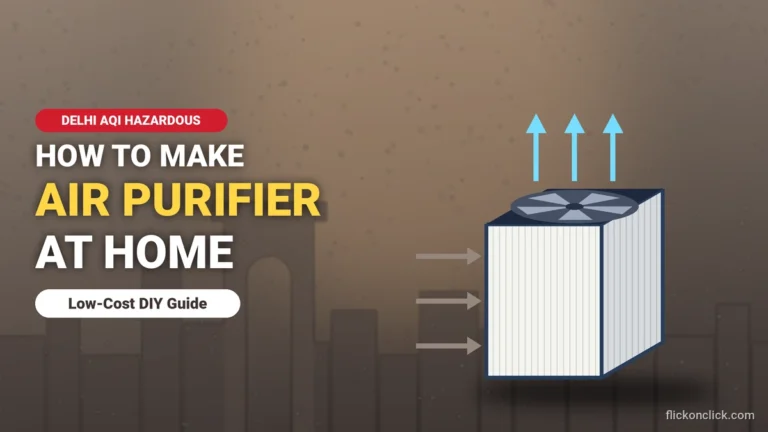
Delhi woke up to toxic air on Monday morning after Diwali celebrations. The overall Air Quality Index (AQI) slipped into the “severe” category on Diwali with an official reading of 483, and private air quality monitors showed even scarier numbers in the early hours of November 9.
With branded air purifiers costing anywhere from Rs 5,000 to Rs 20,000 or more, many families simply cannot afford one for every room. The good news is that a simple homemade air purifier, made with a fan and a good filter, can clean the air in a room surprisingly well. Here is the current pollution situation in Delhi and a simple step-by-step guide to make an air purifier at home.
Delhi AQI Today: Air Quality Turns Hazardous After Diwali
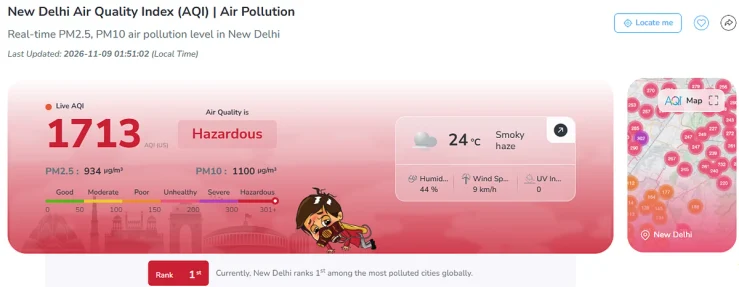
| Official Delhi AQI on Diwali | 483 (Severe) |
| Private monitor reading (1:51 am, Nov 9) | 1,713 (US AQI scale, Hazardous) |
| PM2.5 level (private monitor) | 934 µg/m³ |
| PM10 level (private monitor) | 1,100 µg/m³ |
| WHO safe limit for PM2.5 (24 hours) | 15 µg/m³ |
| Pollution curbs in force | GRAP Stage III |
At 1:51 am on November 9, a private air quality monitoring platform recorded Delhi’s live AQI at 1,713 on the US AQI scale, with PM2.5 at 934 µg/m³ and PM10 at 1,100 µg/m³. It also ranked New Delhi as the most polluted city in the world at that time.
To put that in perspective, the PM2.5 reading was more than 60 times the World Health Organization’s 24-hour safe limit of 15 µg/m³. PM2.5 particles are so tiny that they can go deep into the lungs and even enter the bloodstream.
Official government readings use a different scale that stops at 500, which is why they look lower than private monitors. Both, however, show the same thing: Delhi’s air is at dangerous levels right now.
The Commission for Air Quality Management had already put GRAP Stage III curbs in place across the National Capital Region on November 6. These include a halt on non-essential construction, restrictions on older petrol and diesel cars and hybrid classes for primary school children. Smoke from stubble burning in Punjab and Haryana, along with Diwali firecrackers, has made the situation worse.
Can a Homemade Air Purifier Really Work?
Yes, if it is made the right way. A homemade air purifier works on a very simple idea: a fan pushes or pulls room air through a fine filter, and the filter traps the harmful particles.
Researchers in the United States have tested a popular homemade design called the Corsi-Rosenthal box, which uses a fan and four filters. The studies found that it performed as well as, and in some cases better than, comparable branded HEPA air purifiers, while costing much less to build. It works well because it moves a large amount of air through the filters every minute.
A homemade purifier is not as quiet or as good-looking as a branded one, but for families on a budget, it is a practical way to get cleaner air at home during the pollution season.
Things Needed to Make an Air Purifier at Home
| Item | Approximate cost |
|---|---|
| A table fan or box fan (many homes already have one) | Rs 1,500 to Rs 3,000 |
| HEPA filter (H13 grade) or MERV 13 filter, close to the size of the fan | Rs 600 to Rs 2,000 per filter |
| Strong packing tape or duct tape | Rs 50 to Rs 150 |
| Cardboard sheet | Free or very cheap |
| Scissors or a cutter | Usually at home |
Prices are approximate and depend on the brand and size. HEPA filter sheets and replacement filters are easily available on online shopping sites. Look for “H13 HEPA” or “MERV 13” on the label, as these grades can trap very fine particles like PM2.5.
Method 1: Simple One-Filter Air Purifier (Easiest)
This is the quickest homemade air purifier and can be made in about 15 minutes.
- Pick a filter that is the same size as the fan, or slightly bigger.
- Check the arrow printed on the side of the filter. It shows the direction in which the air should flow.
- Place the filter on the back of the fan, where the fan pulls in air, with the arrow pointing towards the fan.
- Tape the filter tightly to the fan from all sides, so that no air enters from the gaps.
- If the filter is bigger than the fan, cut a cardboard frame to cover the extra space and tape it well.
- Place the fan on a table or stool in the room, switch it on and close the doors and windows.
Placing the filter at the back makes the fan suck air through the filter, which works better than placing it in front.
Method 2: Corsi-Rosenthal Box (Most Effective)
This design uses four filters and cleans air much faster. It works best with a square box fan, though a large table fan can also be used with a cardboard frame.
- Take four filters of the same size.
- Stand them up to form a cube, with the arrows on all four filters pointing inwards, towards the centre of the cube.
- Tape the edges of the four filters together tightly.
- Cut a square piece of cardboard and tape it to the bottom of the cube to close it.
- Place the box fan on top of the cube, facing upwards, so that it pulls air out of the cube and blows it towards the ceiling.
- Tape the fan to the cube from all sides, and cover any open corners with cardboard so no air leaks in.
- Switch it on and keep it in the middle of the room.
In this design, the fan pulls air in through all four filters, so a much larger area of filter is used. This means more clean air and a longer filter life.
Tips to Get the Best Results
- Keep doors and windows closed while the purifier is running.
- Run it on medium or high speed for better cleaning.
- Use it in the room where the family spends most time, especially the bedroom.
- Seal every gap with tape. Even small gaps let dirty air go around the filter.
- Change the filter when it turns dark grey or black. In heavy pollution, this may be needed every few weeks.
- If possible, use a low-cost PM2.5 monitor to check if the air in the room is getting better.
Also Read: Do Air Purifiers Really Improve Health?
Safety Precautions
- Do not leave an old or overheating fan running unattended for long hours. Filters make the motor work harder.
- Switch it off if the fan becomes very hot or makes a burning smell.
- Keep it away from water, curtains and small children.
- Do not use wet cloth, cotton or tissue as a filter. They do not trap fine PM2.5 particles and can grow mould.
- Avoid homemade “ionisers” or ozone generators, as ozone can harm the lungs.
Common Myths About Cleaning Indoor Air
Indoor plants are often shared online as natural air purifiers. They make a home look nice, but research shows that a few plants cannot clean polluted air at the scale needed in a city like Delhi. Similarly, burning camphor or incense only adds more smoke to the room.
Other Ways to Stay Safe From Pollution
- Wear a well-fitted N95 mask when going outside. Simple cloth or surgical masks do not stop PM2.5.
- Avoid morning walks and outdoor exercise when the AQI is severe.
- Keep windows closed during early morning and late evening, when pollution is usually highest.
- Use the kitchen exhaust fan while cooking.
- Drink plenty of water and eat fresh fruits and vegetables.
- Children, older people, pregnant women and people with asthma or heart problems should take extra care and consult a doctor if they feel breathless or uneasy.
Final Word
With Delhi’s air touching hazardous levels after Diwali, cleaner indoor air has become a need, not a luxury. A homemade air purifier with a fan and a good HEPA or MERV 13 filter is a simple, low-cost way to protect the family, especially for those who cannot afford a branded machine. It is not a perfect replacement for a good-quality purifier, but it can make a real difference to the air quality at home.
Note: AQI readings change every hour. Readings from private monitors and official government stations may differ due to different scales and locations. This article is for general information and is not medical advice.