


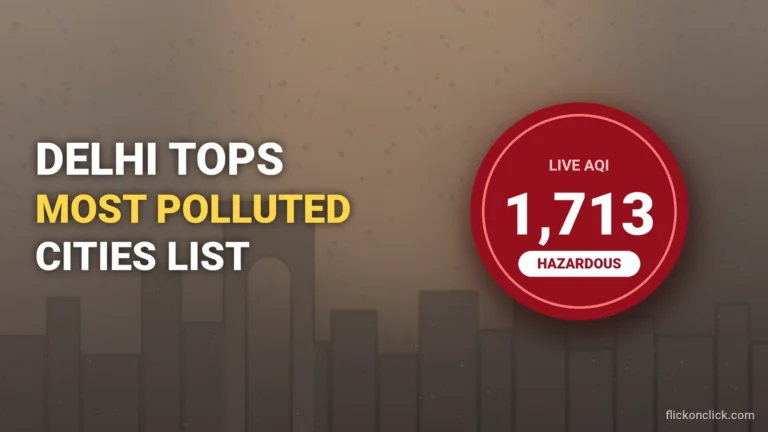
Delhi has once again topped the list of the most polluted cities in the world, a day after Diwali celebrations. As per live data from air quality tracker AQI.in, the national capital recorded an AQI of 1,713 on the US AQI scale in the early hours of Monday, November 9, the highest among all cities tracked by the platform.
What is even more worrying is that all 10 cities on the list are from India. Cities from Madhya Pradesh, Punjab and Uttar Pradesh joined Delhi in the “hazardous” category, as smoke from Diwali firecrackers mixed with farm fire smoke and calm winds.
Top 10 Most Polluted Cities Today (November 9, 2026)
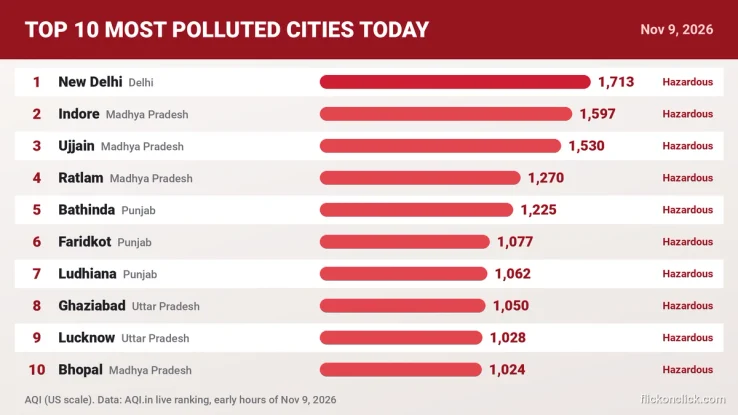
| Rank | City | AQI (US) | Status |
|---|---|---|---|
| 1 | New Delhi, Delhi | 1,713 | Hazardous |
| 2 | Indore, Madhya Pradesh | 1,597 | Hazardous |
| 3 | Ujjain, Madhya Pradesh | 1,530 | Hazardous |
| 4 | Ratlam, Madhya Pradesh | 1,270 | Hazardous |
| 5 | Bathinda, Punjab | 1,225 | Hazardous |
| 6 | Faridkot, Punjab | 1,077 | Hazardous |
| 7 | Ludhiana, Punjab | 1,062 | Hazardous |
| 8 | Ghaziabad, Uttar Pradesh | 1,050 | Hazardous |
| 9 | Lucknow, Uttar Pradesh | 1,028 | Hazardous |
| 10 | Bhopal, Madhya Pradesh | 1,024 | Hazardous |
Source: AQI.in live ranking, early hours of November 9, 2026. Live AQI readings change every hour.
Madhya Pradesh has the most cities on the list, with four entries: Indore, Ujjain, Ratlam and Bhopal. Punjab has three cities, Bathinda, Faridkot and Ludhiana, while Uttar Pradesh has two, Ghaziabad and Lucknow.
Delhi AQI Today: Pollution at Hazardous Levels
| Delhi AQI (US scale) | 1,713 (Hazardous) |
| PM2.5 | 934 µg/m³ |
| PM10 | 1,100 µg/m³ |
| Weather | 24°C, smoky haze |
| Wind speed | 9 km/h |
| Time of reading | 1:51 am, November 9 |
Delhi’s PM2.5 level of 934 µg/m³ was more than 60 times the World Health Organization’s 24-hour safe limit of 15 µg/m³. These tiny particles can go deep into the lungs and enter the bloodstream.
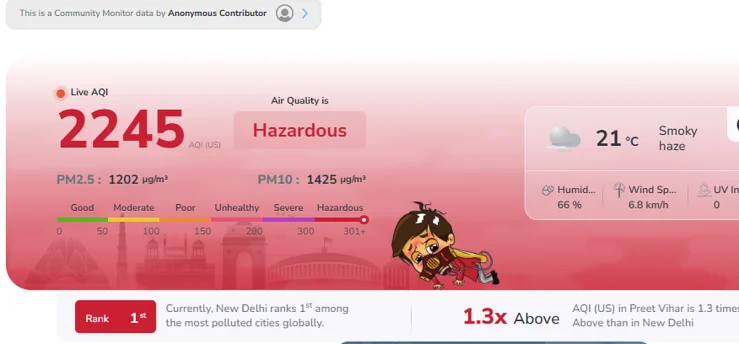
Some areas of the city were even worse. A community air quality monitor in Preet Vihar, East Delhi, showed an AQI of 2,245, with PM2.5 at 1,202 µg/m³ and PM10 at 1,425 µg/m³. That was about 1.3 times higher than the city’s overall reading.
What Official Data Shows
Official readings from the Central Pollution Control Board (CPCB) use a different scale that stops at 500, which is why they look much lower than private monitors. Even so, they confirm the severe situation.
On Diwali morning, 11 of 23 CPCB monitoring stations in Delhi were already in the “severe” category, with AQI above 400. Punjabi Bagh recorded 450, RK Puram 449, IIT Delhi 446 and Dwarka 444. Air quality worsened further after firecrackers were burst through Diwali night.
Why Is Delhi Trending Today?
Delhi is trending on social media and search engines today as people share photos of thick smog, screenshots of record AQI readings and complaints about burning eyes and breathing trouble. Here are the main reasons behind the spike in pollution.
1. Firecrackers on Diwali Night
The Supreme Court had allowed only certified green crackers in Delhi-NCR during fixed time windows on November 7 and 8. Even so, the firecrackers burst during Diwali celebrations added a large amount of smoke and fine particles to the air within a few hours, on top of the pollution that was already in the “severe” range.
2. Stubble Burning in Nearby States
Farmers in Punjab, Haryana and other states burn crop leftovers after the paddy harvest to clear their fields quickly. Satellite data showed 589 farm fires across six states on November 6 alone, including 357 in Punjab and 139 in Madhya Pradesh. Over 6,200 such incidents have been recorded since September 15. Winds carry this smoke towards Delhi and the rest of North India.
3. Calm Winds and Cooler Nights
Wind speeds below 10 km/h stop pollutants from spreading out. With cooler November nights, the smoke and dust stay trapped close to the ground, which leads to the thick grey smog seen over the city.
4. Vehicles and Dust
Vehicle emissions remain one of the biggest daily sources of pollution in Delhi. The Delhi government’s Decision Support System estimated that transport alone contributed over 21% of the city’s pollution on Saturday, before Diwali. Construction dust and road dust add to the problem.
Why Madhya Pradesh and Punjab Cities Are on the List
The presence of Indore, Ujjain, Ratlam and Bhopal in the top 10 shows that the pollution problem is no longer limited to Delhi-NCR. Heavy firecracker use during Diwali, along with farm fires in parts of Madhya Pradesh, appears to have pushed the state’s cities into the hazardous range.
Punjab’s Bathinda, Faridkot and Ludhiana are in the heart of the state’s paddy belt, where stubble burning is common at this time of the year.
What the Government Has Done
The Commission for Air Quality Management had imposed GRAP Stage III restrictions across Delhi-NCR on November 6, before Diwali, as a precaution. Under these rules:
- Non-essential construction and demolition work is banned.
- Stone crushers and mining activities are restricted.
- BS-III petrol and BS-IV diesel four-wheelers are banned in Delhi, Gurugram, Faridabad, Ghaziabad and Gautam Buddh Nagar.
- Primary school classes can be held in hybrid mode.
- Offices may allow up to 50% of staff to work from home.
A full ban on firecrackers in Delhi has come back into force from November 9.
Health Advice for Residents
- Avoid outdoor walks, running and exercise, especially in the early morning.
- Wear a well-fitted N95 mask when stepping out. Cloth and surgical masks do not stop PM2.5.
- Keep doors and windows closed and use an air purifier indoors if possible.
- Children, older people, pregnant women and people with asthma or heart problems should take extra care.
- Seek medical help in case of breathlessness, chest pain or continuous coughing.
For families who cannot afford a branded air purifier, read our guide on how to make an air purifier at home.
Note: AQI readings from private monitors and government stations may differ due to different scales, sensors and locations. Live AQI values change every hour.