


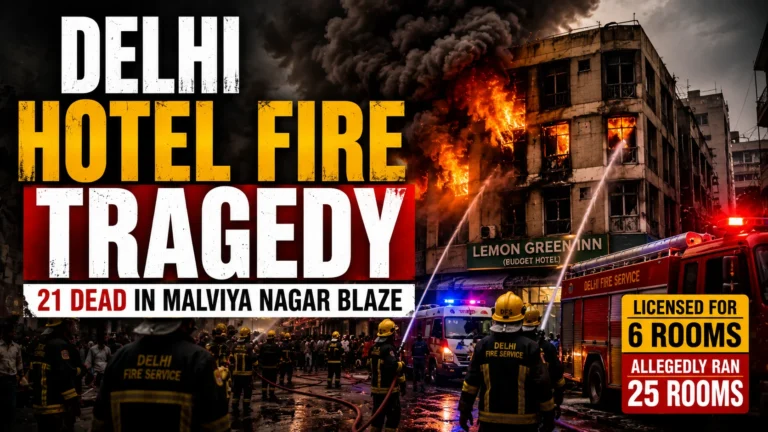
A devastating fire tore through a budget hotel in South Delhi’s Malviya Nagar on Wednesday morning, killing at least 21 people and injuring dozens more in one of the worst hotel fire tragedies the city has seen in recent years.
The fire broke out at Lemon Green Inn, with the Delhi Fire Service receiving the first call at around 9 am. More than ten firefighting vehicles were dispatched to the scene, including water tenders, water bowsers, a quick response vehicle, and additional firefighting units.
Several of those killed are foreigners, mainly from Central Asia and Africa, officials said. More than 40 people were rescued and rushed to hospital, where 21 were declared brought dead. There are fears the death toll may rise further as several of those injured remain in a critical condition.
Injured guests were taken to Max Hospital in Saket and the AIIMS Trauma Centre. Rescue teams worked through smoke-logged sections of the building, evacuating guests trapped across multiple floors. Three people were initially pulled out from the basement and rushed to the hospital.
What makes this tragedy particularly disturbing is what investigators found about how the hotel was actually being operated.
The establishment was operating under the Delhi government’s Bed and Breakfast scheme, under which it had been granted permission to run six rooms. Authorities found it was allegedly running 25, including some in the basement, raising immediate questions about licensing compliance and adherence to fire safety norms.
Running more than four times the permitted number of rooms — including accommodation in a basement — in a dense residential neighbourhood is the kind of violation that turns a bad situation into a catastrophe. Guests in basement rooms have fewer escape routes, smoke travels downward, and the added occupancy means more people are trapped when something goes wrong.
The cause of the fire is yet to be determined. Investigators are expected to examine whether fire safety standards were followed and whether the hotel’s operations were in line with the permissions it held.
PM Modi Announces Compensation
Prime Minister Narendra Modi expressed grief over the loss of lives and announced an ex-gratia of ₹2 lakh each to the next of kin of each of the deceased and ₹50,000 for those who were injured.
“The loss of lives due to a fire incident in Malviya Nagar, Delhi is tragic. My condolences to those who have lost their loved ones. Wishing a speedy recovery to the injured. Authorities are providing all possible assistance to those affected,” PM Modi said in a post on X. Delhi Lieutenant Governor Taranjit Singh Sandhu and Chief Minister Rekha Gupta also condoled the deaths.
This tragedy fits a pattern that India has seen too many times. Budget hotels in dense urban areas operate beyond their licensed capacity, fire safety compliance is weak or entirely absent, and when something goes wrong in the early hours — when guests are asleep and exits are often blocked or inadequate — the results are fatal.
The Malviya Nagar area is a busy, congested part of South Delhi that has become increasingly popular with budget travellers and foreign visitors. The presence of several foreign nationals among the dead points to how these unlicensed or over-capacity guesthouses are often the first accommodation choice for international visitors on tight budgets — people who have no way of knowing the safety standards of the place they’re checking into.
Also Read: Fuel Price Hike Could Change Vehicle Buying Decisions Among Indians: Here’s What May Happen Next
The fact that rooms were allegedly being run in the basement is a detail that investigators will look at closely. Basement accommodation in a fire scenario leaves guests with almost no safe exit route once smoke fills the lower floors.
Authorities have begun an investigation into the cause of the fire and the extent of the hotel’s safety and licensing violations. Criminal liability will likely be examined, particularly given the alleged scale of the overstep from the permitted six rooms to 25.
For the families of the 21 people who did not walk out of that building on Wednesday morning — many of them visitors from other countries, far from home — the question of accountability will matter a great deal. Whether that accountability actually follows is the part Delhi has struggled with after every such tragedy.
The investigation is ongoing, and the death toll may yet rise.