


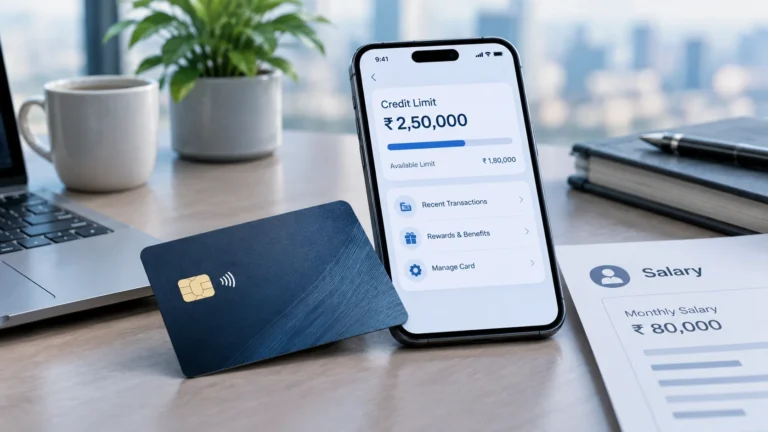
Movie tickets, online shopping, EMI purchases, and credit cards have quietly become part of almost everyone’s daily routine. But here’s a question worth pausing on. Why does your bank sometimes offer you a credit limit that’s actually higher than your monthly salary? And more importantly, just because you can spend that much, should you?
Why Do Banks Offer Limits Higher Than Your Salary?
This is a genuinely common scenario. Someone earning Rs 50,000 a month gets offered a credit limit of Rs 70,000, and it naturally raises questions. The truth is, banks don’t just look at your salary when deciding your limit.
They also factor in your credit score, your repayment history, and your overall financial profile. Someone with a strong track record of paying on time might get a limit that looks disproportionate to their income on paper but makes sense once the bank considers everything else.
That said, there’s another piece to this puzzle that’s a little less talked about: the bank’s own profit motive. Credit card companies genuinely benefit from offering higher limits.
If you spend within your limit and pay your full bill on time, the bank still earns a commission from the merchant every time you swipe.
And if you don’t pay in full, the bank profits even more through interest charges and late fees. Either way, a higher limit tends to work in the bank’s favour, which is worth keeping in mind the next time your limit gets bumped up without much explanation.
The craze around credit cards has only grown stronger among younger users too, largely driven by cashback offers, attractive deals, and perks like free airport lounge access. All of that makes cards genuinely appealing, but it also makes it easier to lose track of how much you’re actually spending.
How Much Should You Actually Spend
Here’s a simple rule worth following. Try to keep your credit card spending to around 30 percent of your take-home salary. So if you’re bringing home Rs 60,000 a month, ideally you shouldn’t be spending more than about Rs 18,000 through your credit card.
Financial experts generally advise against crossing this threshold, since spending beyond it can hurt your credit score and make it genuinely difficult to clear your bills on time.
Is Paying Just the Minimum Due a Good Idea?
Also Read: Best Stocks to Buy This Month
Short answer: no. Paying only the minimum due might feel like a convenient way to manage cash flow in the short term, but it’s really a trap dressed up as flexibility. It benefits the bank far more than it benefits you, since the remaining balance keeps accumulating interest month after month.
Over time, this can spiral into a cycle that’s genuinely hard to climb out of. The better approach is to pay your total amount due in full every single month. If you’re not sure whether paying earlier actually helps beyond just avoiding this trap, this breakdown on whether it’s better to pay your credit card bill early or wait until the due date is worth a read.
Should You Have Multiple Credit Cards
A lot of people these days prefer keeping separate cards for different purposes, one for fuel, another for online shopping, and so on. This can genuinely work well if you’re organized about it. The key is staying on top of due dates across every card, ideally using auto-pay or reminders so nothing slips through the cracks.
It’s also worth avoiding the temptation to use your credit card for every single transaction just because it’s convenient. If you’re weighing whether adding a second card is actually worth it for you, this look at the pros and cons of having two credit cards walks through exactly that.
The Bottom Line
A high credit limit isn’t necessarily a compliment from your bank; it’s often just smart business on their end. Understanding that distinction, and sticking to spending habits that keep you in control rather than the bank, is really the difference between a credit card working for you and one quietly working against you.