


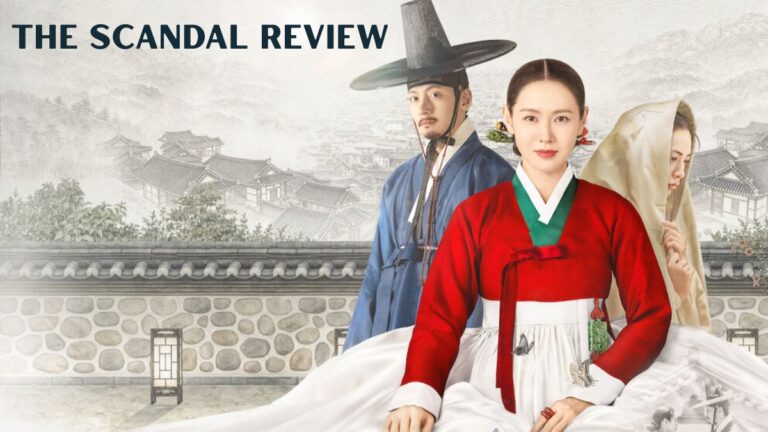
The Scandal Review: ★★★★☆ (4/5)
The Scandal reworks Dangerous Liaisons into a beautifully mounted Joseon drama, anchored by three magnetic central performances, even if its slower pacing occasionally tests patience.
Rating: ★★★★☆ (4/5) | Platform: Netflix | Genre: Period Drama, Romance
Episodes: 8 | Director: Jung Ji-woo | Cast: Son Ye-jin, Ji Chang-wook, Nana
In Joseon, desire was rarely ever a private matter. What you wanted, who you wanted, and whether you were even allowed to want at all could shape the entire course of your life. The Scandal takes that contradiction and turns it into an eight-episode game of seduction and manipulation, one where emotions eventually catch up to everyone involved whether they want them to or not.
The Netflix series follows Lady Cho, played by Son Ye-jin, an intelligent noblewoman frustrated by the restrictions placed on women in her world, and Cho Won, played by Ji Chang-wook, a celebrated playboy who treats romance as little more than a sport. The two strike a wager, Cho Won must seduce Hui-yeon, a young widow played by Nana who is determined to remain chaste. What starts as a calculated game slowly becomes far harder to control once real feelings start entering a situation that was never designed to leave room for them. Directed by Jung Ji-woo, the series is based on the 2003 Korean film Untold Scandal, itself inspired by Pierre Choderlos de Laclos’ classic novel Dangerous Liaisons.
For a period drama built entirely around temptation, The Scandal is refreshingly uninterested in turning its Joseon setting into a history lesson. The social restrictions of the era matter deeply to the story, but they never become an excuse for the plot to drag itself through layers of unnecessary exposition. The first episode efficiently sets up the wager, the stakes, and the personalities involved, and from there, the series largely trusts its central game to carry the narrative forward.
What makes the show genuinely compelling is how well it understands its central trio. Ji Chang-wook has always had a knack for moving between genres effortlessly, and Cho Won gives him another chance to show that range, shifting from boyish charm to quiet desperation with barely a change in expression. Son Ye-jin is equally strong, refusing to let Lady Cho settle comfortably into either victim or manipulator. There is real calculation in her gaze, but also genuine loneliness underneath it, making her far more interesting than a conventional schemer who announces every move she makes.
Nana, meanwhile, gives Hui-yeon a quiet vulnerability that keeps her from becoming a simple pawn in someone else’s game. She plays the character with real emotional agency, and her gradual awakening throughout the series becomes one of its more genuinely affecting threads.
The chemistry between all three actors is really where The Scandal finds its pulse, particularly the push and pull between Cho Won and Hui-yeon, a mix of attraction, distrust, and the growing awareness that something about their entire situation is fundamentally wrong. Director Jung Ji-woo also uses physicality as its own kind of language throughout the series, letting glances, distance, and touch carry as much weight as dialogue, and treating desire itself as complicated rather than simply forbidden.
That said, for a show literally titled The Scandal, there are moments where you wish it leaned even further into its own premise. Given the reputation of its source material, the show occasionally feels like it has carefully calculated exactly where its own boundaries lie, playing things a touch safer than its title promises.
The biggest issue holding the series back is pacing. At eight episodes, the story occasionally circles around its characters and conflicts rather than consistently pushing forward, and a few plot developments arrive more conveniently than convincingly. Still, once the emotional stakes between the three leads deepen, the show becomes considerably easier to stay invested in.
In the end, The Scandal works best when it stops being a simple story about seduction and becomes a study of people trying to claim control in a world that gives them very little of it. It may not be quite as outrageous as its title suggests, but it remains beautifully mounted, intelligently performed, and anchored by three actors who understand exactly how much can be communicated without saying a word.
If bold anthology storytelling is more your speed, our review of Lust Stories 3 is worth checking out, and for something completely different, our review of Stranger Things: Tales From ’85 Season 2 covers Netflix’s latest animated trip back to Hawkins.