


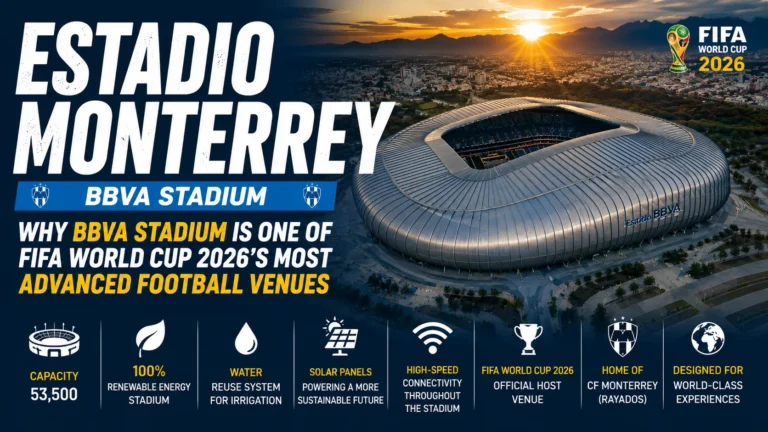
Northern Mexico does things its own way. Monterrey is an industrial powerhouse, a city built on steel, manufacturing, and a fierce regional identity that sets it apart from the rest of the country. So it makes sense that its football stadium would have its own distinct character too.
Estadio BBVA — officially Estadio Monterrey for the tournament — is hosting four FIFA World Cup 2026 matches: three group stage games from Group F, and one Round of 32 knockout tie on June 29. It’s the smallest of Mexico’s four host venues, but it brings something the others don’t quite match — a genuinely pioneering approach to sustainable stadium design.
Estadio Monterrey Stadium at a Glance
| Official Tournament Name | Estadio Monterrey |
| Primary Name | Estadio BBVA |
| Location | Guadalupe, Monterrey, Mexico |
| FIFA World Cup Capacity | 51,243 |
| Home Club | CF Monterrey (Rayados) |
| Total 2026 Matches | 4 |
| Group Stage Matches | 3 (all Group F) |
| Knockout Matches | 1 (Round of 32) |
| Round of 32 Date | June 29, 2026 |
| Sustainability Distinction | First LEED Silver stadium in the Americas |
Built for the Heat — On Purpose
Monterrey gets hot. Genuinely hot. Summer temperatures in northern Mexico regularly climb into territory that makes outdoor sport genuinely challenging, and the people who designed Estadio BBVA knew exactly what they were dealing with.
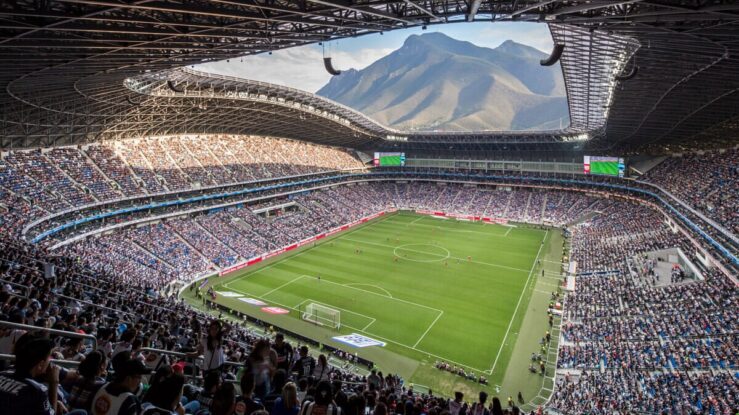
The result is a stadium with a cantilevered roof — a roof structure that extends outward without needing support columns underneath, providing extensive shade across much of the seating bowl. Combined with that roof are structural elements built into the stadium’s facade, often described as “gills,” which allow air to flow naturally through the building.
| Design Feature | Purpose |
|---|---|
| Cantilevered roof | Provides shade across the seating bowl |
| Structural “gills” | Built into the facade to allow natural airflow |
| Heat management | Designed specifically for Monterrey’s hot summers |
| Result | Naturally ventilated bowl that needs less artificial cooling |
It’s a smart piece of design thinking — rather than fighting the climate with heavy air conditioning, the stadium works with the airflow patterns of the region to keep the bowl comfortable using less energy.
The First LEED Silver Stadium in the Americas
Here’s where Estadio BBVA genuinely stands apart from almost every other venue in the 2026 World Cup, and arguably from most stadiums across the entire Western Hemisphere.
When it was built, Estadio BBVA became the first stadium in the Americas to achieve LEED Silver certification — a recognised international standard for environmentally responsible building design. LEED certification covers things like energy efficiency, water conservation, sustainable materials, and overall environmental impact.
| LEED Silver Feature | What It Covers |
|---|---|
| Sustainable building materials | Environmentally responsible construction |
| Energy efficiency | Reduced overall power consumption |
| Water conservation | Efficient water usage systems throughout |
| Natural ventilation | The “gills” reduce the need for mechanical cooling |
For context, being first in an entire continent to hit this standard — for a stadium of this size — was a genuinely significant achievement at the time it was built. Other venues, like Mercedes-Benz Stadium in Atlanta, have since reached even higher certifications (LEED Platinum), but Estadio BBVA helped pave the way for sustainable stadium design across the Americas.
Home of Rayados
Estadio BBVA is the home ground of CF Monterrey, known to fans as Rayados — one of the most successful and well-supported clubs in Liga MX. The rivalry between Rayados and their cross-city neighbours, Tigres, is one of the fiercest in Mexican football, and this stadium has hosted its fair share of those derby occasions.
That club heritage gives the venue a genuine football identity beyond just being a World Cup host. The atmosphere here on a big Rayados night is already known to be intense — and that’s the foundation the World Cup atmosphere will be built on.
The Full Match Schedule
Estadio BBVA is hosting four matches — three from Group F during the group stage, and one Round of 32 knockout tie.
| Date | Stage | Match | Notes |
|---|---|---|---|
| June 14, 2026 | Group Stage | UEFA Playoff Winner B vs. Tunisia | Group F opener |
| June 20, 2026 | Group Stage | Tunisia vs. Japan | Group F |
| June 24, 2026 | Group Stage | South Africa vs. South Korea | Group F finale |
| June 29, 2026 | Round of 32 | Group F Winner vs. Group C Runner-up | First knockout round |
All three of Monterrey’s group stage matches come from Group F — a group that brings together teams from three different continents, which makes for one of the more genuinely international groups in the entire tournament.
Group F — A Truly Global Lineup
Group F features Tunisia, Japan, South Africa, South Korea, and a UEFA playoff winner still to be confirmed. That’s African, Asian, and European representation all converging on one stadium in northern Mexico.
| Nation | Confederation | Football Style/Reputation |
|---|---|---|
| Tunisia | CAF (Africa) | Strong World Cup pedigree, organised defensively |
| Japan | AFC (Asia) | Technical, possession-based football |
| South Africa | CAF (Africa) | Seeking a breakthrough tournament performance |
| South Korea | AFC (Asia) | Fast, attacking, high-tempo style |
| UEFA Playoff Winner B | UEFA (Europe) | Qualifier TBD |
For Monterrey, hosting a group with this much international variety means the city gets a genuine cross-section of World Cup football — three matches with completely different tactical identities, fan cultures, and football traditions, all on the same pitch within a two-week window.
The June 20 match — Tunisia vs. Japan — is particularly interesting on paper. Tunisia’s organised, physical approach against Japan’s quick passing and movement is the kind of stylistic contrast that tends to produce genuinely entertaining football.
Similar Reads: MetLife Stadium | AT&T Stadium | Boston Stadium | Estadio Akron
The Round of 32 — June 29, 2026
The knockout match on June 29 is the standout fixture at Estadio BBVA. It brings together the winner of Group F and the runner-up from Group C — meaning whoever tops this very group could be playing their next match right back here, in front of a crowd that has already seen them play three times.
For a team that wins Group F, there’s something genuinely appealing about not having to travel for their first knockout match. Familiar surroundings, a pitch they’ve already played on, and potentially a crowd that has started to warm to them over the group stage. Small advantages like that can matter in knockout football, where every edge counts.
| Round of 32 Details | Information |
|---|---|
| Date | June 29, 2026 |
| Participants | Group F Winner vs. Group C Runner-up |
| Capacity | 51,243 |
| Significance | First knockout round of the tournament |
Similar Reads: Atlanta Stadium | Kansas City Stadium | Houston Stadium
Mexico’s Smallest Venue, Big on Character
At 51,243, Estadio BBVA is the smallest of Mexico’s four World Cup venues — smaller than Estadio Azteca (80,824), and smaller than both Estadio Akron in Guadalajara (45,664… actually slightly larger here) and other host stadiums across the country.
| Mexican Venue | FIFA Capacity |
|---|---|
| Estadio Azteca (Mexico City) | 80,824 |
| Estadio Monterrey (Estadio BBVA) | 51,243 |
| Estadio Guadalajara (Estadio Akron) | 45,664 |
But size isn’t everything. What Estadio BBVA offers instead is a genuinely intimate atmosphere, a passionate home fanbase in Rayados supporters, and a stadium design that has quietly been ahead of its time on sustainability since the day it opened.
Similar Reads: BC Place Vancouver | Toronto Stadium | Estadio Azteca
Why Monterrey Deserves Attention
In a tournament with venues boasting 80,000+ seats, semi-finals, and a Final, it would be easy to overlook a smaller, four-match host city in northern Mexico. But Estadio BBVA earns its place on the World Cup map through genuine substance — architecture designed around the local climate, a sustainability certification that was genuinely pioneering for its time, a passionate club football culture, and a Group F lineup that brings together three continents’ worth of football styles.
Four matches. One knockout tie. A roof built to beat the heat, and a building that proved sustainable stadium design could work in the Americas long before it became the industry standard.
Monterrey is ready.