


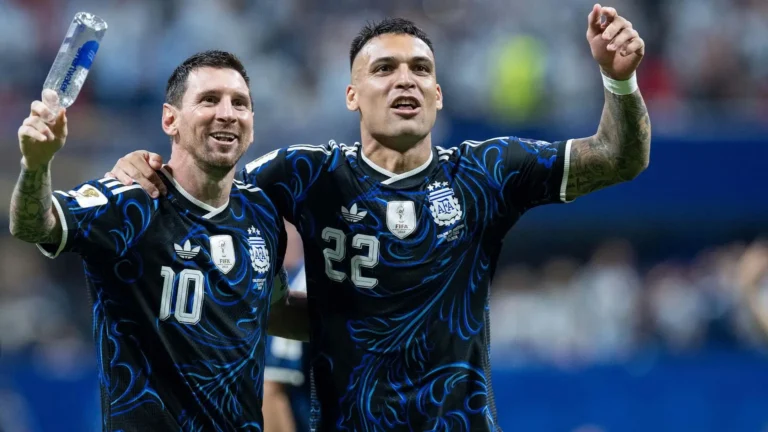
England dared to dream again. And again, it ended in heartbreak. In a match that had everything — tension, history, controversy, and two of the most dramatic late goals you’ll see at any World Cup — Argentina pulled off a stunning 2-1 comeback victory over England at a roaring Mercedes-Benz Stadium in Atlanta to book their place in the FIFA World Cup 2026 final.
With just five minutes of normal time remaining and trailing by a goal, Lionel Messi grabbed the game by the scruff of the neck and simply refused to let Argentina lose.
Two assists in a breathtaking seven-minute spell — first for Enzo Fernández’s stunning long-range strike in the 85th minute, then for Lautaro Martínez’s headed winner deep into stoppage time — sent the South American fans inside the stadium into absolute delirium.
For England, it is a familiar and devastating feeling. For Argentina, they now stand on the brink of history.
A Match That Started With Fire Before a Ball Was Kicked
The atmosphere inside Mercedes-Benz Stadium told you everything before kick-off. Both sets of fans tried their best to drown out the other side’s national anthem — a fitting preview of what was to come on the pitch.
England and Argentina rarely produce calm, polite football matches, and this was no exception. The first half was fractious and physical, with Leandro Paredes flying into Jude Bellingham early on and Enzo Fernández returning the favour on Elliot Anderson shortly after. Referee Ismail Elfath had his hands full.
With neither side managing to establish any real rhythm, a tense and goalless first half gave way to something far more dramatic after the break.
England Take the Lead
The goal that gave England hope came from a moment of real quality.
Morgan Rogers, who has been one of the players of this tournament, delivered a magnificent curling cross from the right flank in the 55th minute. Anthony Gordon read the delivery perfectly, ghosting past Cuti Romero to steer a clinical finish past Emiliano Martínez.
England were ahead, the crowd was rocking, and the Three Lions had a World Cup final in their sights.
Thomas Tuchel then made the call that millions of England fans will spend the next several years arguing about. Rather than pushing for a second goal, England dropped into a defensive low block, choosing to protect the lead and absorb pressure rather than extend the advantage.
It is a strategy that has undone England before. It undid them again here.
Messi Refuses to Let Argentina Go Out
Argentina pushed and pushed. Pickford made a stunning fingertip save to deny substitute Nico González. Alexis Mac Allister struck the post with a header. The pressure was relentless. The goal would not come.
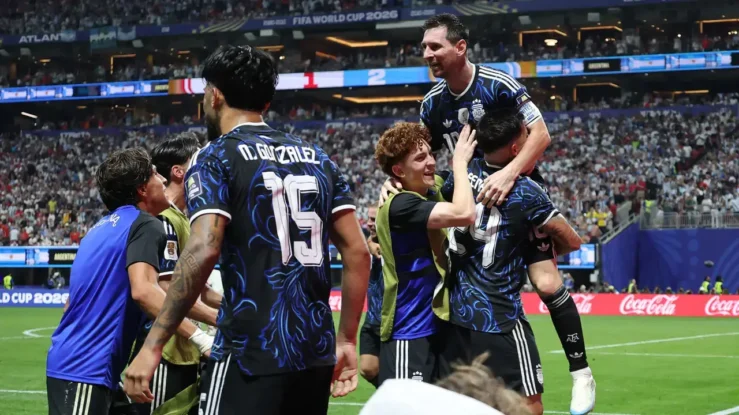
Then, in the 85th minute, a short-corner routine gave Messi the ball. He laid it off cleanly to Enzo Fernández, who needed no second invitation — stepping back and unleashing a fierce, curving long-range strike that sailed into the far corner before Pickford could even react.
The stadium erupted. England were rattled. The defensive structure that had held for so long began to crack.
Two minutes into stoppage time, Argentina delivered the knockout blow.
Messi found space on the flank, shifted the ball onto his right foot, and delivered what can only be described as a perfectly weighted, effortless chip into the six-yard box. Lautaro Martínez — who had come on as a substitute — read the flight beautifully, leaping between John Stones and Reece James to power a header past Pickford.
Two-one to Argentina. Game over.
At the final whistle, an exhausted Messi dropped to his knees. The man who has given his entire life to this tournament, this shirt, and this moment had done it again.
The Aftermath — and the Controversy
There was one more flashpoint after the final whistle.
Lisandro Martínez and Giovani Lo Celso held up a banner reading “Las Malvinas Son Argentinas” — a political declaration claiming sovereignty over the Falkland Islands — while grinning and waving to fans in the stands. FIFA’s Stadium Code of Conduct explicitly bans political banners inside venues, and the incident is expected to draw an official response from the governing body.
The question of the Falklands has long been a sore point in English-Argentine relations, stretching back to the 1982 conflict in which hundreds of soldiers on both sides lost their lives. The players’ decision to brandish the flag immediately after a win over England made it impossible to view as anything other than deliberate.
FIFA have been notified and are expected to investigate.
England Captain Harry Kane’s Reaction
Harry Kane, who has carried England to another semi-final but again fallen short of the ultimate prize, was measured but clearly devastated in his post-match comments.
“Gutted for the boys, gutted for everyone — the team, the staff, the fans,” Kane said. “We played a good game the large majority of it. When we went 1-0 up, we seemed to try and hold on, which at this level is not enough.”
Also Read: Spain vs Argentina World Cup 2026 Final: Commentators & Reporters
What Happens Next
Argentina now face Spain in the FIFA World Cup 2026 final at MetLife Stadium in East Rutherford, New Jersey on Sunday, July 19.
Both teams are the reigning champions of their respective continents — Argentina holding the Copa América, Spain holding the European Championship — making this the first time the continental champions of both South America and Europe have met in a World Cup final.
For Argentina, victory would make them only the third team in history to successfully defend the World Cup title, joining Italy (1934 and 1938) and Brazil (1958 and 1962). It would also be Lionel Messi’s second World Cup winner’s medal — and quite possibly the greatest individual achievement in the history of the sport.
For England, it is the third-place playoff against France on Saturday.
The final is on Sunday. The stage has been set.