



In June 2026, millions of Indians opened Telegram and saw one word: “Connecting…” It never connected. For six days, the app that 150 million people in this country use for everything from study notes to stock tips simply vanished. No warning on the app itself. Just gone.
That was the moment the question “why is Telegram banned?” went from a lazy debate topic to a real, lived experience for an entire nation. And honestly? The government’s reasons were stronger than most people expected.
This piece looks at what actually happened, why the government blocked Telegram, and the bigger question that refuses to go away: should Telegram be banned for good?
First, the Facts: Is Telegram Banned in India Right Now?
Let’s clear the air before the opinions start flying. Telegram is not banned in India at the moment. What happened was a temporary, nationwide block from June 16 to June 22, 2026, ordered by the Ministry of Electronics and Information Technology (MeitY) under Section 69A of the IT Act.
The trigger? The NEET-UG 2026 re-examination scheduled for June 21. The National Testing Agency (NTA) told the government that Telegram channels were openly selling “leaked” NEET papers, spreading fake exam news, and running fraud rackets that targeted desperate students and their parents. The government pulled the plug on the whole app until the exam was safely done.
Telegram fought it in court and lost. The Delhi High Court rejected the company’s appeal and upheld the block as a lawful, proportionate step. Even after the ban lifted on June 22, Telegram’s message-editing feature stayed disabled until June 30 under a separate order, with full functionality back only from July 1.
So no, this was not a permanent ban. But it was the clearest signal yet that the government has run out of patience. And that brings us to the real debate.
Why Was Telegram Banned in India? The Quick Version
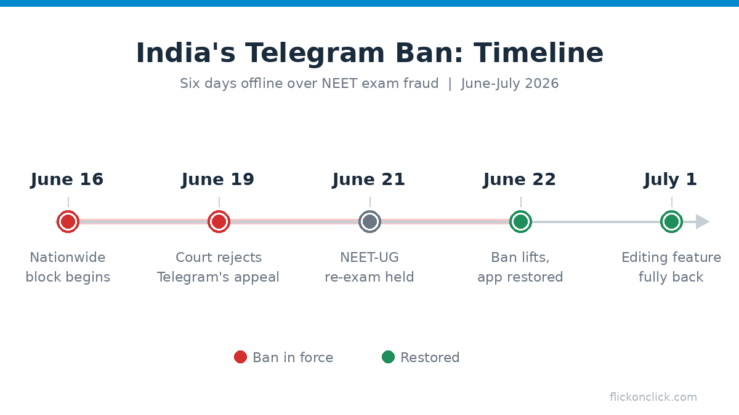
| Question | Answer |
|---|---|
| When was Telegram blocked? | June 16 to June 22, 2026 |
| Who ordered it? | MeitY, on the NTA’s recommendation |
| Under which law? | Section 69A of the IT Act, 2000 |
| Main reason | NEET paper leak scams and exam fraud |
| Was it permanent? | No, temporary and exam-linked |
| Did courts approve? | Yes, the Delhi High Court upheld it |
| Current status | Fully restored since July 1, 2026 |
Now let’s dig into the reasons — because “exam leaks” is just the headline. The full story is a lot messier.
The Strongest Reasons Behind the Telegram Ban Debate
1. Exam Paper Leaks Became a Business Model
The immediate reason for the Telegram ban in India was brutal in its simplicity. Channels with names openly referencing a “leaked NEET paper” were charging students and parents money for access to exam content. Reuters reported that the government blocked the app precisely because these channels were distributing or selling supposedly leaked material before the re-test.
Here’s the twist: the NTA maintained that no genuine paper existed outside the secured exam chain. Which means most of these channels were pure fraud — taking money from panicked families for papers that were fake. Either way, students lost. That’s the kind of harm that makes a government act.
2. Organised Cheating Networks Found a Home
This wasn’t three teenagers in a group chat. According to the BBC, the government described full-blown cheating syndicates exploiting Telegram to deceive candidates and coordinate fraud at scale. Anonymous admins, disposable channels, encrypted chats, zero accountability. If you were designing a platform for an exam mafia, it would look a lot like this.
3. Telegram Was Too Slow to Act
Perhaps the most damning detail. Reuters’ inside account of the days before the block revealed that officials were frustrated by Telegram’s failure to remove accounts sharing leaked papers fast enough. The government didn’t wake up one morning and ban an app on a whim. It asked. It waited. Then it acted.
This is the pattern that keeps repeating with Telegram worldwide — moderation that always seems to arrive after the damage is done.
4. Misinformation Around a High-Stakes Exam
The NTA told the Delhi High Court that Telegram was being used to spread fake messages related to the examination. Think about the audience here: lakhs of teenagers sitting for the most competitive medical entrance exam in the world, plus their families. One viral fake message about a “cancelled exam” or a “leaked paper” can cause genuine panic. Misinformation is bad everywhere. Misinformation aimed at exam-stressed 17-year-olds is something else entirely.
5. The Edit Button Was Weaponised
This one deserves its own paragraph because it’s genuinely clever and genuinely ugly. Authorities said Telegram’s message-editing feature was misused to manufacture fake “paper leak” evidence. The trick: post a random message before the exam, then edit it afterwards to contain actual questions — while the original timestamp stays intact. Suddenly you have “proof” that the paper leaked in advance.
That’s why the editing feature stayed disabled for a week after the app itself came back. When a core feature of your product becomes a forgery tool, you’ve got a design problem, not just a moderation problem.
6. Public Order and the Law Were on the Government’s Side
The block was issued under Section 69A’s public-order and blocking powers, framed squarely as a safety measure. And when Telegram called the move unconstitutional, the Delhi High Court disagreed, confirming that the government was legally empowered to direct the blocking of public access. Whatever your opinion on the ban, the legal foundation held up in court within days.
7. Blocking Channels Doesn’t Work — Channels Just Respawn
Why block the entire app instead of just the bad channels? Because the court record itself noted that Telegram’s design makes blocked channels easy to recreate, making enforcement a game of whack-a-mole. Ban “NEET_Leaked_Paper” today and “NEET_Leaked_Paper_2” appears tonight. When surgical action is impossible, governments reach for the hammer. Telegram’s own architecture forced the blanket ban.
8. This Is a Global Pattern, Not an Indian Overreaction
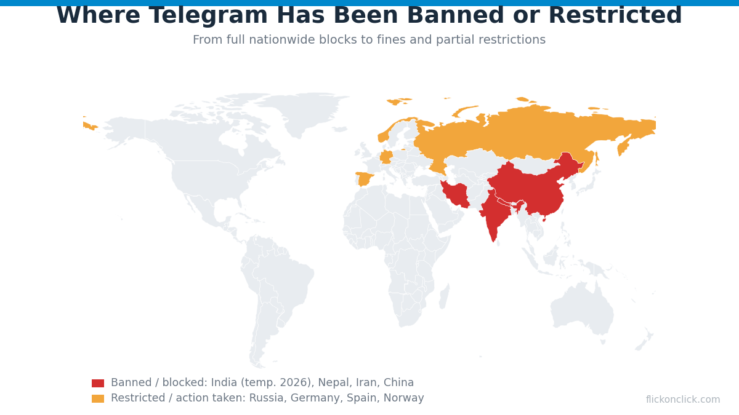
If India were the only country with Telegram problems, you could call this an overreach. It isn’t. As Firstpost documented, Telegram has been banned, blocked, or restricted across multiple countries over moderation failures, security concerns, and illegal content. Nepal blocked it over fraud and money laundering. Germany fined it for ignoring hate-speech laws. Spain briefly blocked it over copyright. Norway barred it from government devices as a security risk.
When this many governments, with completely different politics, keep reaching the same conclusion about the same app, the app is the common factor.
Why Was Telegram Chosen Instead of WhatsApp?
A fair question that trended during the ban. The answer comes down to structure. WhatsApp caps group sizes and ties accounts to phone numbers with stricter identity trails. Telegram offers massive public channels with hundreds of thousands of anonymous subscribers, searchable public discovery, and admins who can hide behind usernames. The paper-leak economy didn’t run on WhatsApp because WhatsApp isn’t built for broadcasting to strangers at scale. Telegram is. The feature set that makes Telegram powerful is exactly what makes it dangerous.
The Other Side: Telegram’s Defence Deserves a Hearing
An honest opinion piece has to sit with the counterarguments, because they’re not weak.
Telegram called the ban “grossly disproportionate” and an overbroad restriction on free speech, pointing out that it cut off more than 150 million Indian users — including lakhs of students who use Telegram to access study material and coaching content — to stop a handful of criminal channels. Founder Pavel Durov questioned whether the ban even worked, and the VPN download surge during those six days suggests he had a point. Determined fraudsters route around bans; ordinary users bear the cost.
Digital rights activists add a bigger worry: if Section 69A can switch off an entire platform for a week, what stops it from being used against platforms the government simply dislikes? “Blanket shutdown” is a precedent, and precedents outlive the emergencies that create them.
These are serious concerns. But here’s where I land: rights come with a working assumption that the platform hosting your speech makes a good-faith effort to stop crime on its rails. Telegram’s track record — in India and across a dozen other countries — shows a company that treats moderation as someone else’s problem until a government forces its hand. Free speech is the shield. Paper-leak rackets preying on students are not the speech it was built to protect.
The Telegram Ban Impact: Who Actually Paid the Price?
The six-day block was a live experiment in what India without Telegram looks like, and the results were revealing.
Students felt it first. Ironically, the group the ban was meant to protect was also the group most disrupted by it. Coaching institutes across the country run their entire content delivery through Telegram channels — daily practice sets, PDFs, doubt-solving groups. For a week, all of that went dark, days before a major exam.
Traders and creators scrambled. Stock market tipsters, crypto communities, news aggregators, and content creators who built audiences of lakhs on Telegram had no way to reach them. Many rushed followers over to WhatsApp Channels and Instagram broadcast lists mid-week, and some of that audience never came back. Platform risk stopped being a theory that week.
VPN apps had their best week ever. Downloads surged across India as users routed around the block, which raises the uncomfortable question of how effective an app-level ban really is against the people it targets. The fraudsters presumably had VPNs on day one. It was the ordinary users who sat staring at “Connecting…”
Telegram lost more than a week of traffic. India was its largest market before the block. Every serious channel owner in the country now knows the app can disappear overnight with court approval. That kind of trust, once dented, changes behaviour permanently — and it hands the government leverage for every future negotiation with the platform.
Frequently Asked Questions
Why is Telegram banned? Telegram is not currently banned in India, but it was temporarily blocked in June 2026 because channels on the app were selling fake “leaked” NEET papers, running exam fraud rackets, and spreading exam misinformation.
How long was Telegram banned in India? Six days — June 16 to June 22, 2026 — with the message-editing feature disabled until June 30.
Which law was used to block Telegram? Section 69A of the IT Act, 2000, which lets the government direct blocking of public access to online platforms on grounds like public order.
Was Telegram banned because of exam leaks? Yes. The NEET-UG 2026 re-exam was the trigger. The NTA flagged channels selling supposed leaked papers and defrauding candidates.
Can Telegram be used during a ban? Officially, no. In practice, VPN usage spiked sharply during the block, though using workarounds to access a blocked platform carries its own legal risk.
Is the Telegram ban temporary or permanent? The June 2026 ban was explicitly temporary and exam-linked. There is no permanent ban in India as of now, though the episode has strengthened calls for tougher action.
What happened in the Telegram court case? Telegram challenged the block in the Delhi High Court as unconstitutional. The court rejected the appeal and upheld the government’s blocking powers.
The Bottom Line
The June 2026 ban lasted six days, but the argument it settled will last much longer. India showed that it can switch Telegram off, that the courts will back it, and that the sky doesn’t fall when it happens. Telegram, for its part, showed once again that it moves only when forced.
Should Telegram be banned permanently? A full ban punishes 150 million legitimate users for the sins of criminal channels, and that maths is hard to defend. But a platform that keeps enabling exam mafias, fraud rackets, and fabricated evidence — and keeps dragging its feet on cleanup — should expect the temporary bans to get longer, more frequent, and less apologetic each time. The June block wasn’t the end of this story. It was the warning shot.
What do you think — was the government right to block Telegram, or did 150 million users pay for the crimes of a few? Drop your take in the comments, and share this with someone who spent those six days refreshing “Connecting…”