


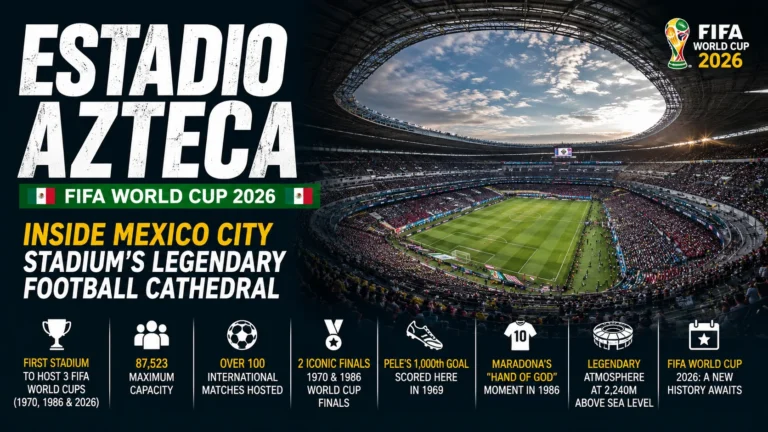
Some stadiums host football matches. Estadio Azteca hosts history.
On June 11, 2026, the opening ceremony and the very first match of the FIFA World Cup 2026 took place at a stadium that has already done this twice before. In 1970. In 1986. And now, in 2026, Estadio Azteca becomes the first stadium on the planet to host three FIFA World Cups. No other ground in football history can say that.
For the tournament, it carries the official name Mexico City Stadium. But everyone — players, fans, commentators — will keep calling it what it has always been called. Azteca.
Estadio Azteca Stadium at a Glance
| Official Tournament Name | Mexico City Stadium |
| Primary Name | Estadio Azteca |
| Location | Mexico City, Mexico |
| FIFA World Cup 2026 Capacity | 80,824 (largest of all 16 venues) |
| Opened | 1966 |
| Total 2026 Matches | 5 (including the opening match) |
| Opening Match Date | June 11, 2026 |
| Opening Match | Mexico vs. South Africa |
| World Cups Hosted | 1970, 1986, 2026 |
| World Cup Finals Hosted | 1970 and 1986 — only stadium to host two |
A Stadium That Has Already Made History Twice
To understand why Azteca matters so much, you have to go back to where it all started.
Construction began in 1961, and the stadium opened in 1966 — built to be one of the great football cathedrals of Latin America. It didn’t take long to prove that reputation right.
In 1970, Azteca hosted the World Cup Final, where Brazil beat Italy in front of 114,164 spectators. That Brazil team, led by a 29-year-old Pelé at the peak of his powers, is still regarded by many as the greatest international side ever assembled. Azteca was where that team became immortal.
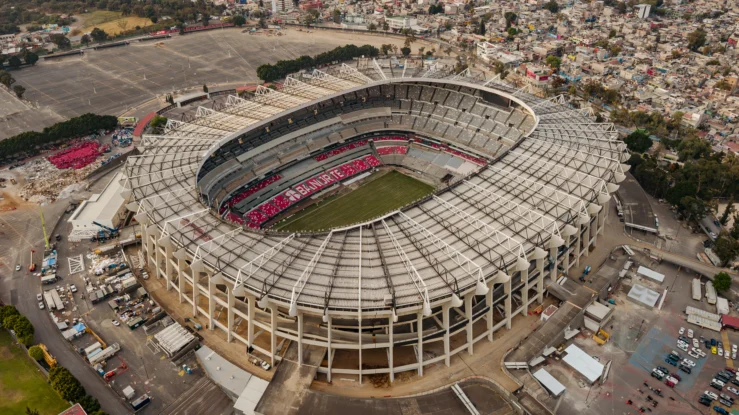
Then in 1986, it happened again. Azteca hosted another World Cup Final — Argentina against West Germany, ending 3-2 in Argentina’s favour, in front of 114,600 fans, the largest crowd ever to watch a World Cup final. That tournament belonged to Diego Maradona, and his “Goal of the Century” — a mesmerising solo run through England’s defence in the quarterfinal — happened on this very pitch.
| World Cup | Year | Final Result | Attendance | Star Player |
|---|---|---|---|---|
| 1970 | Mexico | Brazil 4-1 Italy | 114,164 | Pelé |
| 1986 | Mexico | Argentina 3-2 West Germany | 114,600 | Diego Maradona |
No other stadium in football history has hosted two World Cup finals. And no other stadium has been the place where both Pelé and Maradona — widely considered the two greatest players to ever play the game — lifted the trophy.
Three World Cups, Three Opening Matches
The 2026 tournament adds another layer to Azteca’s legend. Beyond hosting the finals in 1970 and 1986, Azteca also hosted the opening matches of those tournaments. And on June 11, 2026, it does it again.
That makes Azteca the first stadium ever to host three World Cup opening matches — 1970, 1986, and 2026.
| Record | Detail |
|---|---|
| First stadium to host 3 World Cups | 1970, 1986, 2026 |
| Only stadium to host 2 World Cup finals | 1970 (Brazil v Italy), 1986 (Argentina v West Germany) |
| First stadium to host 3 opening matches | 1970, 1986, 2026 |
| Mexico’s home World Cup record at Azteca | Unbeaten in 1970 and 1986 |
That last point is worth pausing on too. In both of the previous World Cups held here, Mexico’s national team didn’t lose a single match at Azteca. For Mexican fans heading into 2026, that history carries real meaning — even if football doesn’t always repeat itself.
The Opening Match: Mexico vs. South Africa, June 11, 2026
The 2026 World Cup is the biggest in history — 48 teams, the most ever, spread across three host nations. And it all begins here, with Mexico vs. South Africa on June 11, 2026.
For Mexico, this is about as significant as a football match can get. Playing the opening match of a World Cup on home soil in the most famous stadium in the country’s football history — an enormous amount is riding on this for the host nation, both in terms of pressure and opportunity.
The 1970 opener — also Mexico vs. Soviet Union, also at Azteca — drew a crowd of 107,000. With Azteca’s current FIFA capacity set at 80,824, organisers won’t quite match that 1970 number, but expectations are still for a sold-out, deafening atmosphere from the very first whistle.
| Opening Match Comparison | Year | Match | Attendance |
|---|---|---|---|
| 1970 Opening Match | 1970 | Mexico vs. Soviet Union | 107,000 |
| 2026 Opening Match | 2026 | Mexico vs. South Africa | Capacity 80,824 |
Mexico’s Group Stage Schedule at Azteca
As co-hosts, Mexico are guaranteed to play all three of their group stage matches on home soil — and Azteca gets two of them.
| Date | Match | Venue |
|---|---|---|
| June 11, 2026 | Mexico vs. South Africa | Estadio Azteca (opening match) |
| June 18, 2026 | Mexico vs. TBD | Estadio Guadalajara |
| June 24, 2026 | Mexico vs. TBD | Estadio Azteca (final group match) |
So Mexico opens their tournament at Azteca, travels to Guadalajara for their second group match, and then returns to Azteca for their decisive final group game on June 24. For a host nation, bookending your group stage campaign at the most historic stadium in your country’s footballing history is about as good as it gets.
Similar Reads: Estadio Akron | Toronto Stadium | BC Place Vancouver
The Biggest Stadium in the Tournament
At 80,824, Azteca isn’t just the biggest venue at the 2026 World Cup — it’s the largest football stadium in all of Latin America.
| Venue | FIFA 2026 Capacity |
|---|---|
| Estadio Azteca (Mexico City) | 80,824 |
| MetLife Stadium (New York/New Jersey) | 80,663 |
| AT&T Stadium (Dallas) | 70,649 |
| SoFi Stadium (Los Angeles) | 70,492 |
That ranking puts Azteca ahead of even MetLife Stadium — the venue hosting the World Cup Final. It’s a remarkable statistic for a stadium that opened back in 1966 and has needed to keep pace with modern stadium standards for six decades.
According to historical records, Azteca also holds six of the ten biggest attendances in World Cup history — a statistic that speaks to just how often this stadium has been filled to (and beyond) capacity for the sport’s biggest occasions.
Similar Reads: MetLife Stadium | AT&T Stadium | Boston Stadium
Twenty Months of Renovation
Getting a stadium built in 1966 ready for a tournament in 2026 isn’t a small job. Azteca went through roughly 20 months of renovation work ahead of the World Cup, covering nearly every part of the venue.
| Renovation Area | What Changed |
|---|---|
| Locker rooms | Rebuilt to FIFA standards |
| Internet connectivity | Modernised for fan and broadcast use |
| Playing surface | Reconstructed with new natural grass |
| Drainage | Improved systems for consistent playing conditions |
| Video screens | Upgraded Jumbotron displays |
The goal of these renovations wasn’t to erase what makes Azteca special — it was to bring a historic venue up to the standard FIFA requires while keeping the character that has made this stadium legendary for generations of fans.
Similar Reads: Atlanta Stadium | Kansas City Stadium | Houston Stadium
Why Azteca Matters for 2026
Every World Cup needs a venue that captures the weight of history — a place where the opening ceremony feels like it means something beyond just the first match of a long tournament. Azteca is that place, and it earns it honestly.
This is a stadium where Pelé’s Brazil became immortal in 1970. Where Maradona scored perhaps the greatest individual goal in World Cup history in 1986. Where two World Cup finals were decided, both producing some of the most-watched football matches ever played. And now, in 2026, it gets to begin the story of the largest World Cup ever assembled — 48 teams, three host countries, and a tournament that will be talked about for decades.
When Mexico walks out against South Africa on June 11, 2026, they’ll be doing so on a pitch that has carried the weight of football history for almost 60 years. The renovations are done. The grass is new. The screens are upgraded. But the history — that’s the same as it’s always been.