


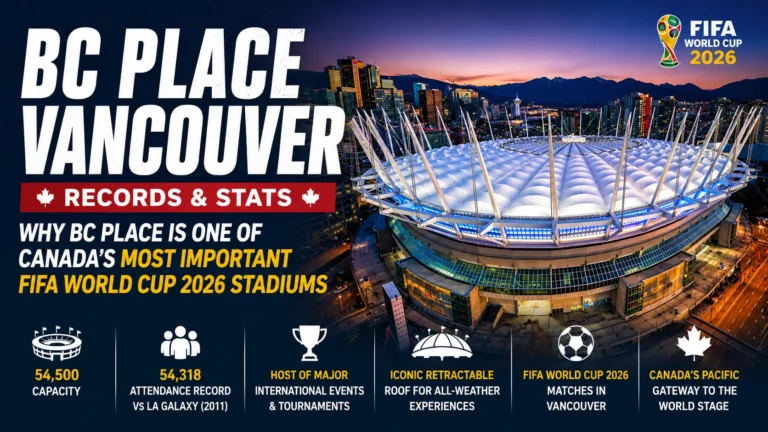
Vancouver doesn’t do things halfway. When the city found out it would be hosting the World Cup, the response wasn’t just a few cosmetic touch-ups. It was a complete $180 million transformation of BC Place — new technology, new luxury spaces, upgraded screens, and most importantly, an entirely new playing surface grown from scratch specifically for this tournament.
BC Place is hosting seven matches during the 2026 World Cup: five group-stage games (including two of Canada’s matches), one Round of 32 tie, and a Round of 16 clash on July 8. For a city on Canada’s Pacific coast that has built a quiet but genuine football culture over the years, this is the moment it’s been waiting for.
BC Place Vancouver Stadium at a Glance
| Location | Vancouver, British Columbia, Canada |
| Roof Type | Retractable |
| Previous Playing Surface | Artificial turf |
| New Playing Surface | Natural grass (specially grown for 2026) |
| Renovation Cost | Over $180 million |
| Total World Cup Matches | 7 |
| Group Stage Matches | 5 (including 2 Canada matches) |
| Knockout Matches | 2 (Round of 32, Round of 16) |
| Round of 16 Date | July 8, 2026 |
| 2015 Women’s World Cup Final | Hosted (USA 5-2 Japan) |
A Pitch Grown From Scratch
The headline upgrade at BC Place isn’t the screens, the lounges, or even the roof. It’s the grass.
For years, BC Place used artificial turf — practical for a multi-purpose venue that hosts everything from CFL football to concerts, but not what FIFA requires for World Cup matches. So for 2026, the stadium underwent a complete surface transformation: the artificial turf came out, and a brand-new natural grass pitch went in.
What makes this particularly interesting is where that grass came from. It wasn’t just ordered and laid down — it was specially cultivated by a farm in Abbotsford, a city about an hour outside Vancouver, grown specifically to meet FIFA’s standards before being transported and installed at the stadium.
The benefits of natural grass over artificial turf for top-level football are well established — better ball roll, more predictable bounce, and significantly reduced injury risk for players making sharp turns and sudden stops. For a stadium that will host two of Canada’s own matches, getting that surface right mattered enormously.
The Retractable Roof Advantage
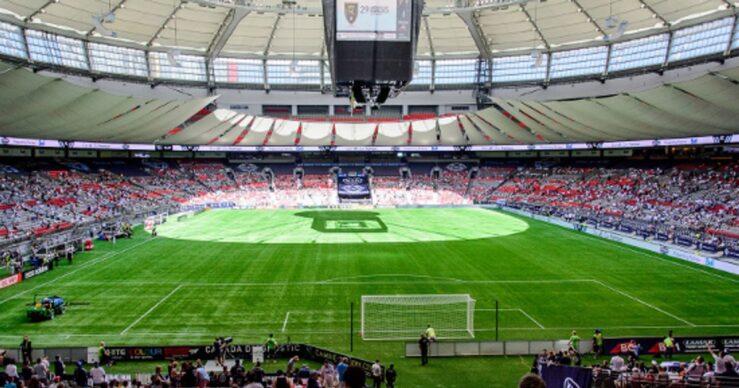
BC Place is one of the few World Cup 2026 venues with a retractable roof, and that gives it a genuine edge over open-air stadiums.
Vancouver’s weather can be unpredictable — rain is a real possibility even in summer, and temperatures can swing depending on the day. With a retractable roof, none of that matters. Organisers can close the roof for climate control, guaranteeing consistent playing conditions regardless of what’s happening outside.
| Roof Benefit | What It Means |
|---|---|
| Weather protection | Rain or wind won’t disrupt matches |
| Climate control | Consistent temperature for players and fans |
| Scheduling reliability | Zero risk of weather delays |
| Fan comfort | Comfortable conditions throughout |
For a tournament with a tight schedule across 16 venues, having even one stadium where weather simply isn’t a factor is valuable. It means BC Place can be relied upon, match after match, without contingency planning for storms.
The Full Match Schedule
| Date | Stage | Match | Notes |
|---|---|---|---|
| June 14, 2026 | Group Stage | Australia vs. Türkiye | Group D opener at BC Place |
| June 17, 2026 | Group Stage | TBD | Group Stage |
| June 20, 2026 | Group Stage | Canada (Group B) | Canada’s first match at BC Place |
| June 23, 2026 | Group Stage | Canada (Group B) | Canada’s second match at BC Place |
| June 26, 2026 | Group Stage | TBD | Group Stage |
| July 4, 2026 | Round of 32 | TBD vs. TBD | First knockout round |
| July 8, 2026 | Round of 16 | TBD vs. TBD | Last 16 |
The opening match at BC Place — Australia vs. Türkiye on June 14 — kicks things off in Group D, a group that also includes the USA and Paraguay. It’s a solid, competitive opener with two teams who will both believe they can progress.
But the heart of this stadium’s tournament is June 20 and June 23 — two of Canada’s Group B matches, played on home soil, on a pitch grown an hour up the road, under a roof that guarantees perfect conditions. For Canadian players and fans, this is about as close to a perfect setup as a host nation could ask for.
The Round of 32 on July 4 keeps the knockout drama building, before the Round of 16 on July 8 — one of only eight matches at that stage across the entire tournament.
Canada’s Two Home Matches
Hosting a home nation’s matches always carries extra weight, and BC Place gets two of them in Group B.
There’s something to be said for what this means practically for the Canadian team. They get to play on a grass pitch they’ve trained on, in a stadium where the conditions are controlled and predictable, in front of a crowd that will be entirely on their side. Between Toronto’s opener and Vancouver’s two Group B matches, Canada will have played the majority of their group stage campaign on home turf.
| Why Home Matches Matter | Detail |
|---|---|
| Pitch familiarity | Players have trained on similar natural grass surfaces |
| Climate control | No weather surprises affecting performance |
| Crowd support | Vancouver’s football community shows up |
| Travel reduction | Less time spent adapting to new cities |
For a nation co-hosting the World Cup for the first time, having two matches at a stadium this well-prepared is a significant advantage — on paper, at least. What happens on the pitch is always another matter.
A Stadium With Real Football History
BC Place isn’t new to major football tournaments. Back in 2015, it hosted matches during the FIFA Women’s World Cup — including the tournament final, where the United States defeated Japan 5-2 in one of the most one-sided major finals in recent memory.
During that 2015 tournament, BC Place hosted nine matches in total, and one of them set an attendance record that still stands as a marker of the stadium’s potential: 53,193 fans watched Nigeria take on the United States in a Group D match on June 16, 2015.
| 2015 Women’s World Cup at BC Place | Detail |
|---|---|
| Total matches hosted | 9 |
| Final | USA 5-2 Japan |
| Highest attendance | 53,193 (Nigeria vs. USA, June 16, 2015) |
That history matters. It means the operations team, the city’s infrastructure, and the stadium itself have already proven they can run a major FIFA tournament successfully. The 2026 men’s World Cup will be the first time the men’s tournament comes to BC Place — but it won’t be walking into unfamiliar territory.
Similar Read: MetLife Stadium | AT&T Stadium | Boston Stadium | Toronto Stadium
The $180 Million Transformation
Beyond the pitch and the roof, the renovation that prepared BC Place for 2026 covered a wide range of upgrades. New technology systems, refreshed luxury lounges for hospitality guests, and upgraded video screens (Jumbotrons) were all part of the package.
| Upgrade Area | What Changed |
|---|---|
| Playing surface | Artificial turf → natural grass |
| Technology | New systems installed throughout |
| Hospitality | Luxury lounges refreshed |
| Video screens | Upgraded Jumbotron displays |
| Total investment | Over $180 million |
For a venue that already hosted a Women’s World Cup final, this level of investment signals that Vancouver — and Canada more broadly — wanted BC Place to be ready not just to meet FIFA’s minimum requirements, but to genuinely stand out among the 16 host venues.
Similar Read: Atlanta Stadium | Kansas City Stadium | Houston Stadium
Why BC Place Matters in the Bigger Picture
Canada is co-hosting this World Cup alongside the United States and Mexico, with two venues of its own — BC Place in Vancouver and BMO Field (Toronto Stadium) in Toronto. Between them, Canada hosts 13 matches total.
BC Place’s role in that story is significant. Two of Canada’s three group stage matches happen here. A Round of 16 match — one of the biggest stages outside the semifinals and final — happens here. And it happens on a pitch that was grown specifically for this moment, under a roof that takes weather out of the equation entirely.
For Vancouver, a city that has always had a quieter football culture compared to some of Canada’s other major cities, this tournament is a chance to show what the West Coast can do when it comes to hosting the world’s biggest sporting event.