


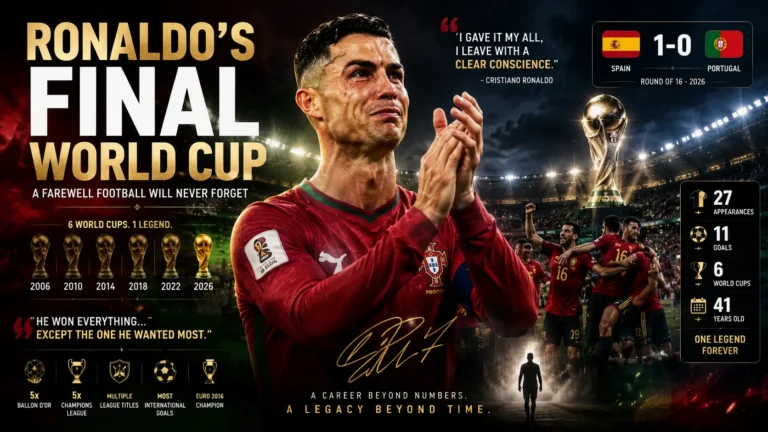
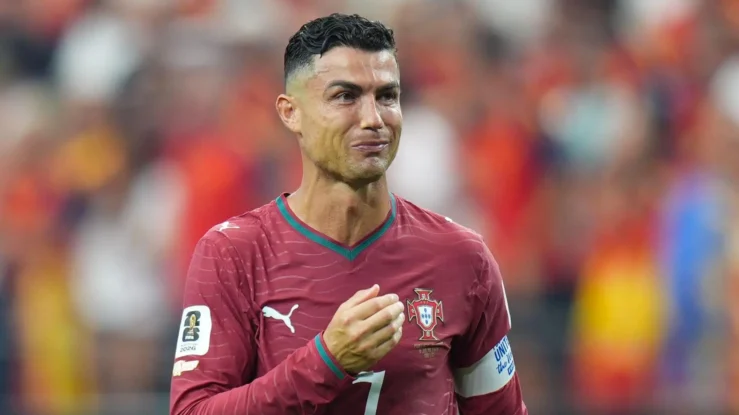
When the final whistle blew at Dallas Stadium in Arlington, Texas on the night of July 7, 2026, Cristiano Ronaldo stood on the pitch with tears in his eyes. He turned to face the stands, and he applauded. Not quickly, not briefly — he stood and clapped, taking in the crowd one last time while wearing the jersey that has meant more to him than perhaps anything else in his professional life.
Spain had beaten Portugal 1-0 through a Mikel Merino header in stoppage time. One late goal. That was all it took to end Ronaldo’s World Cup story — a story that stretched across six tournaments, 27 appearances, and 41 years of a life devoted almost entirely to football.
What Cristiano Ronaldo Said Afterwards
There was no anger in Ronaldo’s post-match words. There was sadness, clearly, but also something that sounded like acceptance.
“I’m sad to leave the World Cup this way,” he said. “As I said yesterday, I gave it my all, and I leave with a clear conscience. That’s the life of a footballer. You have to move forward.”
He confirmed this was his final World Cup, though he stopped short of announcing full international retirement — saying he needed time with his family before making any decisions. Portugal coach Roberto Martinez spoke with unmistakable emotion about what the evening meant. “We’re talking about an icon in football,” he said. “There aren’t many Cristiano Ronaldos. We have to be thankful for what he did at this World Cup.”
The Numbers Behind the Journey
The records Ronaldo leaves behind from his World Cup appearances deserve to be looked at clearly, without inflation or sentimentality.
He is the only player in football history to score in six consecutive World Cups. He scored three goals in this 2026 tournament alone, at age 41. His total of 27 World Cup appearances is second only to Lionel Messi’s 30. His 11 World Cup goals place him ninth on the all-time list.
The best he ever went at a World Cup was the 2006 semi-final — his debut tournament. Every edition since brought renewed belief that this time might be different. Every edition ended before the trophy could be claimed. It never came. And now it never will.
The Trophy That Was Always Missing
If you want to understand the bittersweet weight of Ronaldo’s career, you only need one sentence: he won everything except the one thing football considers the greatest.
Five Ballon d’Or awards. Five UEFA Champions League titles. League championships in England with Manchester United, in Spain with Real Madrid, in Italy with Juventus. The record for most goals in men’s international football. He even delivered Portugal their first major international trophy — the UEFA Euro 2016 title, lifted in Paris in tears of a very different kind.
“The 2016 Euros title is on the same level as a World Cup,” he said in Dallas. It was not bravado. It was a man trying to make peace with a career that gave him almost everything, but not quite everything.
The World Cup is different. It is the trophy that defines football’s conversation about greatness more than any other. Johan Cruyff never won it. Neither did Alfredo Di Stefano, George Best, or Ferenc Puskas. Their places in history are secure regardless. And so is Ronaldo’s.
What His Last World Cup Actually Looked Like
It would be easy to remember this tournament only as the end. That would be unfair.
Ronaldo played at 41 in a World Cup and scored three times. Opponents who grew up watching him on television were marking him on the pitch, and he still found ways to threaten. Stadiums still paused when he touched the ball. Even as Lamine Yamal, Kylian Mbappé, Erling Haaland, and Ousmane Dembele command the new generation’s attention, Ronaldo drew eyes wherever he went. That is not sentiment — that is still the reality of his presence.
The belief that one moment of magic could change everything followed him to the very end. That belief, earned across two decades of extraordinary consistency, is not something a World Cup medal can create or destroy.
Also Read: 10 Hottest Wives and Girlfriends of Famous Footballers in 2026
A Legacy Built on More Than Trophies
Football gave Cristiano Ronaldo almost everything. Records that seemed permanent until he broke them. Money and fame beyond calculation. A global following that set alarms for three in the morning to watch him play in different time zones. Children in every country who copied his free-kick run-up in school playgrounds until their parents called them in for dinner.
He made an entire generation believe that talent was only the starting point — that discipline, obsession, and relentless self-improvement could take a footballer beyond what nature alone provided. That message landed. Millions of young players who grew up watching him carry it with them still.
The World Cup was the one thing missing from the collection. On a Monday night in Texas, after a 1-0 defeat to Spain, that became permanent. Ronaldo walked off the pitch in tears, applauding the fans who stayed to watch him leave.
In the end, the greatest player of his generation walked away from the World Cup without the one trophy he wanted most. And somehow, some way, it does not change a single thing about what he was.