


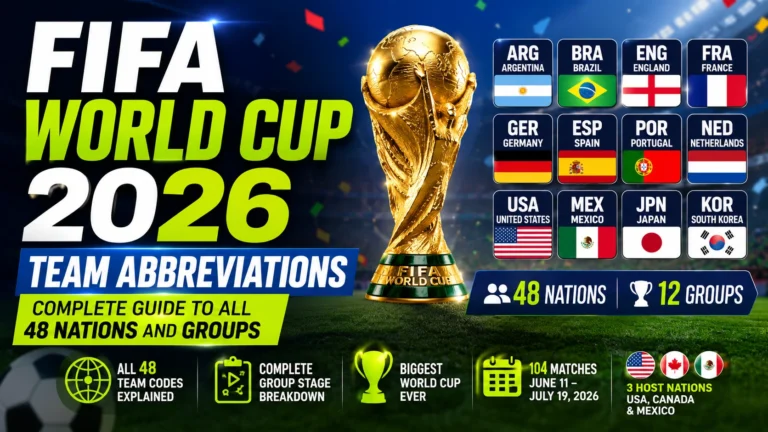
The 2026 FIFA World Cup is the biggest the tournament has ever been. Forty-eight teams, twelve groups, 104 matches spread across the United States, Canada, and Mexico — it’s a lot to keep track of, and that’s before you even get into the three-letter country codes flashing across your screen during every match.
If you’ve been watching and wondering what “CIV” or “RSA” actually stands for, you’re not alone. Here’s the complete list of team abbreviations, plus a full breakdown of exactly which teams ended up in which group.
The Opening Weeks Have Already Delivered Drama
The tournament kicked off on June 11 with hosts Mexico taking on South Africa at the legendary Estadio Azteca, and it’s been eventful from the very first whistle. Team USA opened with a commanding 4-1 win over Paraguay. Lionel Messi scored a hat-trick as Argentina cruised past Algeria 3-0. There have already been a few genuine shocks along the way too, with Germany putting seven past Curaçao in one of the more lopsided results so far.
With 104 matches on the schedule and the final set for July 19 at MetLife Stadium — officially renamed New York New Jersey Stadium for the tournament — there’s plenty of football still to come.
2026 FIFA World Cup Team Abbreviations
Here’s the full list of three-letter codes you’ll see on scoreboards throughout the tournament:
- Algeria (ALG)
- Argentina (ARG),
- Australia (AUS)
- Austria (AUT)
- Belgium (BEL)
- Bosnia and Herzegovina (BIH)
- Brazil (BRA)
- Cabo Verde (CPV)
- Canada (CAN)
- Colombia (COL)
- Croatia (CRO)
- Curaçao (CUW)
- Czechia (CZE)
- DR Congo (COD)
- Ecuador (ECU)
- Egypt (EGY)
- England (ENG)
- France (FRA)
- Germany (GER)
- Ghana (GHA)
- Haiti (HAI)
- Iran (IRN)
- Iraq (IRQ)
- Ivory Coast (CIV)
- Japan (JPN)
- Jordan (JOR)
- Mexico (MEX)
- Morocco (MAR)
- Netherlands (NED)
- New Zealand (NZL)
- Norway (NOR)
- Panama (PAN)
- Paraguay (PAR)
- Portugal (POR)
- Qatar (QAT)
- Saudi Arabia (KSA)
- Scotland (SCO)
- Senegal (SEN)
- South Africa (RSA)
- South Korea (KOR)
- Spain (ESP)
- Sweden (SWE)
- Switzerland (SUI)
- Tunisia (TUN)
- Turkey (TUR)
- United States (USA)
- Uruguay (URU)
- Uzbekistan (UZB)
How the Format Works
Each team plays the other three teams in its group in a round-robin format. The top two teams from each of the 12 groups, along with the eight best third-place finishers, advance to the Round of 32.
From there, it’s straight knockout football. The Round of 32 begins June 28, the Round of 16 starts July 4, the quarterfinals begin July 9, and the semifinals kick off July 14. The third-place playoff lands on July 18, with the final the very next day on July 19.
Similar Article: FIFA World Cup Champions: Complete List of All Winners From 1930 to 2022
The Complete Group Stage Lineup
Group A: Mexico, South Africa, South Korea, Czechia
Group B: Canada, Bosnia and Herzegovina, Qatar, Switzerland
Group C: Brazil, Morocco, Haiti, Scotland
Group D: United States, Paraguay, Australia, Turkey
Group E: Germany, Curaçao, Ivory Coast, Ecuador
Group F: Netherlands, Japan, Sweden, Tunisia
Group G: Belgium, Egypt, Iran, New Zealand
Group H: Spain, Cabo Verde, Saudi Arabia, Uruguay
Group I: France, Senegal, Iraq, Norway
Group J: Argentina, Algeria, Austria, Jordan
Group K: Portugal, DR Congo, Uzbekistan, Colombia
Group L: England, Croatia, Ghana, Panama
Similar Read: Best Apps to Watch FIFA World Cup 2026 Live in India on Mobile and TV
A Few Groups Worth Watching Closely
Group I has already earned a reputation as this tournament’s toughest group, pairing 2018 champions France with a dangerous Senegal side, a resurgent Norway, and Iraq. Three of those four teams sit inside the world’s top 30, which makes for one of the most unpredictable groups on paper.
Group K has also delivered its share of surprises early on, with Cristiano Ronaldo’s Portugal held to a surprise draw by DR Congo in their opener, throwing the group wide open heading into the final round of matches.
Meanwhile, Group L offers a fascinating subplot for England fans — Thomas Tuchel’s side opened with wins, but the path through the knockout rounds may actually be friendlier if they finish second or third rather than topping the group outright, given how the bracket is structured.
With six debutant nations in the tournament — Cape Verde, Curaçao, Jordan, and Uzbekistan among the newcomers — and the format bigger than ever before, this World Cup has plenty of room left for more surprises before it’s all over on July 19.