


The FIFA World Cup is the most watched sporting event on the planet. It runs once every four years, lasts just over a month, and produces moments that entire generations define themselves by. Maradona’s hand of God goal. Pele at seventeen. Zinedine Zidane headbutting Marco Materazzi in a World Cup final. These are not just football memories — they are cultural events.
Since the first edition in 1930, only eight nations have ever won it. That exclusivity is part of what makes each triumph so significant. Here is the complete record of every FIFA World Cup champion, along with the stories and numbers that define the tournament’s history.
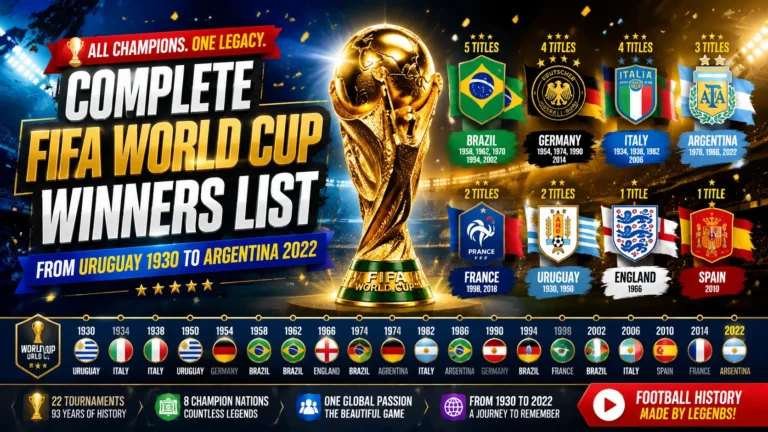
The Complete FIFA World Cup Winners List
| Year | Host Country | Champion | Runner-Up | Final Score |
|---|---|---|---|---|
| 1930 | Uruguay | Uruguay | Argentina | 4–2 |
| 1934 | Italy | Italy | Czechoslovakia | 2–1 |
| 1938 | France | Italy | Hungary | 4–2 |
| 1950 | Brazil | Uruguay | Brazil | 2–1 |
| 1954 | Switzerland | West Germany | Hungary | 3–2 |
| 1958 | Sweden | Brazil | Sweden | 5–2 |
| 1962 | Chile | Brazil | Czechoslovakia | 3–1 |
| 1966 | England | England | West Germany | 4–2 |
| 1970 | Mexico | Brazil | Italy | 4–1 |
| 1974 | West Germany | West Germany | Netherlands | 2–1 |
| 1978 | Argentina | Argentina | Netherlands | 3–1 |
| 1982 | Spain | Italy | West Germany | 3–1 |
| 1986 | Mexico | Argentina | West Germany | 3–2 |
| 1990 | Italy | West Germany | Argentina | 1–0 |
| 1994 | USA | Brazil | Italy | 0–0 (3–2 pens) |
| 1998 | France | France | Brazil | 3–0 |
| 2002 | Japan/South Korea | Brazil | Germany | 2–0 |
| 2006 | Germany | Italy | France | 1–1 (5–3 pens) |
| 2010 | South Africa | Spain | Netherlands | 1–0 |
| 2014 | Brazil | Germany | Argentina | 1–0 |
| 2018 | Russia | France | Croatia | 4–2 |
| 2022 | Qatar | Argentina | France | 3–3 (4–2 pens) |
World Cup Wins by Country — The Championship
| Country | Titles | Years Won |
|---|---|---|
| Brazil | 5 | 1958, 1962, 1970, 1994, 2002 |
| Germany / West Germany | 4 | 1954, 1974, 1990, 2014 |
| Italy | 4 | 1934, 1938, 1982, 2006 |
| Argentina | 3 | 1978, 1986, 2022 |
| France | 2 | 1998, 2018 |
| Uruguay | 2 | 1930, 1950 |
| England | 1 | 1966 |
| Spain | 1 | 2010 |
The Stories Behind the Numbers
Uruguay — The Founding Champions (1930 and 1950)
The first FIFA World Cup was held in 1930 in Uruguay, as the country celebrated 100 years of independence. They had also won gold at the 1924 and 1928 Olympics, making them the legitimate favourites on home soil. Uruguay beat Argentina 4–2 in the final to become the first ever FIFA World Cup champions.
Their second title in 1950 remains one of football’s most dramatic upsets. Playing in Brazil in front of what is widely estimated to have been around 200,000 people at the Maracaña in Rio de Janeiro, Uruguay beat the hosts 2–1 in the deciding match of the final group stage. Brazil, widely expected to win on home soil, were left shattered. The event became known simply as “the Maracanazo” — a wound Brazilian football has never quite stopped feeling.
Italy — The First Team to Defend the Title (1934 and 1938)
Italy won the next two FIFA World Cups — in 1934 and 1938 — and became the first nation to defend their title. Their 1934 triumph came on home soil under Benito Mussolini’s government, a tournament that has always carried political shadow alongside its sporting achievement. The 1938 win in France proved that the 1934 side was not merely a home-crowd advantage.
Italy’s third and fourth titles came decades later — in 1982 in Spain, where Paolo Rossi’s hat-trick against Brazil is still considered one of the greatest individual performances in World Cup history, and in 2006 in Germany, where Gianluigi Buffon’s goalkeeping kept them alive through knockout after knockout before winning on penalties against France in a final most remembered for Zidane’s extraordinary moment of madness.
Brazil — Five Titles, One Relentless Standard (1958–2002)
Brazil are the most successful team at the FIFA World Cup, having won the title five times. They are also the only country to play in all 22 editions of the FIFA World Cup.
Their story begins in 1958 in Sweden, when a seventeen-year-old called Pele arrived on the world stage and scored six goals. Brazil beat hosts Sweden 5–2 in the final to lift the trophy, and Brazil defended their title in 1962.
The 1970 team in Mexico is frequently described as the greatest international football team ever assembled. Pele, Jairzinho, Rivellino, Carlos Alberto — that side won every match in the tournament and played a brand of football that has never quite been replicated. Pele, with three trophies, has won the most World Cups by an individual player.
The 1994 and 2002 titles bookended a period that proved Brazil’s dominance was not merely nostalgia. The 2002 team, featuring Ronaldo, Rivaldo, and Ronaldinho at their peaks, won every knockout match and ended the tournament without conceding a goal after the group stage.
West Germany and Germany — Four Titles Built on Relentlessness (1954–2014)
West Germany’s 1954 triumph in Switzerland, known as the “Miracle of Bern,” came against a Hungarian team that many considered the greatest in the world at that point. The West Germans, having lost the group stage match 8–3 to the same opponents, beat Hungary 3–2 in the final.
Their 1974 and 1990 titles added further evidence of a football culture that produces winners with remarkable consistency. The unified Germany’s 2014 title in Brazil — the famous 7–1 semi-final demolition of the hosts followed by a 1–0 final against Argentina — was the culmination of a decade of methodical rebuilding.
Argentina — Maradona, Messi, and Three Trophies (1978, 1986, 2022)
Argentina, powered by the brilliance of the late Diego Maradona, won their second title in 1986, having first won it in 1978. Lionel Messi added to Argentina’s glory by leading them to their third World Cup title in 2022.
The 1986 tournament in Mexico belongs to Maradona in a way that few individual performances define a World Cup. His goal against England in the quarter-final — the Hand of God followed four minutes later by a solo run from his own half that bypassed five players — remains the most talked-about five-minute sequence in the history of the sport.
The 2022 final in Qatar between Argentina and France produced one of the greatest World Cup finals ever played. Argentina led 2–0 late into the second half before Kylian Mbappé scored twice in ninety seconds to level. The match went to extra time, where Messi scored again before Mbappé completed his hat-trick. Argentina won on penalties in the early hours of the morning in Lusail, and Messi finally had his World Cup.
France — Two Titles Forty Years Apart (1998 and 2018)
The FIFA World Cup got a new winner in 1998 as modern football giants France, under the captaincy of Didier Deschamps, beat Brazil in the final to win their first title on home soil. Zinedine Zidane scored twice with headers from corners in a 3–0 win that felt, on the night, almost inevitable.
Twenty years later, a new French generation won again in Russia — with Kylian Mbappé becoming only the second teenager after Pele to score in a World Cup final. Didier Deschamps was the manager of the French team that won the 2018 FIFA World Cup, making him the third individual to win the title both as a player and a manager. Mario Zagallo (Brazil) and Franz Beckenbauer (Germany) have also achieved the feat.
England — One Title, Sixty Years of Waiting (1966)
England’s solitary World Cup triumph came on home soil at Wembley in 1966. England’s Geoff Hurst scored three goals in the 4–2 win over West Germany and was the first man to score a hat-trick in a FIFA World Cup final. The third goal — hit hard into the roof of the net with the ball bouncing down from the crossbar — has been debated ever since about whether it fully crossed the line. The Soviet linesman said yes. England have been living off that decision ever since.
Spain — One Title, Total Football’s Modern Peak (2010)
Spain’s victory in 2010 in South Africa came at the end of a sustained period of domestic and international dominance built around the Barcelona tiki-taka style. Andres Iniesta scored the only goal in extra time of the final against the Netherlands, becoming the most celebrated goal scorer in the history of Spanish football in the process.
Key Records and Statistics
German striker Miroslav Klose is the all-time top scorer in FIFA World Cups, having scored 16 goals from 2002 to 2014. The record for most goals scored in a single FIFA World Cup is held by Frenchman Just Fontaine, who scored 13 goals in 1958.
| Record | Player / Country | Details |
|---|---|---|
| Most World Cup titles | Brazil | 5 titles |
| Most goals in World Cup history | Miroslav Klose (Germany) | 16 goals |
| Most goals in a single tournament | Just Fontaine (France) | 13 goals in 1958 |
| Most individual titles won | Pele (Brazil) | 3 titles (1958, 1962, 1970) |
| First team to defend the title | Italy | 1934 and 1938 |
| Only team in every tournament | Brazil | All 22 editions |
| Only team to win on all continents | None (Brazil closest) | 5 wins across 3 continents |
Also Read: Kansas City Stadium: Arrowhead’s Thunderous Roar for FIFA World Cup 2026
Looking Ahead to 2026
The 2026 FIFA World Cup will be the first to feature 48 teams rather than 32, hosted jointly by the United States, Canada, and Mexico. It will run from June 11 to July 19, 2026, with the final played at MetLife Stadium in New Jersey. The expanded format means more nations competing, more matches, and an entirely new chapter in the history of the tournament.
Whether Argentina defend their title, whether a new champion emerges from Africa or Asia, whether Mbappé adds a winner’s medal to his hat-trick in the 2022 final — the 2026 World Cup will write its own story. It always does.