


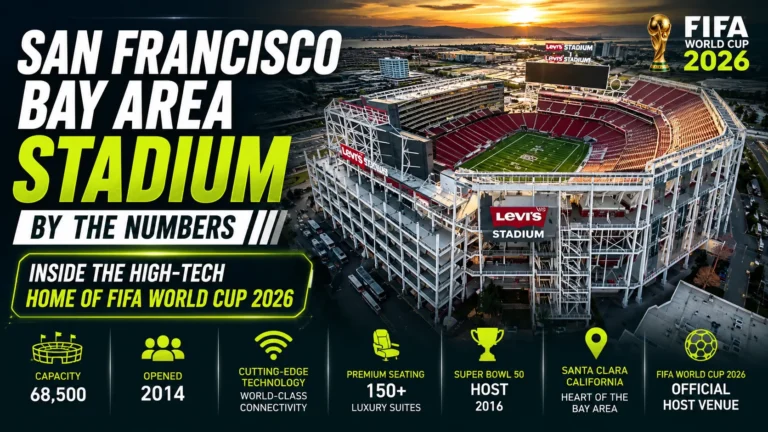
If any stadium in the 2026 World Cup was going to be built around technology, it makes sense that it’s the one sitting in the heart of Silicon Valley. Levi’s Stadium in Santa Clara, California, was designed from the ground up as a “smart stadium” — a venue built around energy efficiency and advanced digital connectivity in a way few sports venues anywhere in the world can match.
For the tournament, it carries the official name San Francisco Bay Area Stadium, and it’s hosting six matches — five from the group stage and one Round of 32 knockout tie on July 1. As California’s third World Cup venue alongside Los Angeles and San Diego, the Bay Area is getting its own distinctive slice of the tournament.
San Francisco Bay Area Stadium at a Glance
| Official Tournament Name | San Francisco Bay Area Stadium |
| Primary Name | Levi’s Stadium |
| Location | Santa Clara, California |
| FIFA World Cup Capacity | 69,391 |
| Opened | 2014 |
| Playing Surface | Hybrid Bermuda grass |
| NFL Home Team | San Francisco 49ers |
| Total World Cup Matches | 6 |
| Group Stage Matches | 5 |
| Knockout Matches | 1 (Round of 32) |
| Round of 32 Date | July 1, 2026 |
A Genuinely “Smart” Stadium
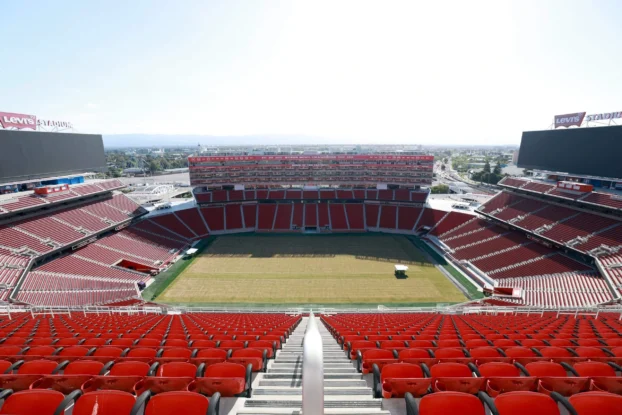
Levi’s Stadium opened in 2014, making it one of the newest venues in the entire 2026 World Cup — newer than Estadio Azteca (1966), Hard Rock Stadium (1987), and Lincoln Financial Field (1987) by decades in some cases. That recent construction date matters, because it meant the building could be designed around modern technology from day one, rather than retrofitted later.
The result is what’s officially described as a “smart stadium” — a venue built with energy efficiency and advanced connectivity as core design principles, not afterthoughts.
| Smart Stadium Feature | What It Means |
|---|---|
| Energy efficiency | Sustainable design reduces overall power consumption |
| Advanced connectivity | High-speed Wi-Fi throughout the venue for fans |
| Integrated smart systems | Technology built into the fan experience itself |
| Operational efficiency | Modern systems improve how the stadium runs day to day |
For a region that built its identity around technology companies and innovation, having a stadium that reflects that culture feels appropriate. Fans attending matches here can expect a seamless digital experience from the moment they arrive — something that’s increasingly expected at major sporting events but isn’t always delivered well.
The Playing Surface
Levi’s Stadium uses hybrid Bermuda grass for its pitch — a surface that combines natural grass with reinforcing synthetic fibres, giving it durability without sacrificing the playing characteristics that professional footballers expect from a natural surface.
| Surface Benefit | Detail |
|---|---|
| FIFA-standard quality | Meets international requirements for top-level football |
| Player safety | Lower injury risk than artificial turf |
| Ball performance | Predictable roll and bounce for technical play |
| Durability | Holds up across multiple matches without degrading |
With six matches scheduled at this venue across roughly three weeks, having a durable surface that performs consistently from the first match to the last is genuinely important.
The Full Match Schedule
| Date | Stage | Match | Notes |
|---|---|---|---|
| June 13, 2026 | Group Stage | Qatar vs. Switzerland | Group B opener |
| June 16, 2026 | Group Stage | Austria vs. Jordan | Group J |
| June 20, 2026 | Group Stage | TBD | Group D |
| June 22, 2026 | Group Stage | TBD | Group F |
| June 25, 2026 | Group Stage | TBD | Group H |
| July 1, 2026 | Round of 32 | TBD vs. TBD | First knockout round |
The opening match at Levi’s Stadium — Qatar vs. Switzerland on June 13 — pairs Asia’s reigning champions against a technically sharp European side. Qatar carry the experience of having hosted the 2022 World Cup themselves, while Switzerland have built a reputation as one of the more tactically organised and difficult-to-beat sides in international football. It’s a genuinely intriguing way to open the venue’s tournament.
Three days later, Austria vs. Jordan brings a different flavour — a European nation with an attacking, high-pressing style against an Asian qualifier looking to make a real statement on the global stage.
The remaining group stage matches are still pending confirmation of exact matchups, but Groups D, F, and H will all be represented at the venue before the schedule moves into knockout territory on July 1.
Similar Reads: MetLife Stadium | AT&T Stadium | Boston Stadium | Estadio Akron
International Variety on Display
| Date | Nations | Confederation Mix |
|---|---|---|
| June 13 | Qatar, Switzerland | AFC vs. UEFA |
| June 16 | Austria, Jordan | UEFA vs. AFC |
| June 20–25 | TBD (Groups D, F, H) | Pending group stage draw |
What’s notable about the confirmed matches so far is the genuine continental mix on display. Qatar and Jordan represent Asian football, while Switzerland and Austria bring European tactical traditions. For Bay Area fans, that means an early taste of genuinely contrasting footballing styles within just a few days of each other.
Similar Reads: Kansas City Stadium | Philadelphia Stadium | Los Angeles Stadium
The Round of 32 — Silicon Valley’s Knockout Moment
On July 1, 2026, Levi’s Stadium hosts its one knockout fixture of the tournament — a Round of 32 tie that will see two teams who have survived their group stage facing a straight knockout for a place in the Round of 16.
The Round of 32 is a new addition to the World Cup format for 2026, introduced specifically because of the expansion to 48 teams. It adds an extra layer of knockout drama before the more familiar Round of 16, quarterfinal, and semifinal stages that fans are used to from previous tournaments.
For whichever two teams end up playing this match, the stakes are straightforward and brutal: win, and you continue toward the Round of 16. Lose, and the World Cup is over.
Similar Reads: BC Place Vancouver | Toronto Stadium | Estadio Azteca | Estadio Monterrey
Home of the 49ers
Levi’s Stadium has been the home of the San Francisco 49ers since it opened in 2014, one of the NFL’s most historically successful franchises. That heritage brings with it the kind of operational experience that comes from hosting major sporting events year after year — NFL playoff games, high-profile regular season matchups, and large-scale event logistics that translate well into hosting a World Cup.
| 49ers Connection | Detail |
|---|---|
| NFL franchise | San Francisco 49ers |
| Franchise history | Multiple Super Bowl championships across decades |
| Stadium experience | Regular host for high-pressure NFL matchups |
| Bay Area significance | Represents Northern California’s biggest football brand |
That NFL pedigree, combined with the stadium’s purpose-built smart technology, gives Levi’s Stadium a genuinely strong foundation heading into the World Cup.
Similar Reads: Atlanta Stadium | Miami Stadium | Houston Stadium | Seattle Stadium
Why the Bay Area Matters in This Tournament
California is unusual among World Cup host states in that it has three separate venues — Los Angeles, San Diego, and the Bay Area at Levi’s Stadium. Each brings something different. Los Angeles has the glamour and the quarterfinal. The Bay Area brings the technology angle and a genuinely international group stage lineup, capped off with a Round of 32 knockout match.
For a region that has spent decades defining what “smart” and “connected” mean for entire industries, getting to host the World Cup using a stadium that was purpose-built around those same principles feels like a natural fit.
Six matches. One knockout tie. A pitch that’s been engineered for durability, and a stadium that’s been engineered for connectivity. Santa Clara is ready to show what Silicon Valley football looks like.