


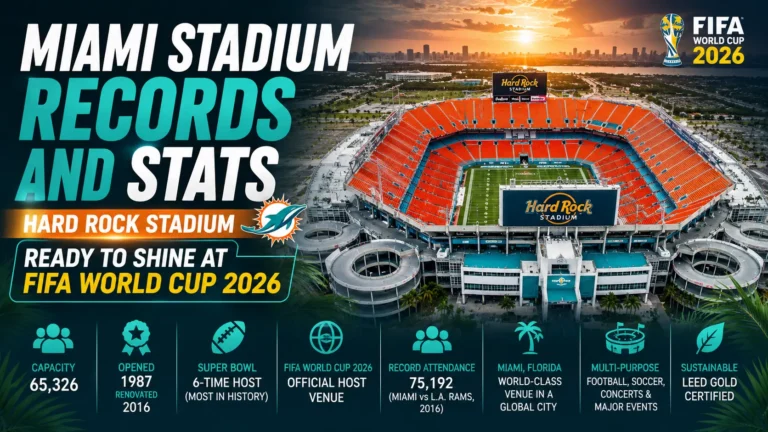
Every World Cup has a match that nobody really wants to play in, but that still matters more than people give it credit for. The third-place playoff — the game between the two teams who just lost their semifinals — is football’s version of a consolation prize with real weight attached. And in 2026, there’s only one stadium hosting it: Hard Rock Stadium in Miami Gardens, Florida.
For the tournament, this venue carries the official name Miami Stadium. It’s hosting seven matches in total — four group stage games, a Round of 32 tie, a quarterfinal, and that one-of-a-kind third-place match. No other venue in the entire 2026 World Cup gets that particular honour.
Miami Stadium at a Glance
| Official Tournament Name | Miami Stadium |
| Primary Name | Hard Rock Stadium |
| Location | Miami Gardens, Florida |
| FIFA World Cup Capacity | 64,478 |
| Opened | 1987 |
| Major Renovation | 2015 |
| NFL Home Team | Miami Dolphins |
| Total World Cup Matches | 7 |
| Knockout Matches | 3 (Round of 32, Quarterfinal, Third-Place Playoff) |
| Third-Place Playoff | The only venue in the tournament hosting this fixture |
Hard Rock Stadium Used to the Biggest Stage
Before a single World Cup ball is kicked here, Hard Rock Stadium has already proven, repeatedly, that it can host events at the highest level of pressure and scale.
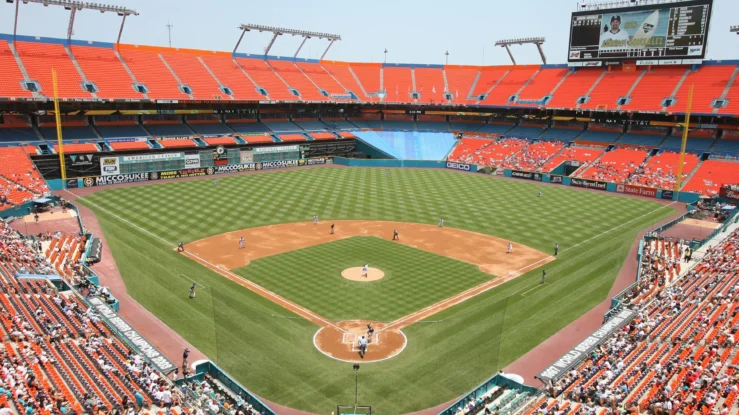
The stadium has hosted six Super Bowls — more than any other venue in NFL history. On top of that, it’s a regular host for the Miami Open, one of tennis’s premier ATP and WTA tournaments, and more recently the Miami Grand Prix, bringing Formula 1 racing to the Florida coast.
| Major Event | Detail |
|---|---|
| Super Bowls hosted | 6 — more than any NFL stadium in history |
| Miami Open | Annual ATP/WTA tennis tournament |
| Miami Grand Prix | Formula 1 race weekend |
| NFL Playoffs | Multiple AFC Championship games |
That kind of multi-sport pedigree matters. A stadium that can pivot from NFL football to tennis to Formula 1 and back again has an operational team that knows how to reconfigure, adapt, and deliver—exactly the skill set needed to host a World Cup.
From NFL Stadium to World-Class Football Venue
Hard Rock Stadium originally opened in 1987, built primarily with NFL football in mind for the Miami Dolphins. But in 2015, the stadium underwent major renovations specifically designed to improve the experience for football (soccer) viewing — adjusting sightlines, seating angles, and general spectator comfort for the round-ball game.
That renovation work means this isn’t a venue awkwardly adapting an NFL bowl for soccer at the last minute. The groundwork for hosting international football matches was laid down nearly a decade before the World Cup arrived.
The Full Match Schedule
| Match Type | Number of Matches |
|---|---|
| Group Stage | 4 |
| Round of 32 | 1 |
| Quarterfinal | 1 |
| Third-Place Playoff | 1 (the only one in the tournament) |
| Total | 7 |
Four group stage matches give South Florida fans their early taste of World Cup action, followed by a Round of 32 knockout tie. Then comes the quarterfinal — one of only four in the entire competition — before the stadium’s signature moment: the third-place playoff.
Why the Third-Place Playoff Matters
It’s easy to dismiss the third-place match as a meaningless exhibition. The two teams playing in it have just suffered the heartbreak of losing a World Cup semifinal — coming agonisingly close to the final, only to fall short. For some players, this match feels like the last thing they want to do.
But history tells a different story. Third-place playoffs have produced some of the most relaxed, attacking, and entertaining football in World Cup history, precisely because the pressure of the tournament has already broken. Players who might otherwise be cautious tend to play with more freedom once the dream of winning the whole thing is gone, but there’s still a podium finish — bronze medal status — on the line.
For 2026, with the expanded 48-team format bringing more matches and more drama than ever before, this will be the first third-place match played at a World Cup of this size. Hard Rock Stadium gets the honour of hosting it, and South Florida’s warm, festival-like sporting culture is arguably the perfect backdrop for what tends to be one of the more relaxed, free-flowing matches of the entire tournament.
The Quarterfinal — One of Four in the Whole Tournament
Before the third-place playoff, Hard Rock Stadium hosts a genuine quarterfinal — one of only four matches at that stage across the entire competition. By the time this match kicks off, only eight teams remain in the World Cup. A loss here means the tournament is over.
| Quarterfinal Significance | Detail |
|---|---|
| Stage | One of four quarterfinals in the tournament |
| Stakes | Loser is eliminated; winner advances to the semifinals |
| Capacity | 64,478 |
| Setting | South Florida’s tropical climate and atmosphere |
That combination — a quarterfinal followed later by the third-place playoff — means Hard Rock Stadium effectively bookends two very different emotional registers of knockout football. One match decided by pure desperation to survive. The other is decided by players who have already faced the worst outcome and are now playing for pride and a bronze finish.
Similar Reads: BC Place Vancouver | Toronto Stadium | Estadio Azteca | Estadio Monterrey
Florida Heat and Atmosphere
Miami’s tropical climate brings its own character to these matches. The heat and humidity of South Florida summer are well known to affect player endurance, and match scheduling will need to account for that, much as it does at other hot-climate venues like Houston and Kansas City.
But that same tropical setting is also part of what makes Miami such a distinctive World Cup destination. South Florida’s blend of Latin American, Caribbean, and broader international communities creates one of the most vibrant, multicultural sporting atmospheres anywhere in the United States. Whatever nations end up playing the quarterfinal or the third-place match here, there’s a strong likelihood that passionate, well-represented fan communities will already be in the stands.
Similar Reads: Atlanta Stadium | Kansas City Stadium | Los Angeles Stadium | Houston Stadium
Tickets and Accessibility
Ticket pricing for Miami Stadium matches has been relatively accessible compared to some of the marquee venues elsewhere in the tournament. Group stage tickets for early June dates have started from around $359 USD, with prices rising for the Round of 32, the quarterfinal, and naturally the highest demand for the historic third-place playoff.
| Match Stage | Approximate Starting Price |
|---|---|
| Group Stage (June 2026) | From ~$359 USD |
| Round of 32 | Higher, knockout premium |
| Quarterfinal | Premium pricing |
| Third-Place Playoff | Highest demand of the seven matches |
Fans looking to attend can check FIFA’s official ticket portal or resale platforms like SeatGeek for current availability as the tournament progresses.
Similar Reads: MetLife Stadium | AT&T Stadium | Boston Stadium | Estadio Akron
Why Hard Rock Stadium Stands Out
In a tournament with venues hosting semifinals, the Final, and multiple quarterfinals, it would be easy to assume the venue without one of those headline matches is somehow less significant. Hard Rock Stadium proves that wrong.
Six Super Bowls. A genuine quarterfinal. And the only third-place playoff in the entire 2026 World Cup — a match that, while often misunderstood, tends to produce some of the freest, most enjoyable football of the whole tournament. Add in South Florida’s tropical energy and multicultural fan base, and Miami Gardens earns its place as one of the more uniquely positioned host cities in this World Cup.
Seven matches. One quarterfinal. One historic third-place finale. Miami is ready to bring its own flavour to the World Cup’s closing stages.