


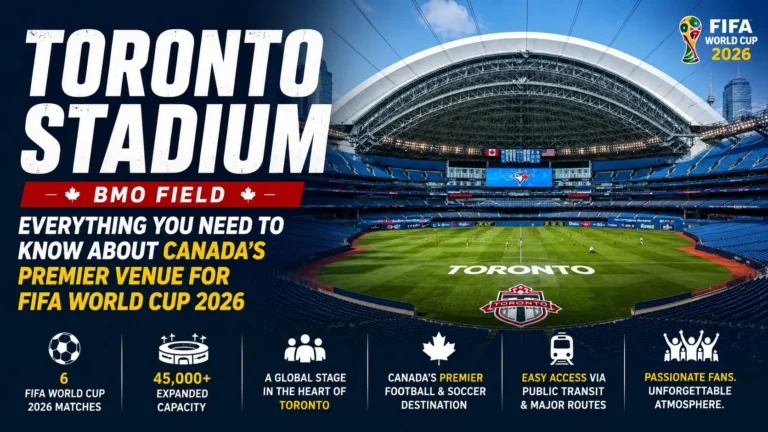
Every World Cup has a moment that hits differently from all the others — the host nation’s opening match. For Canada, that moment arrives on June 14, 2026, at Toronto Stadium, better known to football fans as BMO Field. And in a tournament filled with 80,000-seat giants, this stadium is doing something unusual. It’s the smallest venue in the entire competition — and that might just be exactly what makes it special.
Toronto Stadium will host six matches across the tournament: five group stage games and one Round of 32 tie. But the one everyone in Canada is circling on their calendar is the opener. A home nation, a home crowd, and a stadium that has been completely transformed to make it happen.
Toronto Stadium at a Glance
| Official FIFA Tournament Name | Toronto Stadium |
| Primary Name | BMO Field |
| Location | Toronto, Ontario, Canada |
| FIFA World Cup Capacity | 43,036 (smallest in the tournament) |
| Pitch Type | Hybrid grass |
| Temporary Seats Added | ~17,000 (scaffold stands behind both goals) |
| Total World Cup Matches | 6 |
| Knockout Matches | 1 (Round of 32) |
| Canada’s Opening Match | June 14, 2026 |
| Round of 32 Date | July 3, 2026 |
How a Small Stadium Got World Cup Ready
BMO Field is normally home to Toronto FC in MLS, and its usual capacity sits well below what FIFA requires for a World Cup venue. To get there, engineers installed roughly 17,000 temporary seats using scaffolding structures behind both goals — at the north and south ends of the ground.
The result is a stadium that holds 43,036 people for the tournament — still the lowest capacity of any of the 16 World Cup venues, but a genuine transformation from what the ground normally looks like on an MLS match day. Compare that to Mexico City’s Estadio Azteca, the largest venue in the tournament at 80,824, and you get a sense of just how different these two extremes are.
| Venue | FIFA Capacity | Comparison |
|---|---|---|
| Toronto Stadium (BMO Field) | 43,036 | Smallest in the tournament |
| Mexico City Stadium (Estadio Azteca) | 80,824 | Largest in the tournament |
| Difference | ~37,800 | Toronto is about 43% smaller |
That gap matters less than you might think. A smaller stadium with a full crowd often creates a more concentrated, more intense atmosphere than a half-full giant. And Toronto has already shown it can pack the place out.
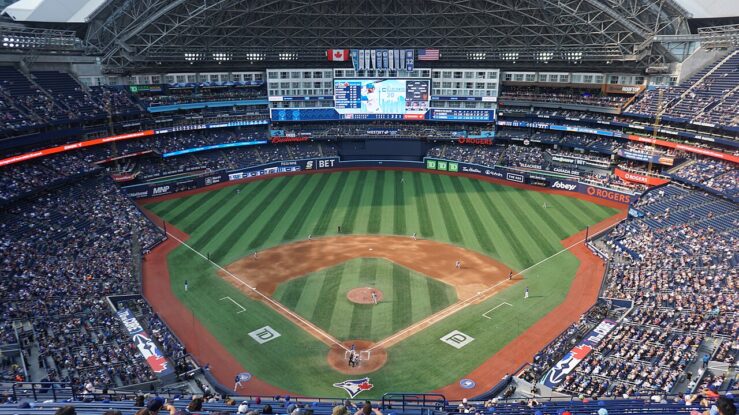
A Record Set Just Two Months Before the World Cup
In May 2026 — barely two months before the tournament kicked off — Toronto FC hosted Inter Miami in an MLS match, and the crowd reached 44,828. That’s higher than the stadium’s official FIFA capacity of 43,036.
| Record | Attendance | Date | Match |
|---|---|---|---|
| All-time stadium record | 44,828 | May 9, 2026 | Toronto FC vs. Inter Miami (MLS) |
| FIFA World Cup capacity | 43,036 | 2026 | Tournament configuration |
For a stadium about to host the World Cup, that kind of record — set so close to the tournament, against a high-profile MLS opponent — is exactly the sort of momentum organisers want to see. It shows the city’s appetite for big football occasions is already there, before the World Cup has even arrived.
Also Read: FIFA World Cup Champions: Complete List of All Winners From 1930 to 2022
The Full Match Schedule
| Date | Stage | Match | Notes |
|---|---|---|---|
| June 14, 2026 | Group Stage | Canada vs. Bosnia & Herzegovina | Canada’s opening match |
| June 17, 2026 | Group Stage | TBD | Group Stage |
| June 20, 2026 | Group Stage | TBD | Group Stage |
| June 23, 2026 | Group Stage | TBD | Group Stage |
| June 26, 2026 | Group Stage | TBD | Group Stage |
| July 3, 2026 | Round of 32 | TBD vs. TBD | First knockout round |
June 14, 2026, is the date Canadian football fans have been waiting for. Their national team, playing a World Cup match on home soil, in front of a sold-out crowd, with the entire country watching. For a nation that has only appeared at the World Cup a handful of times in its history, having this match — at home, in their largest city — is genuinely historic.
Five group stage matches lead into the Round of 32 on July 3, where Toronto Stadium becomes Canada’s primary knockout venue — assuming Canada progresses that far, which, as the host nation, they will be desperate to do.
Why Small Can Be Powerful
There’s a reason football fans often talk about “intimate” stadiums with real affection. When a ground is smaller, several things happen that a giant 80,000-seat bowl can’t replicate as easily.
Proximity to the pitch. In a 43,036-seat stadium, fans are simply closer to the players. The distance between the front row and the back row is much shorter than in a mega-stadium, which means the connection between crowd and game feels more direct.
Noise concentration. Sound doesn’t have as much room to escape or disperse. When a crowd this size makes noise together, it tends to feel louder and more focused than the same noise spread across a much bigger bowl.
Easier navigation. Getting in, finding your seat, getting to concessions, and getting out again is simply more manageable with 43,000 people than with 80,000.
Unified home energy. For Canada’s opening match specifically, having a smaller stadium completely packed with home supporters creates a wall-of-noise effect that can genuinely affect how visiting teams feel on the pitch.
| Factor | Effect of Smaller Capacity |
|---|---|
| Proximity to pitch | Fans closer to the action |
| Noise | Concentrated, doesn’t dissipate as easily |
| Navigation | Easier movement for fans inside the venue |
| Home advantage | More unified, intense crowd energy |
Similar Read: Atlanta Stadium | Kansas City Stadium | Houston Stadium
Canada’s Record at This Stadium
One detail that Canadian fans will take real encouragement from: the national team has a historically strong record in competitive matches played at BMO Field. The mix of an unbeaten home record, a pitch the players know well, and a crowd that will be entirely behind them gives Canada a genuine home-field advantage heading into their opener.
Playing your first match of a World Cup at home, on a pitch you’re familiar with, in a stadium where your team has rarely (if ever) lost — that’s about as good a starting position as a host nation could hope for.
Canada’s Two Venues — A Combined Story
Toronto isn’t the only Canadian city hosting World Cup matches. Vancouver’s BC Place is the other. Between the two venues, Canada is hosting a combined 13 matches across the tournament.
If both stadiums sell out for every one of those matches, the cumulative attendance across Canada’s World Cup venues would reach approximately 625,695 — a number that would represent a new benchmark for football attendance in Canadian history.
| Canadian Venue | Role |
|---|---|
| Toronto Stadium (BMO Field) | Canada’s opening match + 5 more matches |
| BC Place (Vancouver) | Additional Canadian-hosted matches |
| Combined matches | 13 |
| Potential combined attendance | ~625,695 |
For a country that has historically been seen more as a hockey nation than a football one, numbers like that tell a different story — one of a football culture that has been quietly growing for years and is about to get its biggest stage yet.
Similar Read: MetLife Stadium | AT&T Stadium | Boston Stadium | BC Place Vancouver
The Pitch and Playing Surface
BMO Field uses a hybrid grass surface — a mix of natural grass reinforced with synthetic fibres, which is increasingly common at top-level stadiums because it holds up better under heavy use while still playing like a natural pitch. For a venue hosting six matches across roughly three weeks, that durability matters. The pitch needs to look and play well in match six just as much as it did in match one.
What Makes Toronto Stadium Worth Watching
In a tournament dominated by massive American stadiums — 75,000, 80,000, even 94,000-seat venues — Toronto Stadium stands apart simply by being different. It’s smaller. It’s more intimate. And it gets to host one of the most emotionally significant matches of the entire tournament: a host nation’s World Cup opener, in their biggest city, in a stadium that has just set an attendance record of its own.
Six matches. One opener that an entire country has been waiting decades for. And an atmosphere that, despite being the smallest venue in the competition, might end up being one of the loudest, most concentrated, and most memorable of the whole tournament.