


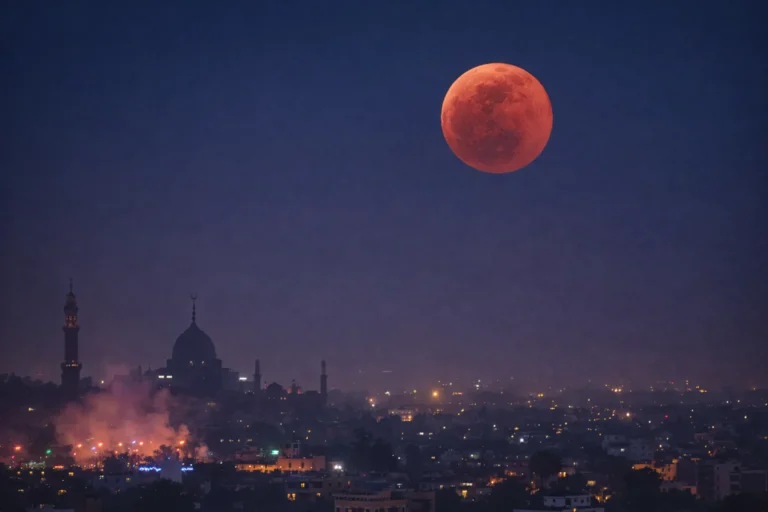
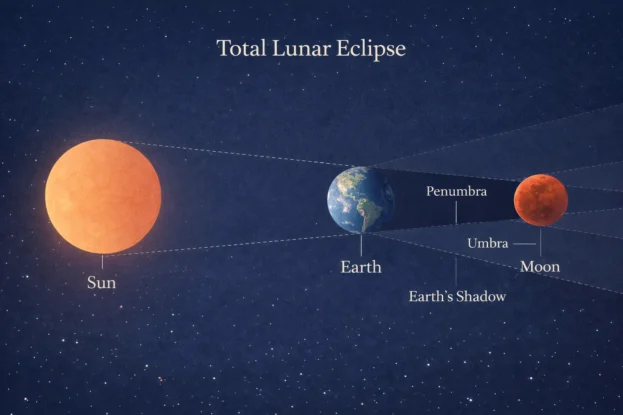
A lunar eclipse happens when the Earth comes between the Sun and the Moon, casting its shadow on the Moon’s surface. This alignment blocks direct sunlight and darkens the Moon, sometimes giving it a reddish tint called a “Blood Moon.” Total lunar eclipses are rare astronomical events visible to large parts of the world when conditions are right.
The 2026 eclipse is classified as a total lunar eclipse, meaning the Moon will move completely into Earth’s full shadow. Totality — the period when the Moon is fully covered — will last around 58 minutes during peak eclipse conditions. This celestial spectacle attracts both skywatchers and casual observers because of its striking red appearance.
Table of Contents
Date and Timing of the 2026 Eclipse
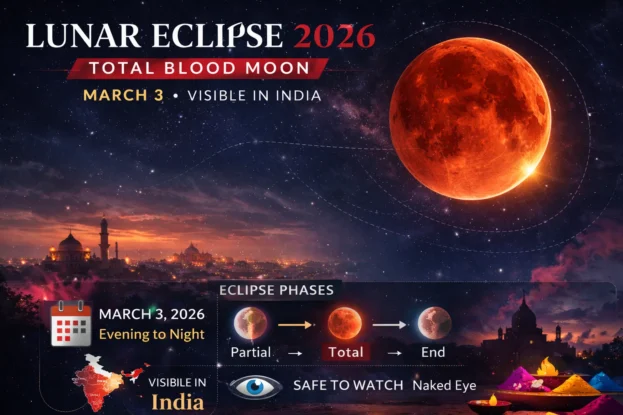
The total lunar eclipse in 2026 will occur on March 3, coinciding with the Hindu festival of Holi in India. On this day, the full Moon’s alignment with Earth’s shadow will create the dramatic eclipse effect visible after sunset in many parts of the country.
According to astronomical data, the penumbral phase begins in the late evening, and the total phase takes place around early night hours in India. While exact local times vary by location, observers can expect the Moon to begin entering Earth’s shadow around late afternoon to early evening before rising in the sky during totality.
How and Where to Watch in India
Across India, the eclipse will be visible shortly after the Moon rises in the eastern sky. In many states, the Moon will begin rising already in partial or total eclipse, making it an excellent viewing opportunity for skywatchers.
Regions in the northeast like Assam, Arunachal Pradesh, and Mizoram will likely see the total eclipse as the Moon rises, while most other parts of the country will witness partial views when the Moon has already moved into Earth’s shadow.
Cities such as Kolkata, Shillong, Dibrugarh, and Itanagar are expected to offer clearer views of the red Moon during totality. However, in western parts of India, only the later stages may be visible as the eclipse will be underway before moonrise.
Why the Moon Turns Red
During a total lunar eclipse, the Earth’s atmosphere bends sunlight into the shadowed area. This refracted light is mostly reddish, which gives the Moon its deep hue during totality.
This effect occurs because shorter wavelengths of light — such as blue — scatter more easily in Earth’s atmosphere, leaving longer red wavelengths to illuminate the Moon’s surface. Astronomers refer to this striking coppery appearance as the Blood Moon effect.
Eclipse Visibility and Moonrise
In most of India, the eclipse will be underway as the Moon rises above the horizon. This means people may see the Moon already partially or fully darkened when it appears.
Eastern and northeastern states will have the advantage of seeing a larger portion of the event. Western regions may only witness part of the eclipse because the Moon rises later and the total shadow event may already be ending.
Cultural Significance and Holi
The timing of the lunar eclipse alongside Holi — a major Indian festival celebrated on the full Moon — adds cultural significance to this event. Traditionally, eclipses in Indian culture are days of interest and reflection, often observed with specific customs or rituals.
In some regions, people may adjust traditional activities such as Holika Dahan — the ceremonial bonfire — based on the eclipse timings and associated Sutak period, a time considered inauspicious before and during the eclipse.
Sutak and Traditional Beliefs
In Hindu tradition, a lunar eclipse is often associated with the Sutak period, which starts several hours before the eclipse. During this time, people may follow certain cultural practices, avoid food preparation, and refrain from specific activities until the eclipse passes.
While scientific explanations for these beliefs differ, the cultural importance of lunar eclipses has persisted in many communities across India for centuries.
Viewing Safety and Tips
Unlike solar eclipses, lunar eclipses are completely safe to watch with the naked eye, and no special protective glasses are needed. Skywatchers only need clear skies and a good view of the eastern horizon shortly after sunset to enjoy the event.
For better observation, find a location with minimal light pollution. Higher elevations and open fields or rooftops often provide clearer views of the Moon’s ascent during totality.
Also Read: HPV Vaccination Drive in India: What It Means for Cervical Cancer Prevention
Scientific Interest and Observation
Total lunar eclipses are valuable for both amateur and professional astronomers. They offer opportunities to study Earth’s shadow, atmospheric effects on light, and even lunar surface reflectivity.
For students and educators, the 2026 eclipse provides a hands-on learning moment to explore celestial mechanics and understand how Earth, the Sun, and the Moon interact during such rare events.
The Global Context
While India will see only parts of the eclipse, other regions around the world — including the Pacific, parts of East Asia, Australia, and the Americas — will witness this total lunar eclipse in full. This wide visibility makes the March 3 event significant for global skywatchers.
Astronomers note this eclipse will be the last total lunar eclipse visible for nearly three years until another occurs near the end of 2028. This adds to the event’s importance for long-term observers.
What to Expect on the Night of March 3
Skywatchers should step outside after sunset and look toward the eastern horizon. If skies are clear, the reddish glow of the Moon will emerge, creating a memorable scene against the twilight sky.
Whether captured through photography or simply enjoyed with the naked eye, the 2026 lunar eclipse promises a stunning natural display visible to millions across India and around the world.