


Starting a business is hard. But starting one in the wrong sector — when investors simply aren’t interested in that space — makes it even harder. In India’s startup world, 2026 looks very different from five years ago. Investors have gotten more careful, more selective, and honestly, smarter about where they put their money.
The good news? There are seven sectors right now where venture capital is flowing steadily, and if your startup idea fits into any of them, you’re starting from a much stronger position. Investors are no longer chasing growth for growth’s sake; they want startups that show execution ability, deep industry understanding, and clear paths to profitability.
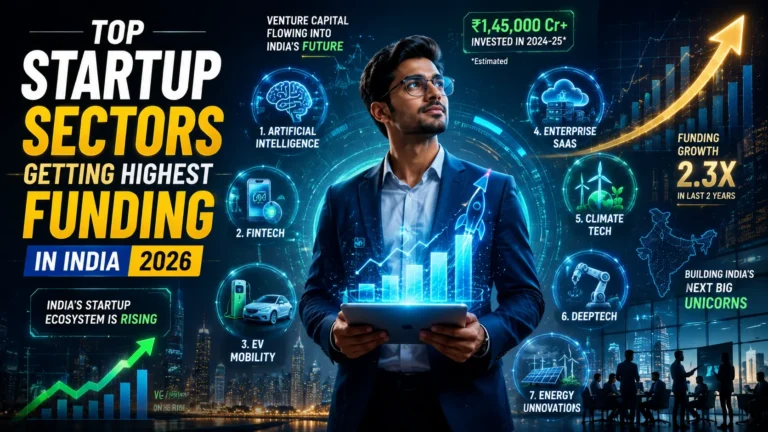
Top 7 Startup Sectors Getting Highest Funding in India 2026
India’s startup funding has shifted decisively toward sectors that solve real-world problems with scalable, sustainable business models. The startup sectors with highest funding in India right now are:
- Artificial Intelligence (AI)
- Climate Tech
- Fintech
- EV Mobility
- Enterprise SaaS
- Deeptech
- Energy Innovation
These sectors are emerging as the top recipients of VC money, driven by India’s digital transformation, sustainability goals, and the maturing startup ecosystem.
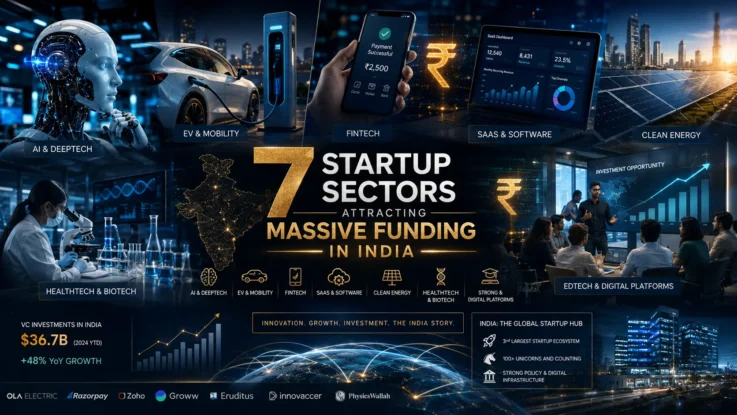
1. Artificial Intelligence (AI)
Let’s start with the obvious one, because it really is as big as everyone says.
AI is the single hottest sector for startup funding in India right now. And this isn’t just about building a chatbot or slapping “AI-powered” onto your pitch deck. Investors are looking for startups that use AI to fix a real, specific problem — in healthcare, finance, logistics, education, or anywhere else.
What makes Indian AI startups particularly attractive to investors is the combination of strong engineering talent and relatively low operating costs. Indian teams can build sophisticated AI products at a fraction of what it costs in the US or Europe, and that’s a real competitive edge.
Between 2024 and 2025, generative AI funding in the SaaS space alone rose roughly 1.5 times. The focus in India has been on applications and platforms — tools that businesses can actually use — rather than the expensive foundational model race happening in the West.
If you’re building something AI-based, make sure you can answer two questions clearly: what specific problem does this solve, and why does AI make the solution better? If you can answer both well, you’re in a good spot.
Also Read: Best Stocks to Buy This Month
Also Read: New Insurance for Bike Owners
2. Climate Tech
This one is growing faster than most people realise.
Climate tech covers a wide range — renewable energy, carbon tracking, energy storage, EV charging infrastructure, smart grids, water management, and industrial emissions monitoring. What ties it all together is the push toward sustainability, both from the Indian government and from global investors who are under pressure to fund ESG-compliant companies.
India has made serious commitments around net-zero targets, and that creates real policy support for climate-focused startups. Investors see this as a long-term play — not a quick flip, but a sector where the tailwinds are structural and durable.
If you’re building in climate tech, your pitch needs to show two things: that your solution actually works at scale, and that your business model makes financial sense, not just environmental sense.
3. Fintech
Fintech has been a favourite for years, and it’s still attracting serious money in 2026.
The reason is simple — India has hundreds of millions of people who are either unbanked or underserved by traditional financial institutions. UPI changed the game for digital payments, but there’s still enormous room to grow in lending, insurance, wealth management, and neobanking.
That said, investors have become more disciplined here. The early days of “grow fast and worry about profits later” are mostly over. What they want now is solid unit economics, regulatory compliance, and a clear story around financial inclusion — not just a slick app targeting urban millennials.
If your fintech startup is solving a genuine pain point for real people — small business owners, rural consumers, first-time investors — you’ll find a willing audience among investors.
4. EV Mobility
Electric vehicles aren’t just a trend in India. They’re becoming infrastructure.
The government has pushed hard on EV adoption through incentives, subsidies, and manufacturing support. And the opportunity isn’t just in cars — two-wheelers, three-wheelers, last-mile delivery vehicles, and public transport fleets are all going electric, often faster than the car segment.
Investors are interested in the full ecosystem here: vehicle manufacturing, battery technology, charging networks, battery swapping, and fleet management software. If your startup sits anywhere in that chain and has a clear technology advantage, funding is available.
The one thing investors want to see clearly is a path to profitability. EV is capital-intensive, so you need to show that the unit economics work once you’re at scale.
5. Enterprise SaaS
Indian SaaS companies have quietly become some of the most competitive in the world.
The model works well — build a product in India, sell it globally, and enjoy the cost advantage that comes with Indian engineering talent. Enterprise SaaS now covers everything from HR tools and project management to AI-powered analytics and industry-specific workflow software.
Investors look hard at a few numbers here: annual recurring revenue (ARR), customer retention rates, and the quality of the customer base. If you have global customers, strong retention, and a product that’s hard to replace once it’s embedded in a company’s workflow, you’re telling a very fundable story.
SaaS funding in India rose about 1.2 times from 2023 to 2024, and the trend is continuing.
6. Deeptech
Deeptech is where things get more technical — and more interesting.
This sector covers semiconductors, robotics, advanced materials, quantum computing, biotech, and defence technology. It requires serious research, strong intellectual property, and longer development timelines. That’s exactly why it was historically underfunded — but that’s changing.
India’s strategic interests in manufacturing, defence, and technological self-reliance are pushing both government and private investors toward deeptech. If you have a research-backed innovation with strong IP protection and a clear industry application, you’ll find that institutional investors are increasingly paying attention to this space.
7. Energy Innovation
Closely related to climate tech, but worth its own spotlight.
Energy innovation focuses specifically on how India generates, stores, and distributes power. Solar, wind, green hydrogen, battery storage systems, grid modernisation — these are all areas where India needs to invest massively over the next decade, and startups that can contribute meaningfully are being funded for it.
The challenge here is that regulatory pathways matter a lot. Investors want to see that you understand the policy landscape, have the right partnerships, and can actually deploy your technology at scale — not just in a lab.
Also Read: 10 Best Coworking Spaces in Delhi for Startups & Freelancers
Quick Comparison: 7 Funding Magnet Startup Sectors in India
| Sector | Key Drivers | What Investors Look For |
| AI | Generative AI, automation, global demand | Real problems solved, data moats, scalability |
| Climate Tech | Net-zero goals, sustainability, policy push | Scalable, sustainable, climate impact |
| Fintech | Digital adoption, financial inclusion | Compliance, unit economics, real pain points |
| EV Mobility | EV adoption, clean transport, incentives | Tech, charging, battery, scalable operations |
| Enterprise SaaS | Global competitiveness, B2B demand | ARR, retention, global customers, AI integration |
| Deeptech | Semiconductors, robotics, defense, biotech | IP, research, long-term defensibility |
| Energy Innovation | Renewables, storage, green hydrogen | Scalability, regulation, partnerships, impact |
Key Takeaways for Startup Founders
- Focus on real problems, not hype. Investors want sustainable business models that solve actual pain points.
- Show execution ability and deep industry understanding.
- Build scalable, defensible products with clear paths to profitability.
- Align your startup with India’s long-term priorities: digital adoption, sustainability, energy transition, and technological sovereignty.
By 2026, India’s startup ecosystem is maturing, and AI, climate tech, fintech, EV mobility, enterprise SaaS, deeptech, and energy innovation are clearly the sectors attracting the highest venture capital funding.
So, What Does This Mean for You?
If you’re at the stage of choosing what kind of startup to build, this list is worth taking seriously. The sectors above aren’t just where the money is — they’re where India genuinely needs innovation, and where the problems are big enough to support large companies.
But here’s the honest truth: picking the right sector is only the starting point. What investors care about, across every single one of these seven areas, is the same thing — do you understand the problem deeply, can you execute, and does your business actually make sense financially?
Build something real. Build it in one of these spaces. And make sure you can explain it clearly to someone who doesn’t know your industry.
That’s still the best startup advice going.