



India’s automobile industry is gradually preparing for a future where cleaner fuels play a larger role. While electric vehicles continue to gain attention, flex fuel vehicles are emerging as another practical solution for reducing emissions and lowering dependence on conventional fossil fuels.
Flex fuel cars are designed to run on different blends of petrol and ethanol. Depending on the vehicle, they can support blends ranging from E20 and E85 to even E100 in some cases. With the government actively promoting ethanol usage and fuel infrastructure improving across the country, several automakers are preparing flex fuel models for India.
Maruti Suzuki has already taken the first major step by introducing the production-ready Wagon R Flex Fuel. However, several other manufacturers have showcased ethanol-compatible vehicles that could reach Indian showrooms in the near future.
What Are Flex Fuel Cars?
A flex fuel vehicle is equipped with a specially modified engine that can automatically adapt to different ethanol-petrol blends. These vehicles use upgraded fuel systems, ethanol sensors, recalibrated engine control units, and corrosion-resistant components to handle higher ethanol content.
Since ethanol is primarily produced from agricultural sources such as sugarcane, it helps reduce crude oil imports and supports local farming industries. It also contributes to lower carbon emissions compared to conventional petrol.
Top 5 Upcoming Flex Fuel Cars in India
| Model | Fuel Compatibility | Expected Price |
|---|---|---|
| Maruti Suzuki Wagon R Flex Fuel | E20 to E100 | ₹5-7 Lakh |
| Toyota Innova Hycross Flex Fuel | Up to E85 | ₹20-25 Lakh |
| Hyundai Creta Flex Fuel | E0 to E100 | ₹14-20 Lakh |
| Tata Punch Flex Fuel | E85 to E100 | ₹7-9 Lakh |
| Maruti Suzuki Fronx Flex Fuel | E20 to E85 | ₹9-10 Lakh |
1. Maruti Suzuki Wagon R Flex Fuel
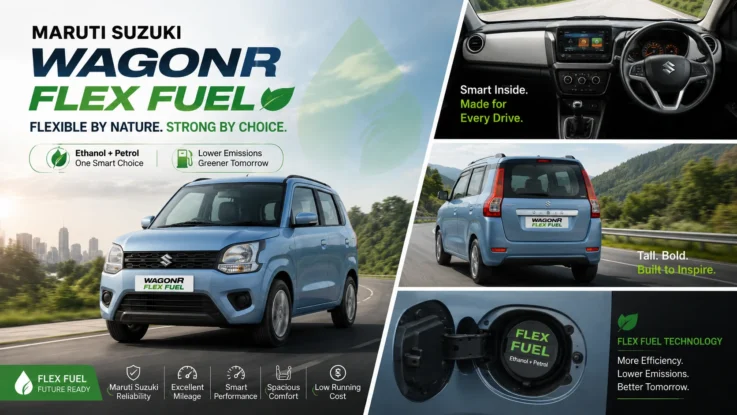
The Maruti Suzuki Wagon R Flex Fuel is currently the most significant flex fuel vehicle in India. It has become the country’s first mass-produced flex fuel passenger vehicle and marks an important milestone in India’s transition toward alternative fuels.
The vehicle uses the familiar 1.2-litre petrol engine found in the standard Wagon R. However, the powertrain has received several modifications, including upgraded fuel injectors, revised fuel pumps, ethanol-resistant fuel lines, an ethanol sensor, and a recalibrated ECU.
Although the vehicle can technically operate on E100 fuel, it has been homologated for E85 fuel usage. At present, the Wagon R Flex Fuel is available only for commercial applications, but it demonstrates Maruti Suzuki’s readiness for future ethanol-powered mobility.
Key Highlights
- 1.2-litre petrol engine
- Supports E20 to E100 fuel blends
- E85 homologation
- Ethanol sensor and upgraded fuel system
- First production-ready flex fuel passenger vehicle in India
2. Toyota Innova Hycross Flex Fuel
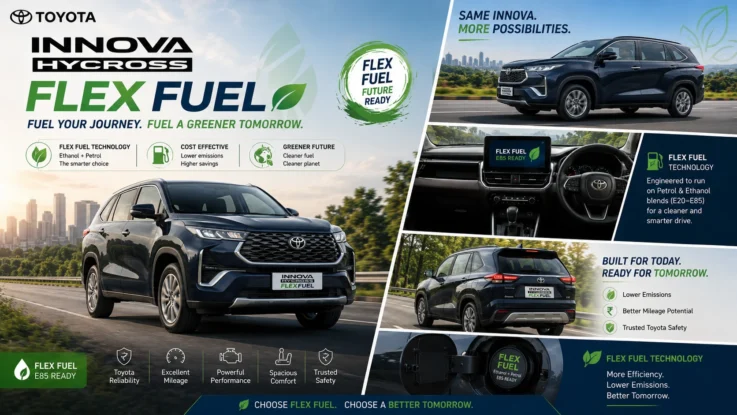
Toyota has been one of the strongest supporters of alternative fuel technologies globally. The company showcased the Innova Hycross Flex Fuel prototype in India and attracted considerable attention.
The vehicle combines Toyota’s strong hybrid technology with ethanol compatibility. Based on the standard Innova Hycross, it uses a 2.0-litre Atkinson-cycle petrol engine paired with an electric motor.
To support ethanol fuel, Toyota has modified various engine components, including spark plugs, piston rings, valves, fuel pumps, and fuel lines. The prototype can operate on ethanol blends of up to E85.
One of the biggest advantages of this setup is that the vehicle can spend a significant amount of time in electric mode, helping improve fuel efficiency while reducing emissions.
Key Highlights
- 2.0-litre strong hybrid powertrain
- Compatible with E85 fuel
- Hybrid and flex fuel combination
- Enhanced fuel system and engine components
- Expected price between ₹20 lakh and ₹25 lakh
3. Hyundai Creta Flex Fuel
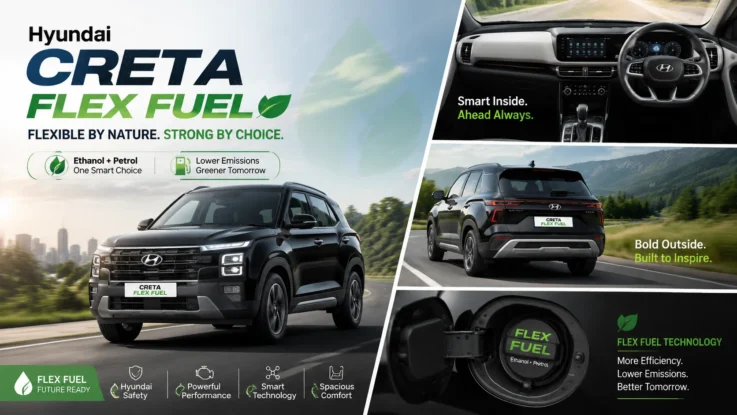
Hyundai surprised many visitors at the Bharat Mobility Global Expo 2025 by unveiling the Creta Flex Fuel. The SUV is already available in ethanol-friendly markets overseas, making India a natural next destination.
Unlike the standard Indian Creta that uses 1.5-litre petrol engines, the flex fuel version employs Hyundai’s 1.0-litre turbocharged petrol engine. This powertrain has been specially tuned to support ethanol blends ranging from E0 to E100.
The engine produces around 120 PS and 172 Nm of torque and is paired with a 6-speed torque converter automatic transmission. Hyundai has retained the SUV’s premium positioning, ensuring buyers continue to enjoy modern features and safety technologies.
Key Highlights
- 1.0-litre turbo petrol engine
- Supports E100 fuel
- 120 PS power output
- 6-speed automatic transmission
- Premium SUV features retained
4. Tata Punch Flex Fuel
Tata Motors entered the flex fuel segment by showcasing the Punch Flex Fuel at the Bharat Mobility Expo. The company used its popular micro SUV platform to demonstrate ethanol compatibility.
The Punch Flex Fuel continues with the familiar 1.2-litre petrol engine. However, the powertrain has received software and hardware upgrades to handle higher ethanol blends effectively.
Changes include revised ECU programming and modified fuel injectors. The SUV can support ethanol blends ranging from E85 to E100, depending on the final production specification.
Since the Punch already enjoys strong popularity among Indian buyers, a flex fuel version could attract environmentally conscious customers looking for an affordable alternative.

Key Highlights
- 1.2-litre Revotron petrol engine
- Supports E85 and potentially E100 fuel
- Manual and AMT compatibility possible
- High ground clearance
- Expected pricing between ₹7 lakh and ₹9 lakh
5. Maruti Suzuki Fronx Flex Fuel
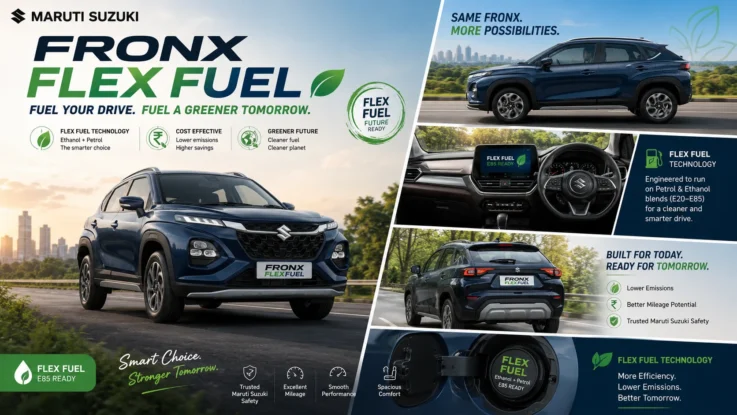
Maruti Suzuki appears committed to expanding its flex fuel portfolio beyond the Wagon R. The company showcased the Fronx Flex Fuel concept at the Japan Mobility Show and is expected to bring the model closer to production in the coming years.
The vehicle is expected to use a modified version of the 1.2-litre K-Series petrol engine. While performance figures are likely to remain close to the standard model, the engine will be capable of handling higher ethanol blends.
Apart from flex fuel-specific badging, the overall design and feature list are expected to remain largely unchanged. This approach could make the Fronx Flex Fuel one of the most accessible ethanol-ready SUVs in India.
Key Highlights
- Modified 1.2-litre K-Series petrol engine
- Supports E20 to E85 fuel blends
- Similar performance to standard Fronx
- Compact SUV practicality
- Expected price around ₹9 lakh to ₹10 lakh
Also Read: Flex-Fuel Vehicles in India — Here’s What That Could Actually Mean for You
Why Flex Fuel Cars Could Become More Popular in India
The government’s push for ethanol blending has already accelerated adoption across the fuel industry. India has achieved its E20 target ahead of schedule, and future plans may include higher ethanol percentages.
As fuel infrastructure expands and E85 dispensing stations become more common, automakers will find it easier to launch flex fuel vehicles across different segments.
For consumers, flex fuel cars offer a familiar driving experience without the charging concerns associated with electric vehicles. They provide a practical middle ground between conventional petrol vehicles and fully electric mobility.
Similar Reads:
What Buyers Should Watch For
The next few years could be crucial for flex fuel technology in India. Models like the Wagon R, Innova Hycross, Creta, Punch, and Fronx have already demonstrated that major manufacturers are investing in ethanol-ready powertrains.
As fuel availability improves and production costs come down, Indian buyers may soon have several flex fuel options across hatchback, SUV, and MPV categories. This could create an entirely new segment focused on cleaner mobility while maintaining the convenience of traditional refuelling.