


Most of us are carrying more stress than we realize. Work deadlines, family pressure, news cycles that never stop — it adds up. And at some point, your body starts keeping score. Sleep gets worse, your mood takes a hit, and your blood pressure creeps up. You know something needs to change, but you are not sure what.
Meditation keeps coming up as an answer, and honestly, the science behind it has become hard to ignore. We are not talking about mystical promises or influencer wellness trends. Researchers have been studying meditation seriously for decades now, and the findings are pretty compelling. Here are 10 benefits of meditation — for your brain, your body, and your everyday life.
Table of Contents
10 Benefits of Meditation for Mind and Body Backed by Science
1. It Genuinely Lowers Stress
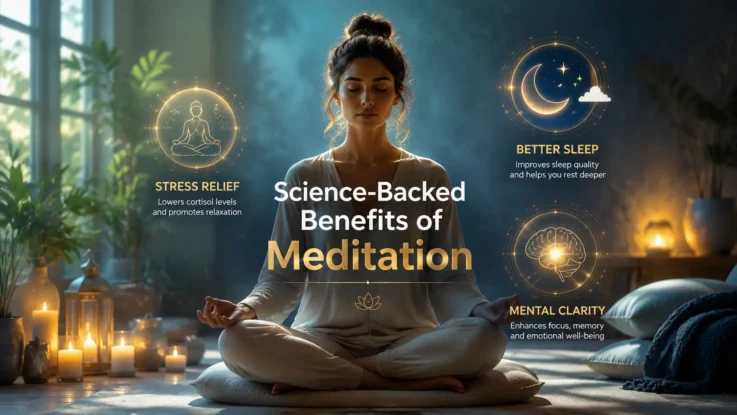
This is the big one, and it is the reason most people try meditation in the first place. Research on mindfulness-based stress reduction, published in 2017, found that the practice reduces the tendency to ruminate — that exhausting loop of negative thoughts that your brain gets stuck in when you are overwhelmed.
What meditation essentially does is shift your brain from a narrative mode (where you are replaying everything that went wrong today) to a sensory mode (where you are simply noticing what is happening right now). That shift alone can break the cycle of chronic stress in a meaningful way.
2. It Helps with Anxiety
If you struggle with anxiety — particularly social anxiety — meditation has shown real results. Breath-focused meditation, in particular, has been found to reduce activity in the amygdala, which is the part of your brain responsible for triggering fear and panic responses.
At the same time, it strengthens the areas of the brain linked to attention and calm decision-making. Think of it as gradually turning down the volume on your internal alarm system while turning up your ability to think clearly.
3. It Improves Your Emotional Health
Emotional regulation — the ability to manage how you respond to difficult feelings — is something a lot of us struggle with without even realising it. Meditation builds this skill over time.
Clinical evidence suggests that mindfulness-based techniques help people develop something called cognitive reappraisal — essentially, the ability to step back from a situation and see it differently before reacting. This has been shown to reduce symptoms of major depression and improve overall emotional resilience.
4. Your Attention Span Gets Longer
In a world full of notifications, short videos, and endless scrolling, our attention spans have taken a serious beating. Meditation is basically a workout for your focus. A 2018 study found that long-term practitioners show meaningful improvements in attention, memory, and how quickly they can process information.
Even short-term programs showed some improvement in mental performance. The key, as with most good habits, is consistency. The longer you stick with it, the more noticeable the changes become.
5. It Can Make You More Compassionate
There is a specific type of meditation called loving-kindness meditation (LKM), and it is exactly what it sounds like. You direct warmth and good wishes toward yourself and others — including people you find difficult. It sounds a bit soft, but the brain science behind it is interesting.
Research shows that LKM increases activation in brain areas linked to empathy and emotional processing. It also reduces negative emotions over time. Basically, it makes you a slightly better person to be around — and that is never a bad thing.
6. It May Help Fight Addiction
Addiction is partly about impulse control — the gap between the urge to do something and the decision to act on it. Meditation widens that gap. It builds mental discipline and increases awareness of the triggers that pull you toward addictive behaviour.
In a 2018 study that followed 60 people being treated for alcohol use disorder, those who practised Transcendental Meditation for three months reported less stress, fewer alcohol cravings, and lower overall alcohol use. These are not tiny numbers — that is a meaningful change in a relatively short period.
7. Better Sleep — Finally
If you lie awake at night with your mind racing through tomorrow’s to-do list, you are not alone. Millions of people struggle to wind down properly at the end of the day. Meditation addresses this directly.
A 2014 study found that meditation promotes a state of physical and mental calm that helps your body shift into rest-and-digest mode — which is exactly what you need for deep, restorative sleep. It is not a sleeping pill, but for many people dealing with mild to moderate insomnia, a consistent meditation practice can make a real difference.
8. It Can Reduce Chronic Pain
This one surprises a lot of people. Meditation does not make pain disappear, but it changes your relationship with it. In both clinical and experimental settings, mindfulness meditation has been shown to significantly reduce how intensely people experience chronic pain.
It works in two ways: it activates the body’s natural pain-relieving processes, and it reduces the emotional stress that tends to amplify physical discomfort. Pain researchers now widely accept that what happens in the mind has a direct effect on how the body feels pain.
9. It Can Lower Your Blood Pressure
High blood pressure puts strain on your heart and increases the risk of serious conditions over time. A 2015 meta-analysis that looked at 12 separate studies found that meditation can help lower blood pressure by reducing the body’s stress response and promoting overall relaxation.
It is not a replacement for medical treatment, and if you have been diagnosed with hypertension, you should absolutely follow your doctor’s advice. But as a complementary habit, meditation is one of the gentlest and most accessible tools available for supporting cardiovascular health.
10. You Can Do It Anywhere — No Equipment, No Cost
This might sound like a small thing, but it is actually one of the most important. Most health interventions cost money, require equipment, or need a specific environment. Meditation needs none of that.
Body scan meditation, breathing exercises, walking meditation — these can be done on your lunch break, on a train, in your car before you walk into the office, or in your bedroom before you go to sleep. Five minutes is enough to start. You do not need a cushion, a studio, or a subscription.
Also Read: Amazing Benefits of Having Dogs Around your Kids
So, Where Do You Start?
The honest answer is: anywhere. Pick one benefit from the list above that resonates with you — maybe it is sleep, maybe it is anxiety, maybe it is just the idea of having five quiet minutes to yourself — and start there.
You do not need to meditate for an hour every morning. Research suggests that even short, consistent sessions over a few weeks can produce real, measurable changes in how your brain and body function. The hardest part is simply starting.
And if you have a health condition that you are managing — heart disease, chronic pain, mental health concerns — it is always worth speaking to your doctor before adding anything new to your routine, including meditation.