


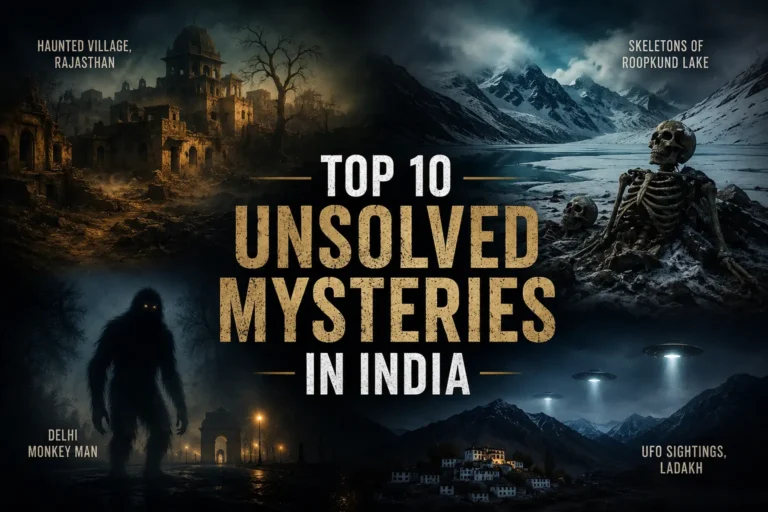
Every country has its share of unexplained events and historical gaps. But India — with its layered civilizations, vast geography, and the sheer density of things that have happened here over thousands of years — seems to produce mysteries with an unusual depth to them. Stories that start with one question and keep opening into more.
A lake full of skeletons from three different centuries. A village abandoned overnight with a curse. A serial killer nobody ever caught. India’s unsolved stories are genuinely extraordinary. Some have theories that most experts accept without fully proving. Some have nothing — just the event itself, still sitting there, unresolved. All of them are worth knowing about.
Table of Contents
Top 10 Unsolved Mysteries in India You Should Know About
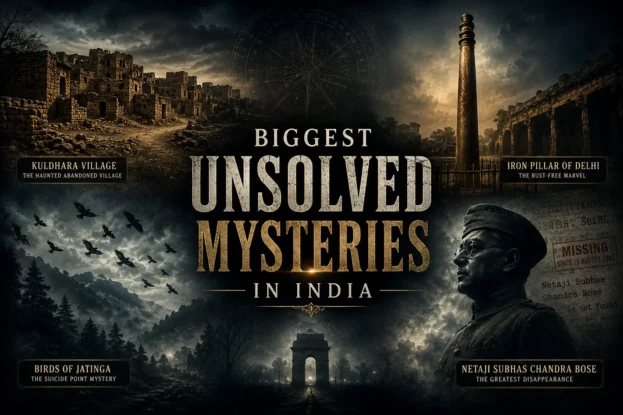
1. The Disappearance of Netaji Subhas Chandra Bose
The official version is straightforward: Subhas Chandra Bose died in a plane crash in Taiwan on August 18, 1945. End of story.
Except it never really became the end of the story for a significant portion of the Indian public, and the skepticism isn’t entirely irrational. There were no independent witnesses who could confirm the crash. Classified documents from that period took decades to be partially released, and some remain sealed. Multiple government inquiries — the Shahnawaz Committee, the Khosla Commission, the Mukherjee Commission — reached different conclusions.
The Mukherjee Commission, as recently as 2005, found that the ashes in the Renkoji Temple in Japan (officially identified as Bose’s) were not his. The Indian government rejected that finding. Meanwhile, across the decades, there were regular reported sightings of Netaji living in various parts of India under different identities.
Was he alive after 1945? Almost certainly not — the evidence for survival becomes implausible at a certain point. But the specific question of exactly what happened that August, and why the documentation remained so murky for so long, still doesn’t have a fully satisfying answer.
2. Roopkund’s Skeletons Get Stranger the More You Study Them
Roopkund Lake sits at about 5,000 meters in the Himalayan range in Uttarakhand. It’s remote, frozen most of the year, and not somewhere you’d expect to find human remains. And yet when the ice melts in warmer months, hundreds of human skeletons emerge from the lake and its surrounding area.
The first explanation — that they were soldiers or pilgrims who died in a catastrophic hailstorm centuries ago — seemed reasonable when it was proposed. The bones showed blunt trauma consistent with being struck from above, and ancient Indian texts describe a hailstorm that killed a large party of pilgrims in the mountains.
Then DNA analysis complicated everything. The skeletons don’t belong to one group from one time period. They appear to come from at least three distinct populations, separated by centuries. One group has ancestry consistent with South Asia. Another has genetic markers pointing to the eastern Mediterranean — Greece, Crete, that region.
What Mediterranean people were doing at a remote Himalayan lake, how they got there, and what killed them remains entirely unresolved. The more answers science has provided about Roopkund, the stranger the questions have become.
3. Kuldhara — The Village That Left Overnight and Never Came Back
About 20 kilometers from Jaisalmer in Rajasthan, Kuldhara sits empty. It has sat empty since the early 1800s. The houses are intact in many places — roofless now, but structurally present — suggesting the people who lived there left in a hurry rather than dismantling their homes over time.
The popular story is that the village’s residents — and those of around 84 surrounding settlements — all abandoned their homes in a single night to escape a powerful and corrupt minister who had designs on the daughter of a prominent family. Before leaving, the story goes, they cursed the land so that no one who settled there afterward would prosper.
Historians tend to be more interested in the practical explanations: water scarcity in an already arid region, economic pressures, and political instability. Any of those could explain a mass exodus.
What neither explanation fully addresses is why the land has remained unoccupied. Rajasthan isn’t short of people looking for land to settle on. Whatever happened in Kuldhara, something about the place has kept it empty for over two centuries.
4. Kodinhi Has Far Too Many Twins and Nobody Can Explain It
Kodinhi is a small village in Kerala’s Malappuram district with a few thousand families and, by recent counts, over 400 pairs of twins. The twinning rate here is multiple times higher than the global average — some estimates put it at six times higher or more.
This has been studied seriously. Researchers have looked at genetics, diet, water sources, and environmental factors. The honest conclusion from the scientific literature is that nobody has yet identified a definitive cause.
Some researchers note that the twinning rate appears to be increasing over generations rather than declining, which makes a simple genetic explanation harder to sustain — you’d expect the trait to dilute over time as people marry into families from outside the village. The fact that it seems to be intensifying suggests something else is at play, but what that something is remains genuinely open.
5. Every Year in Jatinga, Birds Fly Into Things and Die
In the village of Jatinga in Assam, during the months of September through November, something strange happens on foggy nights. Birds — many species, not just one — fly erratically toward artificial lights and crash into buildings, trees, and other structures in large numbers. Many die.
For generations, locals interpreted this as the birds being drawn down from the sky by supernatural forces. The modern scientific explanation involves fog, specific wind patterns, and the way artificial light disorients migrating birds under certain atmospheric conditions.
The problem is that disorientation by artificial light is a documented phenomenon that happens in many parts of the world. What doesn’t happen elsewhere is birds behaving this specific way, in this specific pattern, only in this specific geographic area. The localization of the phenomenon to Jatinga is what ornithologists and meteorologists haven’t been able to fully account for.
6. Delhi’s Iron Pillar Has Been Standing for 1,600 Years Without Rusting
In the courtyard of the Qutb complex in Delhi stands an iron pillar approximately seven meters tall that was forged sometime around the 4th or 5th century CE. It has been standing in open air, exposed to Delhi’s weather including monsoon humidity, for over sixteen centuries. It has not rusted.
Metallurgical analysis has identified high phosphorus content in the iron as a significant factor — the phosphorus creates a protective film on the surface that resists corrosion in a way that modern iron typically doesn’t. The specific smelting techniques used would have produced this almost accidentally as a byproduct of the process available at the time.
So science has an explanation. What it can’t fully account for is why the craftsmen of that era were able to produce iron of this quality and consistency at a time when the metallurgical knowledge required shouldn’t, theoretically, have existed in quite that form. The pillar isn’t inexplicable — but it is genuinely impressive in ways that are hard to fully rationalize.
7. The Sightings at Kongka La Pass Keep Coming
Kongka La Pass sits in Ladakh near the Line of Actual Control with China — one of the most restricted and least-accessed areas of India. Travelers and locals on both sides of the border have, for decades, reported seeing unusual lights and objects in the sky that don’t behave like conventional aircraft.
The military activity explanation is the rational first stop. Both India and China operate extensively in the region, and experimental aircraft or drones in restricted airspace would reasonably produce unexplained aerial phenomena. The atmospheric conditions at high altitude — temperature inversions, unusual light refraction — can also create convincing visual illusions.
But the reports have continued consistently across different observers, different time periods, and different vantage points in a way that makes pure atmospheric explanation slightly less satisfying than it sounds. The remoteness and military sensitivity of the area also means independent investigation is essentially impossible.
8. The Delhi Monkey Man That Nobody Ever Found
In May 2001, Delhi experienced one of the stranger episodes of mass panic in recent Indian history. Reports began circulating of a creature — described variously as four feet tall, covered in hair, with glowing red eyes and metal claws — attacking people in their sleep in working-class neighborhoods.
The panic was real and had real consequences. People fell from rooftops trying to escape in the dark. Crowds attacked random individuals suspected of being the creature. Police received hundreds of complaints. Multiple eyewitnesses gave consistent descriptions despite not knowing each other.
The official explanation — mass hysteria — is almost certainly correct. The specific conditions of summer heat, power cuts, crowded sleeping arrangements, and rumor spreading through densely populated neighborhoods created exactly the kind of environment where collective fear can generate consistent false perceptions.
But mass hysteria explanations, while scientifically sound, don’t explain the initial trigger. Something started the rumor. Nobody ever identified what.
9. Emperor Ashoka’s Nine Unknown Men
This one sits clearly in the territory of legend rather than documented history, but it’s such an enduring and specifically interesting legend that it belongs on any list of Indian mysteries.
The story goes that after the devastating Kalinga War, Emperor Ashoka — horrified by the scale of the violence he’d caused — assembled a secret society of nine men, each tasked with preserving and protecting a specific area of dangerous knowledge: propaganda, physiology, microbiology, alchemy, communication, gravity, cosmogony, light, and sociology. The idea was that this knowledge was too powerful to be shared publicly and needed to be protected from misuse across generations.
There’s no historical evidence this group existed. But the legend has persisted for centuries, inspired Western writers including Talbot Mundy whose 1923 novel popularized it internationally, and continues to attract people who find the idea — a secret society of scholars protecting dangerous knowledge — deeply compelling.
What makes it interesting as a mystery isn’t whether it’s true (it almost certainly isn’t in any literal sense) but why the idea has stayed alive for so long and what it says about how people have always thought about the relationship between knowledge and power.
10. The Stoneman Murders Were Never Solved
Between 1983 and 1987, a series of murders in Mumbai killed at least twelve homeless people sleeping on the streets. The method was consistent: a heavy stone, typically a paving slab, brought down on the head of a sleeping victim. The killer — or killers — was never identified, never charged, and never caught.
What made the case particularly disturbing was the specificity of targeting. The victims were all homeless men sleeping in the open. There was no apparent robbery motive, no obvious connection between victims. The selection seemed almost random except for the shared vulnerability of people with nowhere safer to sleep.
A similar series of murders appeared in Kolkata in the same period, attributed to a copycat or possibly the same perpetrator operating in both cities. Neither case was ever closed.
Cold cases from the 1980s rarely get solved at this point. But the Stoneman murders remain in Indian crime history specifically because of the combination of their brutality, their apparent randomness, and the absolute absence of any resolution — no suspects, no arrests, no closure for the families of the victims.
Also Read: Tamil Nadu Government Formation: Will Thalapathy Vijay Take Oath as CM Today?
Why These Stories Don’t Go Away
The easy answer is that people like mysteries, and that’s true. But the more honest answer is that these specific cases endure because they resist the clean resolution that makes a story feel finished.
The Roopkund skeletons shouldn’t be there. The Kuldhara exodus shouldn’t have left no trace of where the villagers went. Netaji’s death shouldn’t have generated decades of classified documents. The Stoneman should have been caught.
Each of these mysteries sits at the intersection of the knowable and the not-yet-known — close enough to understanding that researchers keep trying, far enough away that they keep failing. That gap is where the fascination lives.