


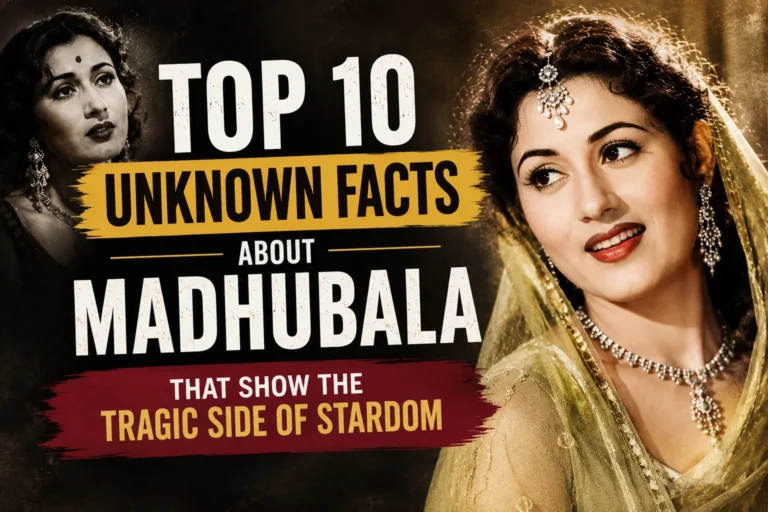
When people talk about Madhubala, they usually start with the beauty. The eyes. The smile. The way she looked on screen in Mughal-e-Azam, like she had been placed there by someone who understood exactly what cinema was for.
All of that is real and worth celebrating. But the full story of who she was — where she came from, what she carried, what she sacrificed, and how short her life actually was — is considerably more complicated and considerably more moving than the image suggests.
She was born Mumtaz Jehan Begum Dehlavi in 1933. She died in 1969, aged 36. In between, she fit in more life, more work, more heartbreak, and more quiet courage than most people manage in twice the years. Here are ten things about her that most people don’t know — or don’t know fully.
Table of Contents
10 Unknown Facts About Madhubala That Reveal Her Tragic Life
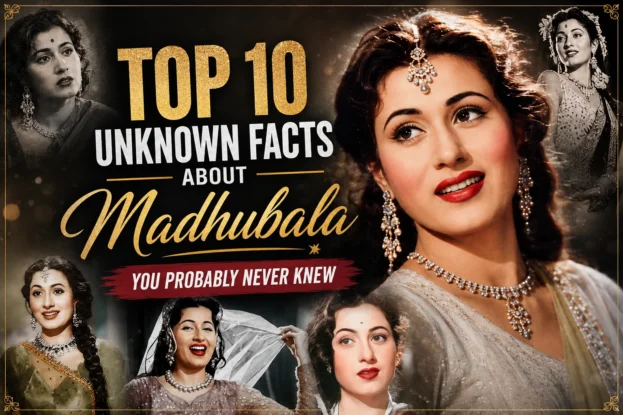
1. She Started Working at Nine Because Her Family Had No Choice
Madhubala made her film debut as Baby Mumtaz at the age of nine. This wasn’t an ambitious stage parent’s decision or a child prodigy chasing fame — it was economic necessity, plain and simple.
Her father had lost his job, and the family was in serious financial difficulty. She was one of several siblings, and the young girl who would one day be compared to Marilyn Monroe began her film career not for glamour but to help keep food on the table.
By the time she was a teenager, she was effectively the family’s primary earner. That responsibility never really left her — her father remained a controlling presence in her professional and personal life throughout her career, a fact that shaped many of the painful chapters that came later.
2. Her Real Name Was Mumtaz Jehan Begum Dehlavi
Mumtaz Jehan Begum Dehlavi became Madhubala at the suggestion of Devika Rani — one of the foundational figures of early Indian cinema, an actress and producer who helped shape Bollywood in its earliest decades.
The name Madhubala means something like “honey girl” or “sweet one” in Hindi — soft, feminine, memorable. It suited her perfectly and became one of the most recognized names in Indian film history.
She was still Baby Mumtaz to people who knew her from childhood, but to the rest of India, she would only ever be Madhubala.
3. She Never Went to School
This is the fact that tends to surprise people most, given how poised and articulate she came across in every public interaction.
Because of her early entry into films and the strict rules her father kept over her life, Madhubala never received any formal education. No school, no teachers, no childhood in the conventional sense.
She taught herself English later in her career with help from journalists and people she trusted in the film industry. She was already fluent in Urdu and Hindi — languages she’d absorbed naturally — and carried herself with a grace and intelligence that had nothing to do with classrooms. But the fact that one of Indian cinema’s greatest stars grew up without ever sitting in a school desk says something significant about the life she was given.
4. She Had a Hole in Her Heart and Nobody Knew for Years
This is probably the most heartbreaking of all the facts about Madhubala, and it’s one that reframes her entire career when you really sit with it.
She had a congenital heart defect — a Ventricular Septal Defect, which is essentially a hole between the chambers of the heart. It wasn’t diagnosed properly during her childhood. The condition went undetected while she was working in films, doing takes, attending shoots, living a physically demanding professional life.
The seriousness of it became impossible to ignore in the early 1950s when she began coughing up blood on film sets. Doctors she eventually saw in London told her she had very limited time left. She survived another nine years after that diagnosis — years in which she continued to work, to love, to suffer, and to create performances that are still being watched today.
Every time you watch her on screen, knowing this, the experience changes completely.
5. She Refused a Hollywood Offer
Frank Capra — the director behind It’s a Wonderful Life, one of the most celebrated films in American cinema history — reportedly saw Madhubala’s performance in Mahal and wanted her for a Hollywood project.
She turned it down.
The reasoning, as best as can be reconstructed from accounts of the time, was loyalty — to Indian cinema, to her audiences, to the world that had made her who she was. She was at the height of her fame and could have made a leap that very few Indian actors of that era were even offered. She chose to stay.
It’s the kind of decision that’s easy to second-guess from the outside. From the inside, knowing what she valued and where she felt she belonged, it makes complete sense.
Also Read: Sara Arjun Confirmed for Madhubala Biopic, Film Set for Direct OTT Release
6. Mahal Was the Film That Changed Everything
Before Mahal in 1949, Madhubala was a known quantity in the industry — a young actress with talent and obvious screen presence. After Mahal, she was a star.
The film came to her through an unusual path. She reportedly replaced Suraiya after director Kamal Amrohi saw something specific in Madhubala that he needed for the role. The haunting, mysterious quality she brought to that film — the ambiguity of her character, the way she inhabited the gothic atmosphere of the story — turned out to be exactly right.
The film was a massive hit. The song Aayega Aane Wala became one of the most famous pieces of film music of its era. And Madhubala became the actress that every filmmaker wanted.
7. International Audiences Compared Her to Marilyn Monroe
There was a period in the late 1940s and early 1950s when Madhubala’s name was appearing in international film publications alongside the biggest Western stars of the era. The comparison to Marilyn Monroe — glamorous, magnetic, somehow both accessible and untouchable — was one that stuck.
Among the more colorful stories that circulated in the film industry was the claim that her complexion was so luminous that the red of paan could be seen through the skin of her throat. It’s the kind of detail that probably has some truth buried in exaggeration — and it captures something real about how people perceived her physical presence, which seemed to operate by slightly different rules than normal.
8. The Love Story With Dilip Kumar That Never Became What It Should Have
Madhubala and Dilip Kumar were, by most accounts of people who knew them both, genuinely in love. They worked together on several films, including the epic Mughal-e-Azam, where the onscreen romantic tension between them draws on something that was clearly not entirely manufactured.
The relationship didn’t survive. Family pressure on both sides, the specific and complicated dynamics of her father’s control over her life, and the growing professional tension that culminated in the Naya Daur legal dispute — all of it contributed to a separation that both of them reportedly never fully made peace with.
Dilip Kumar later wrote about her in terms that made clear the loss was real and lasting. She married Kishore Kumar eventually, a relationship that had its own complications. The love story with Dilip Kumar remains one of the great what-ifs of Bollywood history.
9. The Court Case That Hurt Her in More Ways Than One
The Naya Daur controversy is the moment when several of Madhubala’s personal difficulties became very publicly intertwined.
Producer B.R. Chopra wanted to shoot outdoors in Gwalior. Madhubala’s father refused to allow it. She was replaced in the film by Vyjayanthimala. Chopra filed a court case. Dilip Kumar, as a co-star of the film, became involved in a way that further damaged his relationship with Madhubala.
The legal proceedings were extensively covered and became one of the biggest industry stories of the era. Beyond the professional damage, the episode illustrated painfully how little control Madhubala had over her own professional decisions — her father’s authority over her work was essentially absolute, regardless of what she herself might have wanted.
10. She Appeared in Only Two Color Films
For a woman whose beauty was so frequently described in terms of color — the luminosity of her skin, the radiance of her expressions — it’s a small irony that almost her entire filmography was shot in black and white.
She appeared in color in parts of Mughal-e-Azam and in Jwala. Everything else — Howrah Bridge, Mr. & Mrs. ’55, Chalti Ka Naam Gaadi, Mahal — was black and white.
And yet nobody who watches those films comes away feeling they missed something. Whatever quality she had on screen translated completely regardless of the technology capturing it. Her presence was the color.
Also Read: From Heath Ledger to Irrfan Khan: 11 Actors We Lost Too Soon
What Her Life Actually Means
Madhubala died on February 23, 1969. She was 36 years old. She had spent the last several years of her life largely confined to her bed as the heart condition that had been killing her slowly since her early twenties finally took everything it had been gradually taking for years.
She left behind a filmography that people are still discovering. A postage stamp in her honor was issued by India Post in 2008. Documentaries, retrospectives, and tributes continue to appear decades after her death.
But what stays with you, if you spend time with the actual story rather than just the legend, is how much of her life was shaped by circumstances she didn’t choose — the poverty that put her in front of cameras at nine, the heart condition she didn’t know she had, the father whose control limited her choices, the love story that couldn’t survive the pressures around it.
She made extraordinary things out of all of it. The films remain. The performances remain. The smile, preserved in black and white, remains.
That’s the real legacy — not just that she was beautiful, but that she was so fully, genuinely, heartbreakingly human.