


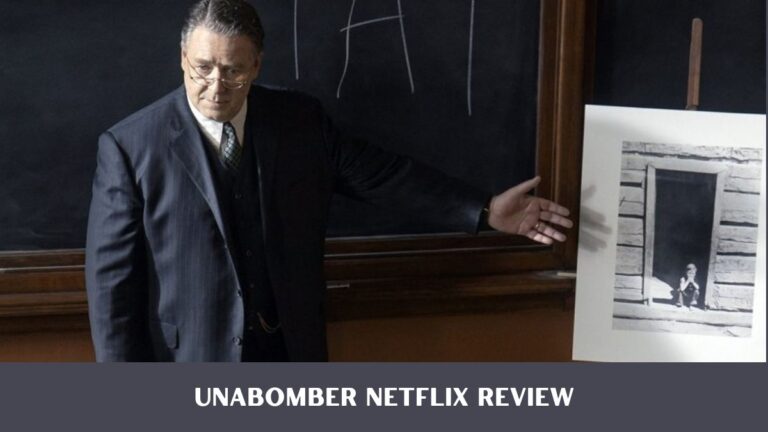
Unabomber Netflix Review: ★★☆☆☆ (2/5)
Unabomber features genuinely strong performances from Russell Crowe and Jacob Tremblay, but its attempt to explain Ted Kaczynski’s crimes through a controversial Harvard experiment feels speculative and unevenly written, especially compared to its weaker modern-day manhunt storyline.
Rating: ★★☆☆☆ (2/5)
Platform: Netflix
Genre: True Crime Drama
Director: Janus Metz
Cast: Russell Crowe, Jacob Tremblay, Shailene Woodley
Netflix’s new docudrama Unabomber centers on a genuinely fascinating real detail from Ted Kaczynski’s life: his time as a teenager at Harvard University, where he took part in a psychological experiment led by professor Henry Murray, played here by Russell Crowe.
Murray, in real life, co-developed a psychological test where people interpret ambiguous images to reveal their own hidden thoughts and conflicts.
The film uses that real background as its jumping-off point, exploring a defense theory raised during Kaczynski’s actual trial: that these intense experiments mentally broke a young, intelligent Ted and helped set him on the path toward becoming the infamous serial bomber known as the Unabomber.
Directed by Janus Metz, the film tells its story across two timelines, jumping between the mid-1990s FBI manhunt for the Unabomber and teenage Kaczynski’s formative years at Harvard under Murray’s experimentation and mentorship.
It is worth noting upfront that while the film is based on true events, there is genuine debate among experts and even Kaczynski’s own family about how directly those Harvard experiments actually connect to his later crimes, and the film’s confidence in drawing that straight line is where much of its trouble begins.
On the less controversial side, the 1990s manhunt storyline follows a fictional composite FBI agent named Joanne Miller, played by Shailene Woodley, who defies internal pushback to build a new profile of the Unabomber based on his published manifesto.
While her character serves the plot efficiently, Woodley’s performance often feels stiff and oddly petulant, and her chemistry with her often-partner, played by Alexander Ludwig, never quite clicks.
The manhunt itself ends up feeling less like a tense pursuit and more like watching someone slowly work through paperwork, and a late emotional scene involving Miller crying in her office lands as one of the film’s most unearned moments.
The Harvard flashback storyline fares considerably better, largely thanks to its cast. Russell Crowe brings real intellectual command and hubris to Professor Murray, making him alternately charming and unsettling, often within the same scene.
Also Read: Unabomber Cast Salary and Movie Budget
Jacob Tremblay does solid work as young Ted, capturing his gradual shift from an optimistic, rule-following student into someone increasingly frustrated and withdrawn. The tension between these two performances, as their egos collide and their trust in each other slowly erodes, gives the film its most genuinely compelling material. The problem is that the writing often does not earn what the performances are trying to sell.
The film works hard to draw a direct, almost comic-book-villain-style origin line from Ted’s Harvard experience straight to his future as a bomber, including inventing a confrontation where Murray essentially diagnoses Ted with schizophrenia decades before he was actually formally diagnosed by court-appointed psychiatrists ahead of his real 1998 trial.
These narrative choices feel less like careful interpretation of real events and more like convenient shortcuts to a predetermined conclusion.
That approach raises a fair question about what this film is actually trying to accomplish. Is it meant as a warning about trusting mentors and authority figures? An argument for empathy toward Kaczynski?
Simply an attempt to dramatize a widely discussed theory for a broader audience? The film never quite answers that question clearly, and its confidence in its own conclusions often outpaces the evidence it actually presents.
Watching it without prior research into Kaczynski’s real history, the film comes across as genuinely uneven, occasionally gripping and occasionally eye-rolling, with the Harvard flashback storyline clearly stronger than the present-day manhunt. Once you dig into what is actually known versus invented for dramatic effect, though, the film’s foundation starts to feel considerably shakier.
Russell Crowe remains the film’s biggest draw, delivering a performance with real command and presence even when the script around him does not always rise to meet it.
If folklore horror or colorful coming-of-age stories are more your speed this week, our review of The Vvaan and our review of Don’t Be Shy are both worth checking out too.