


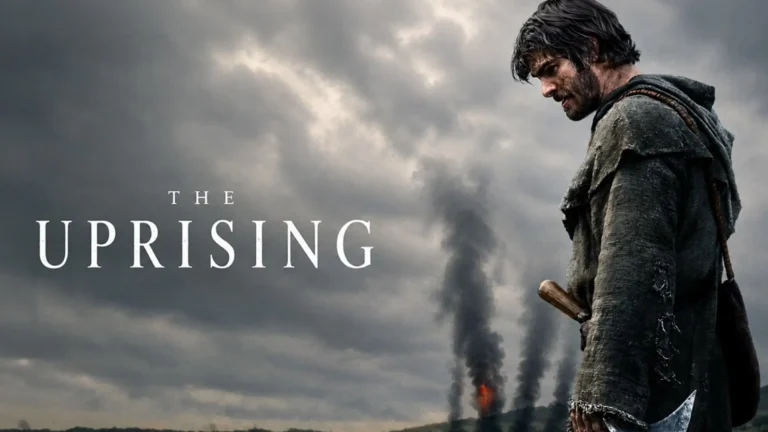
There’s a certain kind of filmmaker who gravitates toward chaos, and Paul Greengrass has built a whole career on it. From Captain Phillips to United 93, he’s spent years turning real historical pressure cookers into gripping cinema. His latest, The Uprising, takes that same instinct and points it at medieval England, specifically the Peasants’ Revolt of 1381.
The film hit theatres on September 10, distributed by Focus Features. UK audiences will have to wait a bit longer, with Entertainment Film Distributors releasing it there on October 9. Interestingly, the film briefly carried the subtitle The Uprising: The Rise of Robin Hood in early US marketing, a nod to how the story eventually ties into that legend, though the final title dropped that framing.
The Story Behind the Uprising
Greengrass wrote, produced, and directed the film himself, and the plot draws from one of medieval England’s most dramatic moments. The setting is 1381, not long after the Black Death wiped out roughly half the population.
England is being run by a council acting on behalf of Richard II, a king who is only fourteen years old and, according to the film, haunted by nightmares of mobs and demons. With the kingdom desperate for money and unwilling to tax the Church or the merchant class, the council decides the burden should fall on the peasantry instead.
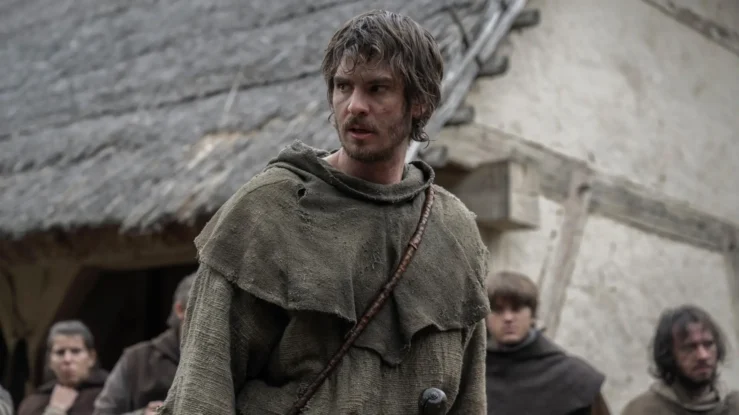
The story kicks off with a ploughman, played by Andrew Garfield, who survived the plague but lost his wife and two children to it.
When he’s confronted by a tax collector demanding death taxes on family members who died years earlier, and after witnessing soldiers forcibly inspecting young women to determine their tax bracket, he finally snaps. He kills a soldier trying to arrest him, and that single act of defiance sets off revolts across the country.
What follows is a story of rebellion led by three very different figures: the Ploughman, Wat Tyler, a former soldier who served the king’s father, and John Ball, a priest whose egalitarian beliefs got him branded a heretic. Their march on London, the king’s betrayal, and the brutal aftermath all build toward an ending that ties the Ploughman’s story to a legend audiences will likely recognize well before the film spells it out.
The Cast Behind the Uprising
Andrew Garfield leads the film as the Ploughman, with Jamie Bell playing John Ball and Cosmo Jarvis taking on Wat Tyler. Woody Norman plays the young Richard II, while Stephen Dillane and Tom Hollander round out the king’s council as Simon Sudbury and Sir Robert Hales.
Thomasin McKenzie, Jonny Lee Miller and Katherine Waterston also feature prominently, alongside Stanley Townsend, Gerald Tyler, Simon Kunz, Sky Yang, Jamie Maclachlan and Dónal Finn.
It’s a genuinely stacked ensemble, and given Greengrass’s track record of pulling grounded, intense performances out of his casts, expect the film to lean hard into the emotional weight of the uprising rather than treating it as a straightforward historical spectacle.
The Crew Behind the Uprising
The film is produced by Jason Blum, Greengrass himself, Gregory Goodman, Joanna Kaye, Joe Neurauter and Lars Sylvest, with Thank You Pictures and Supernix handling production.
Pål Ulvik Rokseth serves as cinematographer, William Goldenberg edits, and Volker Bertelmann composes the score, a name genre fans will recognize from his Oscar-winning work on All Quiet on the Western Front.
Running at 128 minutes, The Uprising is a joint production between the UK, Germany, and the US, filmed entirely in English.
Similar Read: Last Seen Is Coming to Apple TV
Should You Watch It
If you’re drawn to historical dramas that don’t shy away from brutality, or if Greengrass’s earlier work has ever left you gripping your armrest, The Uprising looks built to deliver exactly that kind of tension, just set six centuries earlier than his usual territory. It’s in US theatres now, with the UK release following on October 9.