


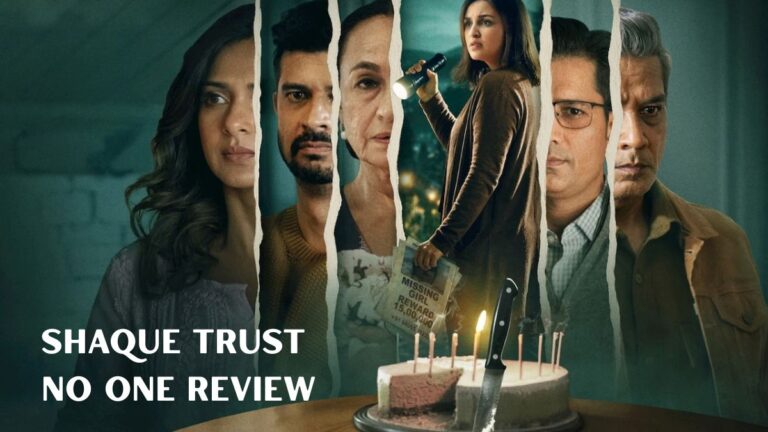
Shaque Trust No One Review: ★★☆☆☆ (2/5)
Shaque Trust No One has a genuinely powerful, real-life-inspired premise at its center. Still, the show overloads itself with unnecessary twists, subplots, and supernatural elements that ultimately dilute both its suspense and its emotional impact.
Rating: ★★☆☆☆ (2/5)
Genre: Thriller, Drama
Episodes: 7
Cast: Parineeti Chopra, Tahir Raj Bhasin, Jennifer Winget, Soni Razdan
There is a genuinely beautiful story buried somewhere inside Shaque: Trust No One. Inspired by the real-life story of Delimar Vera, a baby who disappeared and was reunited with her mother years later, the premise alone is emotional and almost cinematic without needing much embellishment at all.
Unfortunately, the show takes that simple, powerful idea and stretches it across seven episodes of roughly forty minutes each, and that decision ends up being its biggest downfall.
At its core, Shaque follows a mother desperately trying to find her daughter, who was kidnapped at birth, clinging to the belief that her child is still alive and will one day return to her. That premise alone is strong enough to carry an entire story.
Instead, the makers keep piling on additional layers, as if worried the central story cannot hold attention on its own. What results is a show that produces plenty of twists but forgets to build the one thing every good thriller absolutely needs: genuine curiosity.
By the second or third episode, most viewers will have already figured out roughly where the story is heading, leaving the remaining episodes less about wondering what happened and more about patiently waiting for the characters to finally catch up.
The title itself, Shaque, meaning doubt, ends up being the show’s biggest missed opportunity. It clearly wants audiences to suspect everyone around the protagonist, but the writing rarely gives her a genuine reason to doubt anyone specific, which undercuts the entire premise the title promises.
On top of that, nearly every character seems to be hiding some kind of secret, and while that could have made for genuinely juicy, pulpy storytelling, the show tries to simultaneously be a big emotional mother-daughter drama and a twisty ensemble thriller, and somewhere between the two, it loses its focus entirely.
The writing also leans heavily on convenience throughout. A police officer character gets an emotional backstory, then is also inexplicably given the ability to read tarot cards, seemingly just to push the story toward its next revelation rather than organically growing from who the character actually is.
Several heightened sequences, including heavy red lighting and hallucination sequences, announce themselves as thriller elements rather than genuinely earning that tension, occasionally tipping into unintentional comedy instead.
Even the emotional core, which should have been the show’s strongest asset, does not land as powerfully as it needed to. Scenes meant to devastate, like the mother searching for traces of her daughter in other children, often feel staged rather than genuinely heartbreaking.
Parineeti Chopra has real moments of vulnerability that hint at the grief underneath her character’s anger, but for much of the runtime, she plays the role with such consistently intense, angry energy that the line between anguish and vengeance starts to blur.
The supporting cast fares noticeably better. Tahir Raj Bhasin makes his morally grey character genuinely unsettling, while Soni Razdan is a real surprise, using the contrast between her innocent appearance and her character’s actions to create some genuinely uncomfortable moments.
Jennifer Winget, in particular, gets one of the show’s most interesting roles, once again proving after Beyhadh that she can hold attention even when the material around her is inconsistent.
Visually, Shimla looks stunning throughout, but the setting never really becomes a meaningful part of the story itself. Given the region’s natural fog, isolation, and atmosphere, there was real potential to use the location as more than just a pretty backdrop.
In the end, Shaque tries to be a mystery, an emotional family drama, a supernatural thriller, and a miracle story all at once, and in attempting to be everything, it ends up feeling surprisingly thin. Seven episodes later, the real mystery is not who took the daughter, but why this particular story needed seven episodes to tell in the first place.
If courtroom dramas with equally strong performances are more your speed this week, our review of Hunkkaar The Roar is worth checking out too.