



Buying a new smartphone should be simple. You decide your budget, compare a few features and pick the phone that suits your needs. However, things get complicated when two phones offer almost the same features but come with different price tags.
The Redmi 17 and Redmi 17C are a good example. Both smartphones offer a large 6.9-inch display, a refresh rate of up to 120Hz, a 50MP main camera, 5G connectivity and Xiaomi’s HyperOS 3 software. At first glance, they look like similar options for people who want a big-screen smartphone without spending flagship-level money.
The difference becomes clearer when you look at their prices and internal hardware. The Redmi 17 starts at Rs 23,999, while the Redmi 17C starts at Rs 20,999. That is a difference of Rs 3,000, which could be important for buyers working with a limited budget.
The more expensive phone offers a larger battery, faster charging and a different processor platform. However, the Redmi 17C is lighter and has a few connectivity advantages of its own.
So, is the Redmi 17 worth the extra money, or should you save your cash and choose the Redmi 17C? Let’s compare both phones in detail.
Redmi 17 vs Redmi 17C: Price and Key Specifications
Before getting into the smaller details, here is a quick look at the specifications provided for both smartphones.
| Features | Redmi 17 | Redmi 17C |
|---|---|---|
| Starting price | Rs 23,999 | Rs 20,999 |
| Display size | 6.9 inches | 6.9 inches |
| Refresh rate | Up to 120Hz | Up to 120Hz |
| Processor | Snapdragon 4 Gen 5 | MediaTek Dimensity 6300 |
| Manufacturing process | 4nm | 6nm |
| Main rear camera | 50MP | 50MP |
| Front camera | 8MP | 8MP |
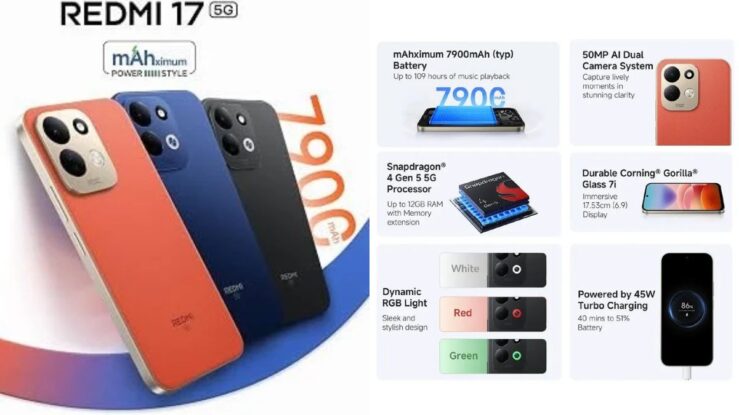
| Battery | 7,900mAh | 6,000mAh |
| Charging | 45W | 33W |
| Weight | 232g | 211g |
| Expandable storage | Up to 2TB | Up to 1TB |
| Connectivity | 5G | 5G |
Specifications are based on the supplied information. Actual performance, battery life and camera quality require hands-on testing.
1. Price Difference: Is the Redmi 17 Worth Rs 3,000 More?
The first thing most buyers will notice is the price gap.
The Redmi 17 starts at Rs 23,999, while the Redmi 17C starts at Rs 20,999. The Redmi 17 therefore costs around 14% more than the cheaper model at their starting prices.
That extra amount gets you a bigger battery, faster supported charging and a processor built using a newer manufacturing process. You also get support for more expandable storage.
These upgrades are useful, but they do not automatically make the Redmi 17 the right choice for everyone.
If you mainly use your phone for WhatsApp, Instagram, YouTube, web browsing and everyday applications, the Redmi 17C already offers several features that matter. Its large display, 120Hz refresh rate, 50MP main camera and 5G support make it worth considering.
On the other hand, people who spend long hours using their phones may appreciate the Redmi 17’s additional battery capacity and faster charging.
The decision comes down to whether those upgrades are worth Rs 3,000 to you.
2. Processor Comparison: Snapdragon vs MediaTek
The processor is another important difference between the two smartphones.
The Redmi 17 uses Qualcomm’s Snapdragon 4 Gen 5 mobile platform, which is built on a 4nm process. Its octa-core CPU includes Cortex-A78 and Cortex-A55 cores, with clock speeds reaching up to 2.4GHz.
The Redmi 17C uses MediaTek’s Dimensity 6300 processor, built on a 6nm process. It also features an octa-core CPU, combining Cortex-A76 and Cortex-A55 cores with speeds of up to 2.4GHz.
On paper, the Redmi 17 has an advantage in its listed performance-core architecture and manufacturing process. This makes it an interesting option for buyers who want the newer-looking hardware specifications.
However, processor specifications alone cannot tell the whole story. Gaming performance, app loading times and multitasking also depend on software optimisation, cooling and how each manufacturer has designed the phone.
Both devices use LPDDR4X RAM and UFS 2.2 storage. The Redmi 17 is listed with 6GB or 8GB RAM options, while the Redmi 17C comes with 4GB or 6GB RAM options.
If you regularly switch between several applications, the higher-memory versions are worth considering. Virtual RAM features can use internal storage to supplement physical memory, but they are not a direct replacement for actual RAM.
For everyday users, the Dimensity 6300 may be sufficient. Buyers who prioritise the Redmi 17’s processor specifications have a reason to spend more, although benchmark results would be needed to establish the actual performance difference.

3. Display: Both Phones Offer a Large 120Hz Screen
Both smartphones feature a 6.9-inch display with a refresh rate of up to 120Hz.
The large screen should be useful for watching videos, reading articles, browsing social media and playing compatible games. The higher refresh rate can also make scrolling and supported animations appear smoother than on a traditional 60Hz display.
The Redmi 17 lists a high-brightness mode of up to 825 nits, while the Redmi 17C lists up to 810 nits in the same mode.
That difference is relatively small on paper, so it would be difficult to declare one phone the clear winner for outdoor viewing without testing them side by side.
There is another detail buyers should consider. The supplied specifications list the Redmi 17C’s resolution as 1,600 × 720 pixels, which falls into the HD+ category. Text and small details may not look as sharp as they would on a higher-resolution screen of the same size.
The supplied Redmi 17 specifications do not clearly establish its display resolution. Buyers who care about screen sharpness should confirm this detail before making a purchase.
In short, both phones offer a large display, but the resolution matters just as much as screen size when it comes to viewing quality.
4. Battery and Charging: The Redmi 17 Has the Advantage
Battery capacity is arguably the biggest reason to consider the more expensive smartphone.
The Redmi 17 comes with a 7,900mAh battery and supports 45W charging. The Redmi 17C has a 6,000mAh battery with support for 33W charging.
The Redmi 17’s battery capacity is approximately 32% higher than that of the Redmi 17C. This could make a meaningful difference for people who use their phones throughout the day for video streaming, navigation, calls and other demanding activities.
However, a larger battery does not automatically guarantee a specific number of hours or days of use. Screen brightness, mobile network conditions, background apps and processor efficiency all affect battery life.
Charging speed is another point in the Redmi 17’s favour. Its 45W support is higher than the Redmi 17C’s 33W rating, although actual charging times would need to be measured to determine how much time buyers save.
The Redmi 17 also supports wired reverse charging at up to 22.5W, compared with up to 10W on the Redmi 17C. This could be useful when you need to charge a compatible accessory or another device.
If you often struggle to find a charging point during the day, the Redmi 17 looks more appealing on paper. If you usually charge your phone overnight, the Redmi 17C’s battery might be sufficient for your routine.
5. Camera Comparison: Both Have a 50MP Main Camera
Camera specifications are another area where the two phones appear similar.
Both devices feature a 50MP main rear camera with an f/1.8 aperture and an auxiliary lens. They also offer an 8MP front camera for selfies and video calls.
Their listed camera features include portrait mode, night photography, HDR and time-lapse. The Redmi 17 also lists dual-camera recording and document mode among its camera features.
At first glance, there is no obvious winner based on megapixel counts alone.
A 50MP camera does not guarantee better photographs than another 50MP camera. Sensor size, image processing, autofocus, lens quality and low-light performance all play important roles in the final result.
For example, two phones with the same camera resolution can produce different results when photographing people indoors or capturing moving subjects at night.
Without sample images and controlled camera tests, it would be unfair to say that the Redmi 17 takes better pictures simply because it costs more.
If photography is your main priority, look for real-world camera samples before choosing between these devices.
6. Design, Storage and Connectivity
The Redmi 17 is the larger-battery option, but that upgrade comes with a weight penalty.
It weighs 232g and measures 8.8mm in thickness. The Redmi 17C weighs 211g and measures 7.99mm thick.
That makes the Redmi 17C 21g lighter and slightly slimmer. The difference may not sound significant, but it could matter if you spend a lot of time holding your phone or prefer a lighter device.
Storage expansion is another difference. The Redmi 17 supports microSD cards up to 2TB, while the Redmi 17C supports expansion up to 1TB.
Both phones use UFS 2.2 internal storage. Their SIM arrangements differ, too. The Redmi 17 uses a hybrid SIM and microSD slot, while the Redmi 17C lists a dual-SIM-plus-microSD arrangement.
For people who regularly use two SIM cards and a memory card together, the Redmi 17C’s listed configuration could be more convenient.
Interestingly, the cheaper phone also lists Bluetooth 5.4, while the Redmi 17 lists Bluetooth 5.1. The Redmi 17C additionally specifies AAC, SBC and LDAC audio codec support. Actual compatibility depends on the connected device and software.
Both phones support 5G, dual-band Wi-Fi, FM radio and a 3.5mm headphone jack. They also carry an IP64 rating, which indicates protection against dust and water splashes under specified conditions. This does not mean either phone is waterproof or suitable for underwater use.
7. Which Phone Should You Buy?
The right choice depends on what you expect from your next smartphone.
Choose the Redmi 17 if you want a larger battery, faster supported charging, a different processor platform and the option to expand storage up to 2TB. It is the more attractive option for buyers who value those specifications and are comfortable paying Rs 3,000 extra.
Choose the Redmi 17C if you want to save money without giving up the large screen, 120Hz refresh rate, 50MP main camera or 5G connectivity. Its lighter design, Bluetooth 5.4 and listed dual-SIM-plus-microSD arrangement are additional reasons to consider it.
Before making a final decision, check the exact RAM variant, display resolution, warranty and current retail price. If you are not in a hurry, it may also help to compare these phones with other devices in the same price range.
For readers following the wider smartphone market, it is worth keeping an eye on other launches as well. You can read about the Samsung Galaxy F70 5G launch and its expected features or explore the latest details in this report on the Xiaomi 18 Pro and Xiaomi 18 Pro Max launch. Comparing phones across different price categories can help you decide whether to buy now or wait for another option.
Final Verdict
The Redmi 17 and Redmi 17C offer a similar basic smartphone experience, but they target buyers with slightly different priorities.
At Rs 23,999, the Redmi 17 makes a stronger case for people who want its 7,900mAh battery, 45W charging and listed Snapdragon 4 Gen 5 platform. These are meaningful specification differences that help explain the higher price.
At Rs 20,999, the Redmi 17C is the more affordable alternative. It retains the large display, 120Hz refresh rate, 50MP main camera and 5G connectivity while offering a lighter body and some useful connectivity advantages.
My pick, based on the supplied specifications, is the Redmi 17. Its larger battery and faster charging make the additional Rs 3,000 easier to justify for people who use their phones heavily.
However, if your budget is tight and you mainly need a smartphone for everyday tasks, the Redmi 17C could be the smarter purchase. Neither phone is automatically better for everyone, and real-world battery, camera and performance tests would be needed to make a definitive comparison.