



Irumudi Movie Review: ★★★☆☆ (3/5)
Irumudi gives Ravi Teja his most mature and grounded role in years, backed by a genuinely socially relevant story and strong performances. The film loses some momentum after its big twist, but its emotional core still lands.
Rating: ★★★☆☆ (3/5)
Language: Telugu
Genre: Family Drama, Action
Runtime: 2 hours 25 minutes
Director: Shiva Nirvana
Cast: Ravi Teja, Priya Bhavani Shankar, Baby Nakshathra
Ravi Teja has had a tough few years, with six films in a row failing to connect with audiences since 2023. Alongside the box office struggles, there had also been growing criticism online about how female characters were being written in his recent films.
With Irumudi, the actor teams up with director Shiva Nirvana for a family action drama that clearly aims to change both his fortunes and the conversation around his films, and for the most part, it succeeds.
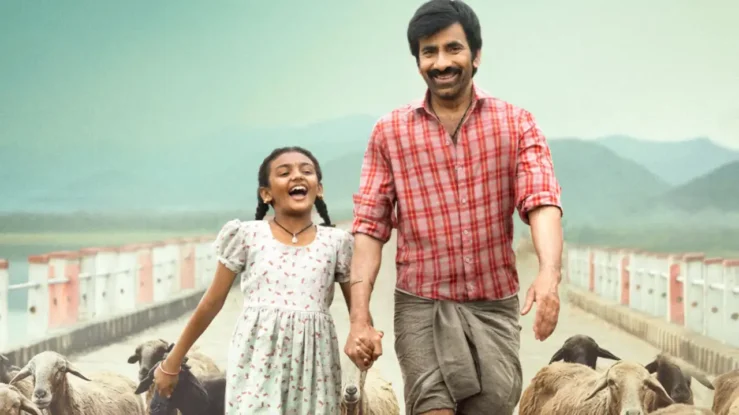
The story follows Trinath, played by Ravi Teja, a farmer in a remote village and a devoted follower of Ayyappa Swamy. He is a loving husband and a caring father to his daughter Manemma, played by Baby Nakshathra, though he also struggles with a drinking problem.
Trinath raises his daughter to be fearless and encourages her to share everything happening in her life with him. He treats every girl in the village like his own daughter, standing up for them whenever they face trouble. But as threats against the village girls begin piling up, Trinath finds himself having to confront dangerous forces determined to harm them.
Similar Article: Khalifa Movie Review
What immediately stands out is Ravi Teja’s performance. This is easily one of his most controlled and mature roles in a long time. There is no trace of his usual larger-than-life mass persona here. Instead, he lets the character carry the film, bringing real vulnerability and quiet intensity to Trinath, especially in his scenes with his daughter, which form the emotional heart of the movie.
Baby Nakshathra, though, might be the true find of the film. As Manemma, she delivers a confident, natural performance that never once feels forced, and her chemistry with Ravi Teja feels genuinely believable.
Priya Bhavani Shankar is equally impressive as Kaveri, Trinath’s wife, particularly in a powerful sequence in the second half that ranks among the best work of her career. Sai Kumar brings real weight to his role as Guru Swamy, while Swasika is genuinely unsettling in a darker, more menacing part.
Related Article: Irumudi Trailer Review
The film’s technical work supports its emotional tone well. GV Prakash Kumar’s background score does a great job building tension in the first half while adding real weight to the family moments.
The two songs built around the Ayyappa Swamy backdrop are woven naturally into the story rather than feeling like forced additions, and one action sequence set to the song Mallepoola Pallaki is genuinely a crowd-pleaser. Cinematographer Vishnu Sarma also deserves credit for giving the film a beautiful, grounded visual quality throughout.
What makes Irumudi genuinely interesting is its central theme, built around two very different approaches to raising a daughter. One reflects old social conditioning, teaching girls to stay quiet and adjust rather than speak up.
The other, represented by Trinath, is about empowering girls to be confident, self-reliant, and unafraid to speak out when something is wrong. Director Shiva Nirvana handles this contrast with real sincerity, never letting the film’s social message get buried under unnecessary commercial elements like random songs or forced comedy tracks.
Similar Article: Nibba Nibbi Review
The first half is genuinely gripping, steadily building tension as the story raises the question of who exactly is threatening the girls in the village. That mystery, combined with the warmth of the father-daughter relationship, keeps the audience invested for a solid two hours before a shocking twist changes the direction of the story.
Unfortunately, the film loses some steam after that twist. While the reveal itself is well written, the fifteen minutes or so that follow before the emotional climax feel noticeably predictable and stretched thin. It is worth noting too that the film deals with genuinely disturbing subject matter, and certain scenes may be difficult to watch, even though they reflect realities that do exist in society.
Despite these shortcomings, Irumudi succeeds in what it sets out to do. It never turns preachy, choosing instead to let its characters and their circumstances carry the message. For parents, especially those raising daughters, the film is likely to leave a lasting impression long after the credits roll.
Overall, Irumudi marks a genuine step forward for Ravi Teja, proving he can carry a performance-driven role with real conviction. Shiva Nirvana deserves credit for tackling a socially relevant subject with honesty, even if the back half of the film does not fully match the strength of its first.