


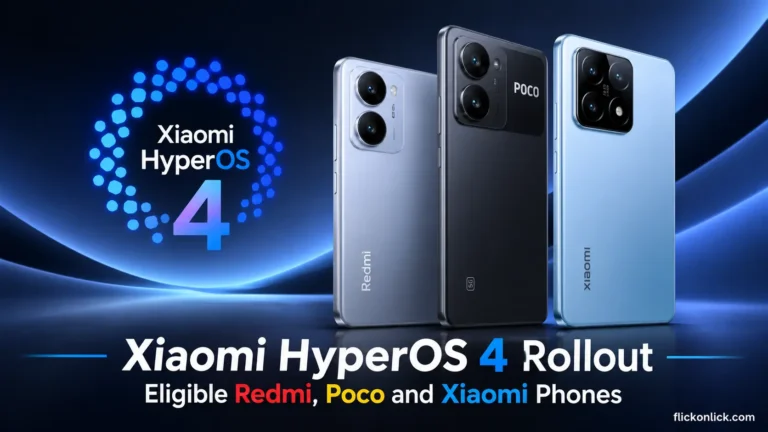
Xiaomi has started rolling out HyperOS 4 worldwide. The company says 82 smartphones and tablets across its Xiaomi, Redmi, and Poco brands will get the update in three waves that run through December 2026. If you own one of these phones, here is what to expect.
The Three Waves
The first wave began in early November. The second follows in mid-November, and the third arrives in December.
| Wave | Timing | Devices |
|---|---|---|
| First | Early November | Xiaomi 17 and 15 series, Redmi Note 17 and Note 15 families, Poco F8 and X8 lineups, Xiaomi Pad 8 tablets |
| Second | Mid November | Xiaomi 15T series, Poco F7 and F9 families, Xiaomi Pad 7 models, Pad Mini, several Redmi and Poco tablets |
| Third | December | Xiaomi 13 and 14 series, Xiaomi 13T lineup, MIX Flip, Redmi Note 14 family, Poco F6 series |
The Xiaomi 13T stands out. It launched in 2023, so many owners expected it to miss another big update. These are scheduled windows, not fixed install dates, and your region and exact model will decide when the notification appears. Do not be surprised if it shows up later than the window suggests.
What Looks Different
HyperOS 4 brings a new design that Xiaomi calls Soft Light Glass. It uses see-through panels, redesigned notifications, and more flexible lock screens with larger clock widgets. Home screens get more layout options, including stacked widgets and flexible folders. The update also improves floating windows and app orientation, which should help most on tablets.
Faster, According to Xiaomi
Xiaomi shared two speed claims from its own testing. Opening 30 apps after nine hours of use took 40.3 seconds on HyperOS 3, and it now takes 36.8 seconds on HyperOS 4. That is about 8.7 percent faster. HDR photo capture time dropped from 313.38 milliseconds to 240.16 milliseconds, about 23.4 percent faster. Xiaomi also reports fewer dropped frames during video playback.
These are company numbers, so your own phone may not match them. Results depend on your hardware and software version.
A Bigger Job for the AI Assistant
The update adds Super XiaoAi 2.0, which runs on Xiaomi’s MiMo language model. It can search your photo library, organize your schedule, control supported smart home devices, and identify products shown on your screen. Xiaomi has also added confirmation prompts before sensitive actions such as deleting or sharing data. The Super Island feature now supports more than 130 services.
There is a catch. Some of these features are limited to certain devices and to China-specific software. Users outside China may not get the full set.
Things to Know Before You Update
The update is large. Notebookcheck reports that the Poco F8 Pro download is over 8GB when installed over stable HyperOS 3, so keep enough storage free and use Wi-Fi.
You can check for the update in your phone’s system settings, though the menu name can vary by model. Eligibility also does not promise every feature. One report says being on the list does not necessarily confirm an Android 17 upgrade, so check the software version and feature list for your own phone before you install.
Why It Matters
For Redmi and Poco owners, this is good news. A fresh look and some speed gains can make a phone feel newer without spending anything. Reaching back to the Xiaomi 13T also suggests Xiaomi is willing to keep older hardware current, which should please anyone thinking of holding on to their phone for another year.
Should You Install It Right Away?
If your phone is in the first wave and you like trying new features, go ahead once the notification arrives. If you rely on your phone for work, waiting a week or two for early user feedback is sensible, since large updates can bring bugs. Back up your data first either way.
Xiaomi is not the only brand preparing an Android 17 skin. If you are curious how another company is handling it, this guide to ColorOS 17, with its features, release date and eligible devices is a useful comparison.
Xiaomi’s HyperOS 4 rollout runs from November to December 2026.