


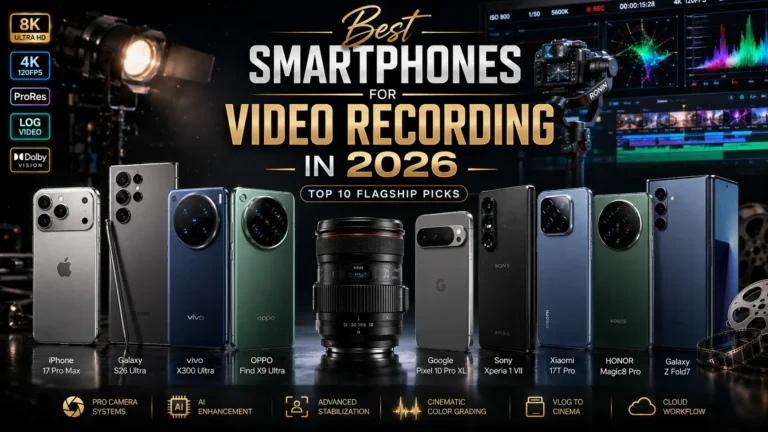
A few years ago, saying a smartphone could replace a dedicated video camera was a stretch. Today, it is not. The top flagship phones in 2026 record in 4K at 120 fps, support professional log formats, handle dual-camera simultaneous recording, and produce footage that genuinely requires a trained eye to separate from dedicated cinema cameras in many conditions.
But not all camera phones are equal, and the best phone for stills is not always the best phone for video. Great video requires a combination of sensor size, computational power, stabilization, audio quality, and software intelligence that only the very best devices deliver fully. Here are the 10 flagship smartphones worth considering if video recording is your priority.
Top 10 Best Flagship Smartphones for Content Creators
| Phone | Best For | OS | Max Video |
|---|---|---|---|
| iPhone 17 Pro Max | Overall best | iOS | 4K/120fps |
| Vivo X300 Ultra | Best Android video | Android | 8K/30fps |
| Samsung S26 Ultra | Best widely available Android | Android | 8K/30fps |
| OPPO Find X9 Ultra | Zoom and versatility | Android | 8K/30fps |
| iPhone 17 | Best affordable iPhone | iOS | 4K/60fps |
| Xiaomi 17T Pro | Best affordable Android | Android | 8K/30fps |
| Google Pixel 10 Pro XL | AI-enhanced video | Android | 4K |
| Sony Xperia 1 VII | Manual control | Android | 4K/120fps |
| Honor Magic8 Pro | All-day shooting | Android | 4K |
| Samsung Galaxy Z Fold7 | Foldable versatility | Android | 4K |
1. Apple iPhone 17 Pro Max — The Overall Best for Video
Key specs: 48MP triple cameras | A19 Pro chip | 4K/120fps | ProRes RAW | 6.9-inch display
If you want the single best smartphone for video recording in 2026, the iPhone 17 Pro Max is where the conversation starts and, for most people, where it ends.
The A19 Pro chip delivers processing power that no Android rival has matched for video workflows, and the camera system has finally achieved something long overdue — all three main cameras are now 48MP. That means switching between wide, ultrawide, and telephoto during video capture no longer produces a noticeable quality difference between lenses.
The professional format support is genuinely impressive. ProRes RAW, Apple Log 2, and Open Gate Recording give videographers the flexibility to capture maximum dynamic range and reframe footage in post-production. Dual recording — simultaneous 4K Dolby Vision from front and rear cameras — is particularly useful for vloggers and interview setups. Genlock support lets multiple iPhone 17 Pro Max units synchronise perfectly for professional multi-camera shoots.
Battery life has improved significantly, the new aluminium body runs cooler under extended recording loads, and the anti-reflective Super Retina XDR display is one of the best screens available for monitoring footage while shooting.
Best for: Professional videographers, content creators, anyone who wants the absolute best video quality available on a smartphone.
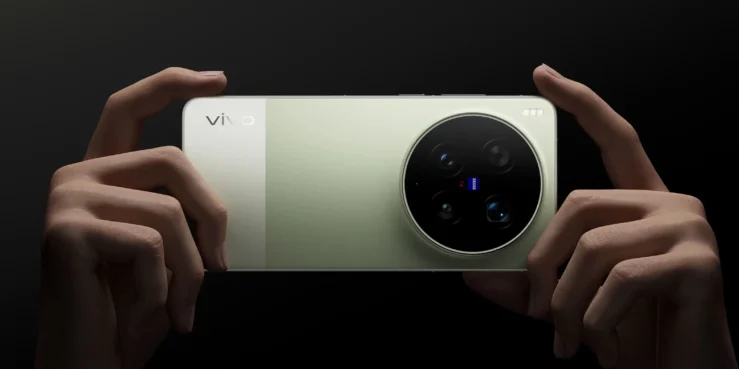
2. Vivo X300 Ultra — Best Android Phone for Video
Key specs: 200MP main + 200MP telephoto | 8K/30fps | 4K/120fps 10-bit Log | Gimbal-grade OIS
The Vivo X300 Ultra has done what no Android phone previously managed — it genuinely competes with the iPhone for video quality without obvious compromise. The stabilisation is gimbal-grade, which means handheld footage looks as smooth as if you were using an external gimbal. The Pro Video mode includes manual controls, waveforms, and histograms — tools that serious videographers expect from dedicated cameras, not phones.
The 200MP main camera shoots from a 35mm perspective, which gives footage a more natural, film-like field of view than the typical wide-angle default most phones use. The 200MP telephoto at 85mm adds compression and reach. Optional teleconverter lenses extend this further into something approaching a modular camera system.
APV 422 encoding and ACES workflow support put this phone in genuine professional territory. The only real limitations are the price — it is expensive, especially with accessories — and availability, which is currently strongest in Europe and Asia.
Best for: Android users who want professional video capability without switching to iOS.
3. Samsung Galaxy S26 Ultra — Best Widely Available Android
Key specs: 200MP main, f/1.4 | Snapdragon 8 Elite Gen 5 | 8K/30fps | Expert RAW | APV codec
Samsung’s Galaxy S26 Ultra remains the most complete and widely available Android video phone in 2026. The main 200MP sensor now sits behind a brighter f/1.4 lens — a genuine improvement for low-light shooting — and the Nightography video processing has taken a meaningful step forward from the S25 Ultra, pulling in more usable detail in dark conditions.
Daylight video from the main and ultrawide cameras is smooth, detailed, and colour-accurate. The enthusiast toolkit — Log, Expert RAW, and the new APV codec — gives content creators real flexibility in post-production, though APV’s large file sizes mean an external SSD is advisable for longer shoots.
The weak point is the 3x camera, which uses a smaller sensor that struggles in anything other than good light. But paired with fast charging, excellent general performance, and Samsung’s seamlessly integrated AirDrop support, it remains a strong all-rounder.
Best for: Android users who want a premium, widely available video phone with strong ecosystem support.
4. OPPO Find X9 Ultra — Best for Zoom and Versatility
Key specs: 200MP main + 200MP 3x telephoto + 50MP 10x periscope | 8K/30fps | O-Log 2 | ACES | Real-time LUT preview
The OPPO Find X9 Ultra’s five-camera Hasselblad Master Camera System is genuinely impressive across the full focal length range. The 200MP 3x telephoto outperforms most rivals at equivalent zoom, and the 50MP 10x periscope comfortably beats competitor digital zoom at that range.
For video, the O-Log 2 and ACES workflow support, combined with real-time LUT preview, mean you can monitor how your footage will look after grading while you are still shooting — a significant time-saver for solo content creators. Stabilisation blends OIS and EIS effectively across all lenses.
The phone is large and heavy at 235 grams, and the optional teleconverter cannot be used in Hasselblad Master mode, which is a frustrating limitation. But as a hybrid photo and video device across multiple focal lengths, very little comes close.
Best for: Travel shooters, zoom-heavy content creators, and those who need versatility across focal lengths for both photo and video.
5. Apple iPhone 17 — Best Affordable iPhone for Video
Key specs: 48MP dual camera | A19 chip | 4K/60fps | 18MP Centre Stage front camera | Four-microphone array
If the iPhone 17 Pro Max is beyond budget, the standard iPhone 17 is still one of the best video phones available at its price. The 18MP Centre Stage front camera automatically keeps the subject framed during vlogging — genuinely useful for solo creators who cannot afford a camera operator. The four-microphone array provides directional audio capture that rivals some external microphone setups.
Photographic Styles give more creative control over the look of footage than the base iPhone has ever offered, and the Camera Control button makes adjusting exposure, depth, and zoom feel intuitive during a live shoot. The main limitation is the absence of a strong optical zoom — if telephoto reach matters to you, this is where the Pro model justifies its premium.
Best for: Vloggers and content creators who want iPhone video quality at a lower price point.
6. Xiaomi 17T Pro — Best Affordable Android for Video
Key specs: 50MP main (1/1.3-inch sensor) | Dimensity 9500 | 8K/30fps | 4K/120fps | Log at 4K60 | 7000mAh battery
The Xiaomi 17T Pro sits at a compelling point in the market — it offers a video feature set that genuinely competes with phones costing significantly more. Log shooting at 4K60 on the main and telephoto cameras, custom LUT support, and 8K30 capability put it in professional territory at mid-range pricing.
The 50MP 5x telephoto is an unusual and valuable inclusion at this price bracket, offering reach and compression that 3x lenses cannot match. The 7000mAh battery with 100W charging means you can shoot all day and be topped up again in under an hour.
The ultrawide is the weak link — no autofocus and reduced low-light performance. Existing 15T Pro users have little reason to upgrade, but for anyone coming from an older device or a different brand, this is exceptional value.
Best for: Budget-conscious videographers who want professional video features without flagship pricing.
7. Google Pixel 10 Pro XL — Best for AI-Enhanced Video
Key specs: Tensor G5 chip | 4K video | Enhanced AI stabilisation | Superior low-light processing
Google’s Tensor G5 chip is purpose-built for on-device AI processing, and the Pixel 10 Pro XL’s video capability is built around that intelligence. The low-light stabilisation is best-in-class for handheld shooting in challenging conditions, and the computational video processing — which analyses and enhances footage on the device — produces consistently smooth, well-exposed results with minimal manual intervention.
For creators who want a phone that makes decisions intelligently and produces great results without manual settings, the Pixel 10 Pro XL’s AI-first approach is genuinely appealing.
Best for: Casual creators who want consistently good automatic video without diving into manual settings.
8. Sony Xperia 1 VII — Best for Manual Control
Key specs: 4K/120Hz display | Dedicated manual video modes | External monitor support | Cinema Pro app
Sony builds cinema cameras for Hollywood productions. The Xperia 1 VII brings those learnings into smartphone form, with dedicated manual video modes, Cinema Pro software with professional-grade controls, and the ability to use the phone as an external monitor for other cameras. The 4K 120Hz display makes reviewing footage in detail genuinely practical.
This is not a phone for automatic shooting — it rewards users who understand cinematography and want full control over their footage. In the right hands, it produces some of the most film-like results available from any smartphone.
Best for: Experienced videographers and filmmakers who want manual control and professional workflow integration.
9. Honor Magic8 Pro — Best for All-Day Shooting
Key specs: Impressive night videography | Exceptional battery life | Strong low-light performance
The Honor Magic8 Pro’s main advantage is endurance. If you are shooting events, travel content, or any situation where you need a phone to last through a full day of video recording without reaching for a power bank, this is the most practical option on the list. Night-time videography is genuinely impressive, and the overall camera system is well-rounded for mixed content across conditions.
Best for: Event videographers, travel creators, and anyone who prioritises all-day battery life alongside solid camera performance.
10. Samsung Galaxy Z Fold7 — Best Foldable for Video
Key specs: Upgraded cameras over Z Fold6 | Hands-free filming angles | Large foldable display
The Galaxy Z Fold7 earns its place on this list specifically for creators who want versatility beyond what a standard slab phone offers. The foldable form factor allows for hands-free filming angles that are genuinely unique — propped up on a table without a stand, used as a monitor while shooting with external cameras, or folded to create stable self-recording positions. The camera system is substantially improved over its predecessor.
Best for: Content creators who want flexibility in shooting angles and the unique capabilities of a foldable form factor.
Also Read: Nothing Phone 4b RCB Edition Is Coming to India on July 7
What to Look for When Choosing
Sensor size matters more than megapixels. A 50MP sensor on a large chip captures better low-light video than a 200MP sensor on a tiny chip. Look at sensor dimensions, not just resolution numbers.
Stabilisation is non-negotiable. Shaky footage is unwatchable. Look for OIS plus EIS — optical and electronic stabilisation working together. Gimbal-grade OIS is the gold standard.
Storage fills up fast. 4K at 60fps, and especially 8K or Log formats, eat storage very quickly. 256GB minimum for serious video work, 512GB or more for extended shoots.
Audio matters as much as video. The best footage is undermined by poor audio. Look for multi-microphone arrays with directional capture, or check that the phone pairs well with external microphones via USB-C.
iOS or Android? Both deliver excellent video in 2026. iOS has historically led on video processing consistency and ProRes support. Android leads on format diversity, hardware variety, and price flexibility. Choose the ecosystem you are already comfortable in — the gap between them is smaller than it has ever been.