


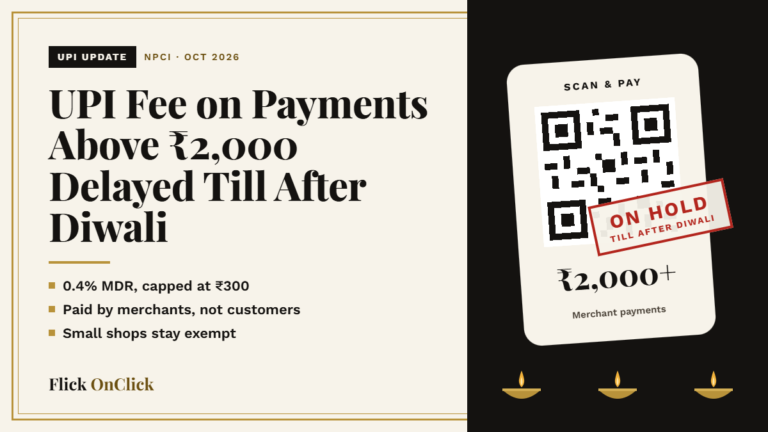
The new fee on UPI merchant payments above ₹2,000 will not start this festive season. The National Payments Corporation of India (NPCI) has pushed the rollout to a date after Diwali. The charge was supposed to begin on October 15, 2026.
NPCI shared the update on October 13. Its UPI and Services Steering Committee said the decision was taken keeping the festive season in mind. A fresh start date will be announced separately. Banks such as ICICI have already started sending this notice to their merchant customers.
What is MDR in simple words
MDR stands for Merchant Discount Rate. It is a small fee a shop pays to its bank for accepting a digital payment. Card payments have always carried this fee. UPI did not, because MDR on UPI merchant payments was removed in January 2020.
The new rule brings it back, but only for a limited set of payments. The Finance Ministry has also clarified that MDR is not a tax. It is not collected by the government or by NPCI.
The new UPI charges at a glance
Under the proposed framework, a 0.4% MDR will apply to select person-to-merchant (P2M) UPI payments above ₹2,000. The fee is capped at ₹300 per payment.
| Payment amount | Fee paid by the merchant |
|---|---|
| Up to ₹2,000 | Nil |
| ₹3,000 | ₹12 |
| ₹5,000 | ₹20 |
| ₹50,000 | ₹200 |
| ₹75,000 and above | ₹300 (cap) |
Some essential sectors will pay a flat ₹5 instead of 0.4% on payments above ₹2,000. These include railways, telecom, insurance, fuel, utilities and education.
What changes for customers
For regular UPI users, nothing changes. The fee is paid by the merchant, not by the person scanning the QR code. Sending money to friends and family (P2P) stays free, whatever the amount.
Banks have been told to make sure merchants do not pass this fee to customers as an extra charge. UPI apps are also not allowed to add platform fees or hidden charges on these payments. So a customer paying ₹3,000 at a store will still pay exactly ₹3,000.
What changes for restaurants and cafes
Most restaurant and cafe bills fall below ₹2,000. Those payments will stay free for the owner.
Also Read: Best Stocks to Buy This Month
The fee will only show up on larger bills, such as family dinners, birthday parties, group orders or catering. A ₹4,000 bill paid by UPI would cost the restaurant ₹16. A ₹10,000 party booking would cost ₹40.
Small outlets have extra relief. Merchants collecting up to ₹1 lakh a month through their existing QR codes will continue to pay zero MDR. Many small cafes, dhabas and tea stalls fall in this group.
Owners also cannot add a “UPI surcharge” to the bill to recover this fee. The cost has to be absorbed or built into regular menu pricing.
What changes for shops and other merchants
Kirana stores, chemists and small retailers mostly handle payments below ₹2,000, so the impact will be small. Reports say about 96% of merchant transactions will not be affected, either because they are under the limit or because the merchant is covered under the small-merchant exemption.
Bigger stores that regularly take high-value UPI payments, such as electronics, furniture, jewellery and apparel shops, will feel the fee more. For them, a ₹50,000 sale by UPI would carry a ₹200 charge.
Why NPCI wants this fee
NPCI says UPI needs a steady income model to pay for growing cybersecurity, scaling and infrastructure costs. UPI now handles billions of payments every month, and the free model has been under pressure for some time.
The plan has faced pushback too. Opposition leaders have questioned the move, and an IIT-Bombay study has called for a lower rate. The Supreme Court, however, refused to stay its rollout.
When will the fee start
No new date has been given yet. NPCI has only said the fee will start immediately after Diwali. Earlier, Moneycontrol had reported that NPCI was also weighing a delay till January 2027.
Until the new date is notified, all UPI merchant payments continue under the current zero-MDR system. Merchants should watch for an update from their bank or payment provider over the next few weeks.
Frequently asked questions
Will customers pay extra for UPI payments above ₹2,000? No. The fee is paid by the merchant. Banks have been told to stop merchants from passing it on to customers.
When will the UPI MDR start? NPCI has said it will start immediately after Diwali. The exact date will be announced separately.
Is sending money to friends or family charged? No. Person-to-person UPI transfers stay free, whatever the amount.
How much is the UPI MDR? It is 0.4% on select merchant payments above ₹2,000, with a maximum fee of ₹300 per payment. Some essential sectors pay a flat ₹5.
Are small shops exempt? Yes. Merchants collecting up to ₹1 lakh a month through their existing QR codes will continue to pay zero MDR.
Is MDR a government tax? No. It is a fee paid to banks and payment providers. It is not collected by the government or NPCI.