


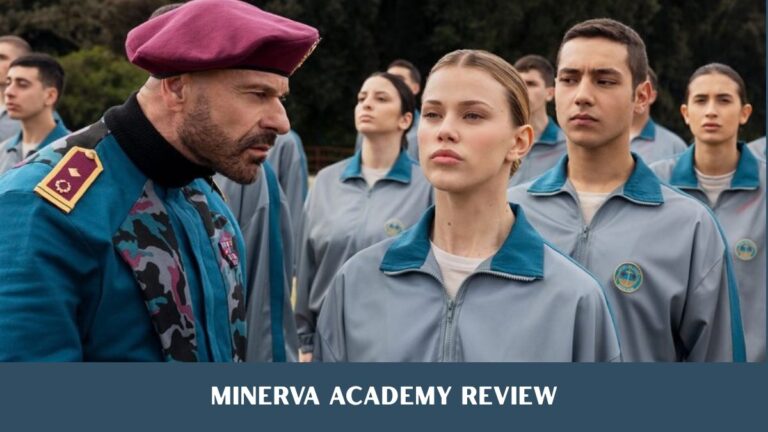
Minerva Academy Review: ★★★☆☆ (3/5)
Minerva Academy begins as a familiar teen drama set inside a strict military school, but it grows steadily darker and more compelling across its eight episodes, anchored by genuinely strong father-son drama.
Rating: ★★★☆☆ (3/5)
Platform: Netflix
Genre: Teen Drama
Episodes: 8
Language: Italian
Cast: Cristiana Capotondi, Irene Maiorino, Massimiliano Gallo, Simone Secce
Netflix’s new Italian teen drama Minerva Academy takes viewers inside a military high school in Naples, where discipline, hierarchy, and tradition collide with everything that normally comes with being a teenager. What starts as a fairly familiar school drama becomes considerably more interesting and considerably darker, as its eight episodes unfold.
Military schools make for an almost perfect teen drama setting. Take teenagers already trying to figure out who they are, place them inside an institution built entirely around obedience and discipline, and strip away their phones, civilian clothes, and personal freedom.
The fictional Minerva, inspired by Italy’s real military high schools, gives the series plenty of raw material to work with even before its central mystery kicks in. Punishing drills, fencing competitions, strict inspections, and senior cadets exercising power over new arrivals fill the halls, alongside nonnismo, the hazing culture that naturally emerges when older students hold power over younger ones.
The show does a genuinely thoughtful job exploring the blurry line between discipline and humiliation and between building resilience and demanding blind obedience simply because that is how things have always been done.
Into this rigid world walks Laura Canali, played by Cristiana Capotondi, a civilian history and philosophy teacher who seems almost comically out of place at Minerva.
She listens to the students, questions decisions, and refuses to accept tradition alone as a good enough reason to keep doing things a certain way. She is not alone in pushing back either. Major Teresa Bonaiuto, the school’s deputy commander, respects Minerva’s rules but wants to leave behind the outdated traditions keeping the institution stuck in its past.
At its core, though, this remains a teen drama, told largely through three first-year cadets. Salvo has the most personal reason for being there, following his childhood friend Francesco into Minerva after Francesco mysteriously disappeared without explanation.
That mystery, what actually happened to Francesco, runs quietly through all eight episodes, giving the season a continuous thread even as individual episodes focus on the everyday rhythms of school life.
Camilla arrives as the familiar rebellious rich girl sent there by her father, while Vincenzo genuinely wants to be there, following in his decorated military father’s footsteps even as that father’s declining health adds real emotional weight to his story.
If you had asked halfway through the season, Minerva Academy might have simply seemed like a solid, familiar teen drama filled with characters we have seen plenty of times before. But the second half genuinely deepens things, showing where these familiar behaviors and personalities actually come from rather than treating them as simple shortcuts.
Commander Achille Giordano, played by Massimiliano Gallo, becomes one of the season’s most compelling figures, a man who runs Minerva with absolute belief in discipline while quietly raising his own children after their mother abandoned the family.
His complicated relationship with his son Diego, played by Simone Secce, becomes the show’s strongest emotional throughline, and both actors deliver excellent performances here. You never doubt that Achille genuinely loves his son; the problem is that loving Diego does not automatically mean he understands him.
That tension, between discipline meant to build strength and discipline that simply punishes weakness, sits at the heart of what makes Minerva Academy genuinely interesting. The series never insists that every tradition is inherently bad, but it does show clearly what happens when rules matter more than the people they are supposed to protect.
Fair warning, though: this is not light teen drama territory. Minerva deals directly with hazing, grief, abuse of power, and other genuinely heavy themes, sitting closer to the darker end of the Netflix teen drama spectrum without ever becoming quite as bleak as something like 13 Reasons Why.
In the end, Minerva Academy takes its time finding its real identity, but the payoff is worth the patience, particularly once the Giordano family drama takes center stage.
If period dramas and bold anthology storytelling are more your speed, our review of The Scandal and our review of Lust Stories 3 are both worth checking out too.