


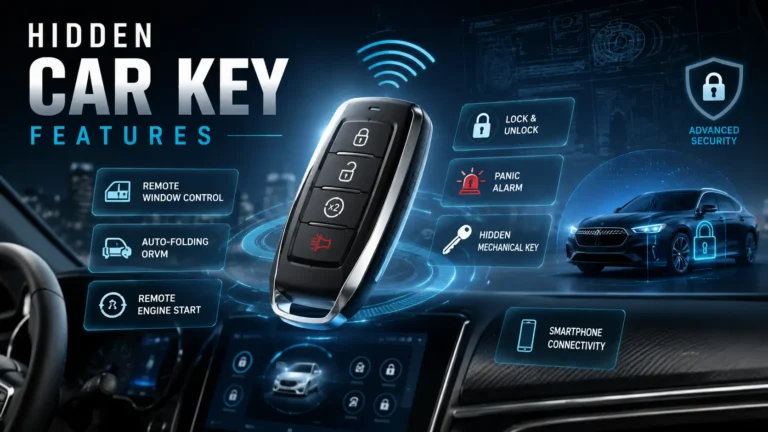
Ask most car owners in India what their key fob does, and you will get the same three answers. Lock the car. Unlock the car. Maybe open the boot. And then they pocket it and forget about it until the next time they park. That is a shame, because modern car keys — even on mid-range vehicles — are genuinely capable little devices.
They sit in your pocket every day doing nothing, quietly waiting for you to discover functions that could make your driving life noticeably more convenient. The problem is that nobody tells you about them. Not the dealership. Not the manual that lives untouched in the glove compartment. Just word of mouth, eventually, years after you bought the car.
Here are the hidden car key features worth knowing about right now.
Remote Window Control — Cool Your Car Before You Get In
This one changes how you experience summer in India.
On many vehicles, pressing and holding the unlock button on your key fob for two to three seconds lowers all the windows simultaneously. Some models also let you close all windows by holding the lock button.
Why does this matter? Because a car parked in direct sunlight in May or June can reach temperatures that make the first few minutes inside genuinely unpleasant. By lowering the windows before you get in — while you are still walking across the parking lot — you let that trapped heat escape. By the time you sit down and start the engine, the cabin is already ten degrees cooler and the air conditioning has a much easier job.
It works without starting the engine. It works before you even reach the car. It is one of those features that sounds minor until you use it once in peak summer and then wonder how you managed without it.
Note: This function is available on select models — check your owner’s manual for the exact button sequence.
The Panic Button Is Not Just for Emergencies
The panic button — usually a red or orange button on your fob with a horn symbol — exists for genuine emergencies. But it has a very practical everyday use that most people never consider.
If you cannot find your car in a crowded mall parking lot, a multi-level parking complex, or anywhere with dozens of similar-coloured vehicles, press the panic button. Your car will honk its horn and flash its indicators simultaneously, making it immediately visible and audible even from a distance.
Hold the button again and it stops. No harm done. Your car is located and you are not wandering around pressing the remote desperately hoping for a blink of headlights.
It is also, of course, useful in an actual emergency — triggering the alarm to attract attention if you feel unsafe near your vehicle.
There Is a Hidden Physical Key Inside Your Smart Fob
This is the one that surprises people the most, usually at the worst possible moment.
Inside almost every modern smart key fob is a small metal key blade — a traditional mechanical key that most drivers only discover when their fob’s battery dies and they cannot get into their car.
Look for a small button or release switch on the side of the fob. Press it and a slim metal key slides out. That key opens the driver-side door manually, which is exactly what you need when the electronics have stopped responding due to a dead battery.
Many push-button start cars can also be started with a dead key fob by holding the fob close to or touching the start button — the car picks up a residual signal at very short range. The specific method varies by manufacturer, so it is worth knowing your car’s procedure before you need it.
Keep a spare CR2032 battery (or whichever size your fob uses) in your glove compartment. It takes about sixty seconds to replace and saves you from an entirely avoidable breakdown situation.
Remote Engine Start — Walk Into a Cool Car
Some advanced vehicles offer remote engine start directly through the key fob, allowing the car to start and run for a set period before you get in.
In India’s heat, this is less of a luxury and more of a practical necessity for anyone who parks outdoors. Starting the car two or three minutes before you enter means the air conditioning has already been running, the dashboard is no longer burning to the touch, and the steering wheel does not require protective gloves.
It also reduces the load on the AC system, since pre-cooling a slightly less extreme interior takes less effort than blasting cold air into a 55-degree cabin from a standing start.
Check your vehicle’s features list or app integration — on many cars this function now works through a smartphone app rather than the key fob directly, particularly on newer connected vehicles.
Door Lock Status Check — Stop Worrying After You Have Parked
That nagging feeling after you have walked fifty metres from your parked car — did I actually lock it? — is something most drivers know well.
Certain modern vehicles allow you to check and confirm the lock status remotely, either through the key fob or through a connected app. A quick confirmation that all doors are secured saves you the walk back and the anxiety that builds if you cannot remember.
In urban parking situations where cars are left overnight or for extended periods, that confirmation adds genuine peace of mind.
Also Read: India Eyes Isobutanol-Blended Diesel After Flex-Fuel Push
Auto-Folding ORVMs — Protection You Did Not Know You Had
Many newer vehicles automatically fold their outside rear-view mirrors when the car is locked using the key fob.
In practice, this means that in tight parking spaces, narrow lanes, or crowded streets, your mirrors are tucked in and protected without you having to remember to do it manually. It also serves as a visual confirmation from a distance — folded mirrors mean the car is locked.
If you have ever come back to a car with a mirror knocked sideways by a passing vehicle or a careless driver, you will understand why this matters. Folded mirrors present a smaller profile and are considerably less likely to take damage.
The Honest Advice
Not every feature here will be available on every car. These functions depend on the model, the variant, and sometimes the market region in which the vehicle was sold. The one reliable source for what your specific car can do is the owner’s manual — the document most of us flip through once after purchase and never look at again.
It is worth ten minutes of your time to check. The features are already in your car. The battery is already charged. All that is missing is knowing where the buttons are.