


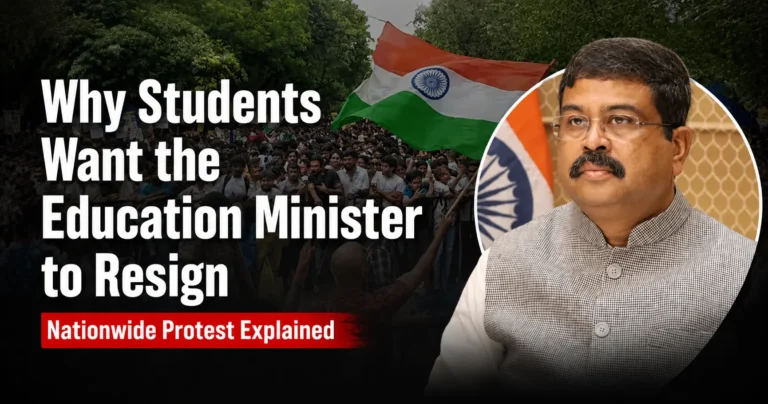
Ask any NEET aspirant what the exam means to them and the answer is never just “an exam.” It is two years of waking up at 5 am. It is a father quietly paying coaching fees he could barely afford. It is a mother postponing everything so her child gets one clean shot at a future. One day, one paper, and everything rides on it.
Now imagine finding out that the same paper was allegedly floating around before the exam, sold to whoever could pay. That is the moment something breaks inside a student. Not just disappointment. Trust.
That broken trust is what has brought thousands of young people onto the streets of Delhi, demanding that Union Education Minister Dharmendra Pradhan step down. The protest has crossed a month now, and it shows no sign of dying out. Here is why.
This Did Not Start Yesterday
One bad year, and students would have moved on. But this is different. Exams like NEET are counted among the toughest exams in India. Students give them everything they have. So when these very exams keep getting leaked or delayed, nobody believes it is an accident anymore.
The NEET-UG mess of 2024, followed by fresh leak allegations in 2026. The CBSE Class 12 portal collapsing right in the middle of board season, leaving lakhs of families staring at error screens. CUET admissions running months behind schedule. Reported irregularities in SSC exams, plus paper leaks in recruitment tests like REET and the SI exam.
Protest groups estimate that nearly one crore young people have been hit by exam failures and leaks in recent months. Even if that figure gets argued over, the basic point stands. The same system keeps failing in the same ways, again and again, and nobody at the top has answered for it yet.
Seven Students Are No Longer Here
This is the part that turned frustration into a movement. Protesters have counted seven NEET aspirants who died by suicide, deaths they connect to the leak controversy and the unbearable stress it created. The Cockroach Janta Party, the outfit leading the agitation, has demanded Rs 1 crore in compensation for each of those families.
A leaked paper can be re-examined. A crashed portal can be repaired. A child who gave up because the system cheated them cannot be brought back. Students on the ground keep repeating this line in different words, and it is hard to argue with. After a certain point, “we are investigating” stops being an acceptable answer.
The Day Delhi Turned Into a Battlefield
The sit-in at Jantar Mantar had been going on peacefully since June 20. Sonam Wangchuk, the Ladakhi reformer many students look up to, joined the hunger strike on June 28. Then came July 20, the opening day of Parliament’s Monsoon session, when protesters decided to march to Parliament itself. They called it Sansad Chalo. Schoolkids in uniform, college students, parents, even grandparents walked with them. Some wore cockroach costumes, a nod to the party’s odd but deliberate name.
The march never reached Parliament.
Barricades seven feet tall had reportedly been welded shut along the route. Metro stations were closed, allegedly with students still stuck inside some of them. When the crowd pushed forward, lathis and tear gas came out. Students from Delhi University described being beaten while marching unarmed. More than 60 protesters were reported injured, and Wangchuk’s wife, Gitanjali Angmo, was allegedly shoved around in the chaos. Around 70 people were arrested by evening.
The police did not walk away unhurt either, and honesty demands saying so. Delhi Police put its own injury count at over 118 personnel, including officers as senior as a Special Commissioner and several women constables. Videos from the day showed one officer falling during a scuffle and being hit and dragged by protesters, another having his helmet ripped off mid-argument. Government vehicles and public property were damaged too, according to the police statement.
So students bled, and policemen bled. Which raises the obvious question. How did a demand for fair exams reach a point where both sides ended up in hospital? The protesters have their answer ready: because for weeks, nobody in power was listening.
The Case for Resignation, in Plain Words
Take the party politics out of it and the students’ logic is not complicated.
Somebody has to own this. The Education Minister sits at the top of the system. When leaks and failures repeat under one tenure, the blame cannot keep landing on exam agencies and junior officials forever. The protesters’ slogan says it plainly, accountability has to start at the top or it starts nowhere.
The promises have already been tried. After 2024, there were assurances, committees, statements. Two years later, students were back on the road over the same problem. For them, that settles the debate about whether the current setup can fix itself.
An exam is only worth the trust behind it. If a rank can be bought, then every honest student’s two years of preparation becomes a gamble. That is the quiet damage nobody measures. Wangchuk put it well during the protest, the leak is only a symptom, and patching exams means nothing if the system underneath stays rotten.
And a resignation, students argue, is the reset button. Not revenge, not politics. Just the first believable signal that the government intends to rebuild rather than defend.
Why This Is Bigger Than One Minister’s Chair
India loves talking about its young population as its greatest asset. That asset works on one condition, that hard work reliably converts into opportunity. Every leaked paper tells a lakh honest students the game is fixed. Every delayed exam steals a year from some family’s plans. Every suicide linked to exam stress is the system flashing red.
That is why this protest refuses to fade, and why it keeps pulling in people who have no exam to write themselves. Parents stand there for their children. Grandparents stand there because they remember when a government job exam meant something. The chair at Shastri Bhawan is almost beside the point. The real question is whether merit still counts for anything in this country.
What the Government Says
Fairness demands the other side too. The government’s position is that investigations into the alleged leaks are still on, and that due process should decide responsibility, not street pressure. Analysts add that no government likes accepting a resignation under protest, since it reads like an admission of guilt. The Centre has met protest representatives, including a sit-down with Union Minister J.P. Nadda, and Delhi Police has defended its July 20 response by pointing to its own injured personnel and the damaged property.
Maybe the minister stays. Maybe he goes. Either way, the questions students are shouting outside Parliament are not going anywhere. Who leaked the papers? Who made money off them? Why does it keep happening? And when does someone, anyone, finally say the words “this was my responsibility”?
The police can block every road, but they cannot block the anger anymore.