


There is a problem sitting at the heart of modern computing that does not get nearly as much attention as it deserves. AI chips are getting more powerful at an extraordinary pace. But they are also getting hotter — generating so much heat that managing it has become one of the semiconductor industry’s most significant engineering challenges.
The solution, most experts agree, lies in better materials. New substances with better thermal properties, better conductivity, better everything. The problem is that finding those materials the traditional way — through years of painstaking laboratory research, trial and error, and interdisciplinary collaboration — is far too slow to keep up with how quickly the chip industry needs them.
That is the gap that Discovered Materials is trying to close, using AI agents to compress what currently takes years of research into a matter of days. The startup, founded by two IIT Madras alumni, has raised $9 million in seed funding — approximately ₹85 crore — to accelerate that work.
Who Is Behind This?
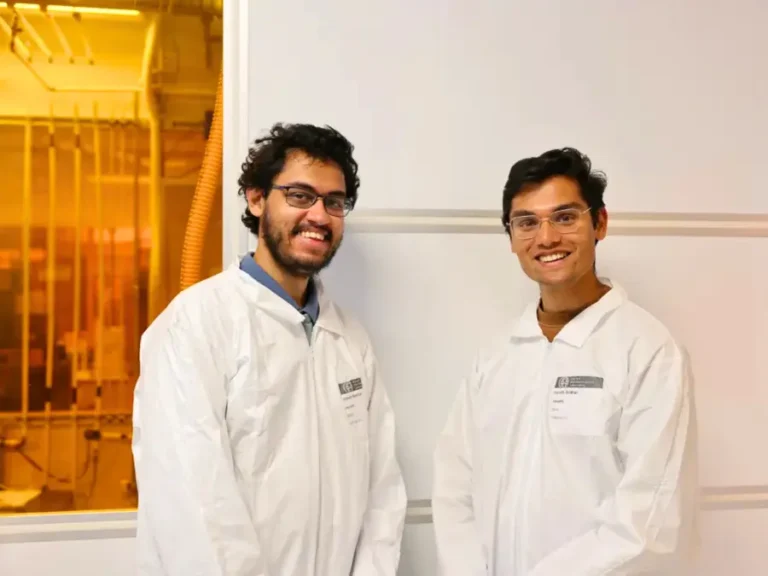
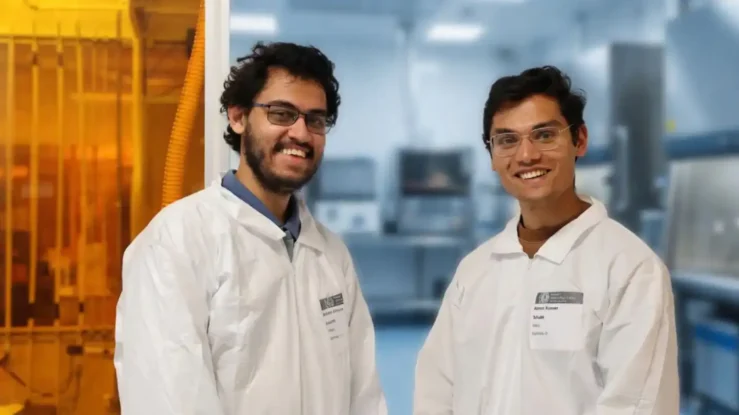
Advaith Sridhar and Akash Ramdas met over a decade ago as students at IIT Madras. Their paths diverged after graduation in directions that now, in retrospect, look almost perfectly designed to converge on this exact problem.
Sridhar went to Stanford University, where he earned a PhD in Materials Science. He has spent the last eleven years researching new materials specifically for semiconductor chips, and his work on nanoscale interconnects was so significant that it became Stanford Engineering’s most widely read story of 2025.
Ramdas went to Carnegie Mellon to study AI, and then spent years as a research engineer building video models and AI agents at Persona AI — which was later acquired — and Luma Labs.
One person who knows everything about the materials that chips need. One person who knows everything about building AI systems that can search, reason, and discover at scale. That combination is not accidental, and it is the foundation of what Discovered Materials is building.
Who Is Investing and Why
The seed round was led by Lightspeed India Partners, with participation from Y Combinator and Peak XV Partners. The angel investor list includes Paul Graham, the founder of Y Combinator himself, along with Gokul Rajaram and Thariq Shihipar.
That is a serious group of names for a seed round. These are investors who back companies when the problem is real, the founders are exceptional, and the timing is right. The fact that both Lightspeed and Y Combinator are in the same round alongside Paul Graham sends a clear signal about how the people closest to the technology landscape are thinking about materials discovery as a category.
Also Read: Best Stocks to Buy This Month
Hemant Mohapatra, Partner at Lightspeed India Partners, explained the reasoning plainly: “AI is creating unprecedented demand for better chips, but progress is increasingly constrained by how slowly new materials reach production.
Akash and Advaith bring together a rare combination of deep materials science expertise and frontier AI engineering, enabling them to compress years of materials R&D into days.”
The Problem They Are Solving
Here is why this matters.
Modern AI chips generate extraordinary amounts of heat. As they get more powerful — more transistors, more processing, more parallel computation — the heat problem gets worse, not better. Managing that heat is already one of the biggest engineering bottlenecks in the semiconductor industry, and it is going to get more difficult as chips continue to advance.
Advanced packaging technologies like 3D stacking — where chips are layered on top of each other to improve performance and reduce power consumption — make the heat problem even harder, because the heat has fewer places to go.
New materials with better thermal properties could solve significant parts of this problem. But finding those materials is the challenge. Traditional materials research involves enormous amounts of human expertise, laboratory time, and iterative testing. It is slow, expensive, and difficult to scale.
Akash Ramdas put the scale of the opportunity bluntly: “Chips today are at least 10,000x less power-efficient than the human brain. New materials are how we close that gap.”
He also pointed to what the company has already achieved: “In the last three months, we have made new thermal materials that match the performance of products that the world’s largest chemical companies took years to develop.”
That claim — matching years of corporate R&D in three months — is the clearest indicator of what AI-driven materials discovery could mean for the industry at scale.
What the AI Agents Actually Do
Discovered Materials’ AI agents work across three interconnected stages of the materials discovery process: simulation, synthesis, and experimental validation.
In plain terms, the AI does not just suggest materials theoretically — it runs simulations to test how they would perform, explores how they could be synthesised in a laboratory, and helps validate those predictions against real experimental results. The agents work across all three stages simultaneously, which is what enables the compression from years to days.
To demonstrate this capability and give the research community a way to measure progress, the company has released hundreds of new AI-discovered materials for semiconductor applications alongside a new benchmark called the Material Discovery Bench — described as the first benchmark specifically designed to evaluate AI agents on real-world semiconductor materials discovery problems.
The benchmark was developed in collaboration with experts from academia and industry, and the company says it will continue to evolve as the agents improve and more experimental validation data becomes available.
Similar Read: 10 Best Coworking Spaces in Delhi for Startups & Freelancers
Where the $9 Million Goes
The funding will primarily be used to expand the team, grow the laboratory infrastructure, and scale the AI research agents. Building AI systems that can genuinely compress materials R&D requires both computational resources and physical laboratory capacity — the AI has to be validated against real experimental results, not just simulations.
The goal is straightforward: make new material discovery fast enough to keep pace with AI’s demand for compute. If the semiconductor industry cannot find better materials quickly enough, the pace of chip improvement will slow. Discovered Materials is betting that AI agents are the tool that breaks that bottleneck.
For two IIT Madras graduates who met as students over a decade ago, it is a genuinely ambitious problem to be working on. The $9 million suggests some of the most respected people in the technology industry think they are the right people to solve it.