



With fuel prices continuing to put pressure on household budgets, knowing exactly how efficiently your car is using fuel isn’t just a curiosity — it’s practical financial information. Most drivers have a rough sense of their car’s mileage, but far fewer know whether what they’re reading is accurate.
The conversation got a fresh push recently when Union Road Transport and Highways Minister Nitin Gadkari made a statement that caught many drivers off guard — that you can’t accurately measure your vehicle’s mileage on your own and that proper measurement requires equipment at an authorised dealership. Predictably, that sparked debate among the many car owners who’ve been calculating mileage themselves for years.
So what’s the truth? And what’s the most reliable method for an everyday driver?
Can You Trust the Mileage Shown on Your Car’s Dashboard?
The fuel economy figure on your dashboard comes from your car’s Engine Control Unit (ECU), which constantly pulls data from sensors monitoring fuel injection, throttle position, engine load, vehicle speed and distance travelled. It then runs those figures through a calculation and displays an estimated fuel consumption figure in real time.
Estimated is the operative word. The ECU’s calculation is genuinely useful, but it is not a precise measurement of real-world fuel consumption. Several everyday factors affect how accurate it is:
- Traffic conditions and stop-start driving
- How hard you’re pressing the accelerator
- Air conditioning use
- Tyre pressure
- Road gradients
- Time spent idling
- When the trip meter was last reset
In practice, the difference between your dashboard reading and your actual fuel efficiency typically falls somewhere between 2% and 10% — sometimes in your favour, sometimes not.
That doesn’t make the dashboard useless. It’s excellent for tracking trends over time and spotting when something has changed. But if you want to know precisely how much fuel your car is actually consuming per kilometre, you need a different approach.
The Tank-to-Tank Method Is the Most Reliable
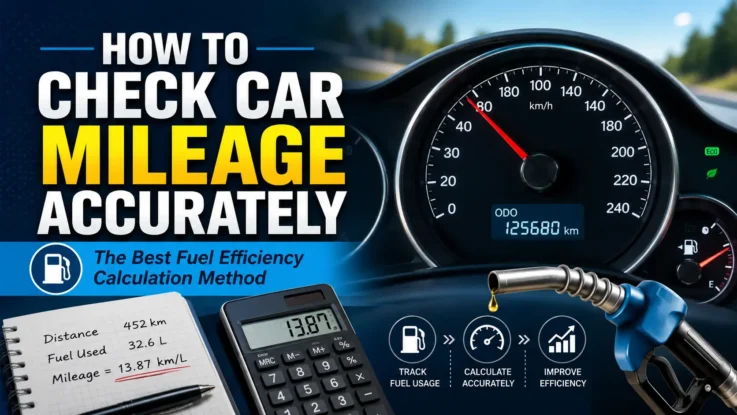
The tank-to-tank method is the gold standard for calculating real-world fuel efficiency, and the reason it’s trusted is simple — it measures what actually happened rather than estimating what the computer thinks happened.
The other advantage is that it requires nothing special. No equipment, no apps, no trips to a service centre. Just a fuel station and five steps.
Step 1: Fill the Tank Completely
Pull into your regular fuel station and fill the tank until the nozzle’s automatic cut-off triggers. The tank needs to be genuinely full — not nearly full — for this to work accurately.
For consistency across multiple measurements, try to use the same station and the same pump each time.
Step 2: Reset the Trip Meter
As soon as you’ve finished filling, reset your car’s trip meter to zero. This is what will tell you how far you’ve travelled before the next refill.
Don’t skip this step or do it later — reset it at the pump before you drive away.
Step 3: Drive Normally
This is important — don’t change anything about how you drive. The point is to measure your real-world fuel efficiency, not an ideally efficient version of it. Drive your usual routes, in your usual way, until you’re ready for your next refill.
Step 4: Refill the Tank
When you return to the fuel station, fill the tank completely again until the automatic cut-off triggers. Write down two numbers: the amount of fuel you just added in litres, and the distance showing on your trip meter.
Step 5: Calculate the Mileage
The formula couldn’t be simpler:
Mileage (kmpl) = Distance Travelled ÷ Fuel Filled
Working through an example:
- Distance travelled: 520 km
- Fuel added: 40 litres
- Calculation: 520 ÷ 40 = 13 kmpl
Your car delivered 13 kilometres per litre over that period of driving.
Repeat the Process for Better Accuracy
One calculation gives you a useful snapshot. Three or four give you something much more reliable.
Daily driving conditions vary — some days are more highway, some are more city traffic, temperatures change, loads change. Averaging your mileage across several refill cycles smooths out those variations and gives you a figure that genuinely reflects how your car performs across different real-world conditions.
This is also how you catch a gradual decline in efficiency that might not be obvious from any single measurement.
What Does an Authorised Dealer’s Machine Do?
When you take your car to an authorised service centre, the diagnostic equipment they connect to your vehicle does something different from measuring fuel consumption.
These systems interface directly with the car’s onboard computer and can read engine health data, fuel injector performance, sensor outputs, ECU fault codes and other technical information that tells a technician whether something is mechanically or electronically wrong.
That’s valuable — but it’s not the same as measuring how far your car travels per litre on actual roads. What dealer diagnostics can do is identify why your mileage might have dropped. A faulty oxygen sensor, clogged fuel injectors, an engine running rich — these are the kinds of problems that a diagnostic machine can pinpoint and that the tank-to-tank method can only flag as “something has changed.”
So Minister Gadkari’s point has merit in a specific context: precise technical measurement of a vehicle’s certified fuel consumption requires controlled conditions and equipment. But calculating your real-world mileage as a practical tool for understanding your car’s performance? The tank-to-tank method handles that perfectly well.
Also Read: Hidden Car Key Features Most Indian Drivers Never Use
Which Method Should You Follow?
For most drivers, most of the time, the answer is clear — the tank-to-tank method is the most straightforward and dependable way to understand your car’s actual fuel efficiency. It’s free, it’s easy, and it measures what actually happened rather than what a sensor estimated.
Keep an eye on your dashboard reading too — it’s a useful early warning system for changes in consumption — but treat it as an indicator rather than a precise figure.
And if your tank-to-tank calculations start consistently showing worse mileage than they used to — without any obvious change in your driving or conditions — that’s a reliable signal that something mechanical or electronic may need attention. At that point, a visit to an authorised service centre is worth the trip.