


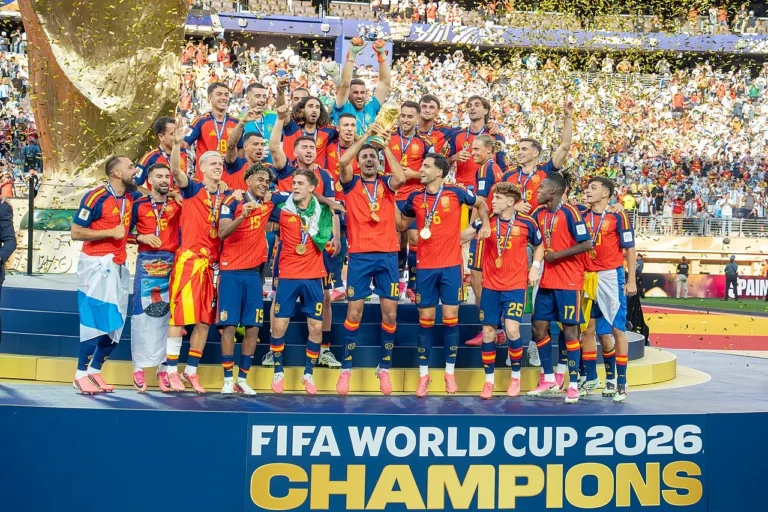
Spain are world champions again. After sixteen long years, La Roja have their hands on the FIFA World Cup trophy once more. Here’s the full final match report and key facts.
A gruelling, tense, and ultimately historic final at New York New Jersey Stadium ended Spain 1-0 Argentina, with Ferran Torres scoring the decisive goal in the 106th minute of extra time to deny Argentina a second consecutive World Cup title.
It was a night that had everything — tactical battles, enormous defensive resolve from both sides, a red card that changed the shape of the match, and one moment of quality that settled it all.
How the Final Played Out
From the first whistle, the shape of this match was clear.
Spain controlled possession through their trademark short passing game, keeping the ball patiently and refusing to give Argentina any free space to breathe. Argentina, in contrast, sat deep and looked to hurt Spain on the counter-attack, using the directness and pace of their forwards to threaten on the break.
For ninety minutes, neither approach produced a goal. The defensive quality on both sides was exceptional, with both goalkeepers barely tested in open play. The match was tight, physical, and absorbed by two teams that clearly respected each other enormously.
Then came the moment that changed everything.
In the dying seconds of normal time, Argentine midfielder Enzo Fernández — the man whose stunning long-range strike had broken English hearts in the semi-final — was shown his second yellow card for fouling a Spanish player. The red card came right at the end of the 93rd minute, sending Argentina into extra time with only ten men.
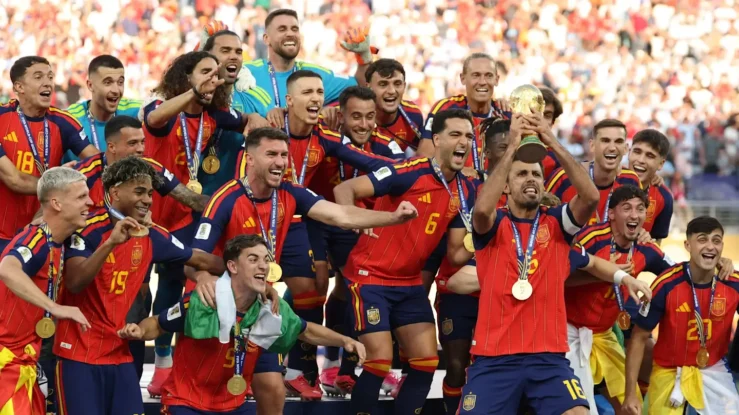
The Decisive Moment
Playing against ten men, Spain grew in confidence and urgency as extra time began.
They pressed higher, moved the ball quicker, and began to find space in areas that Argentina had previously defended comfortably. The Argentine defence, though reduced in numbers, held firm for as long as they possibly could.
But in the 106th minute, the moment arrived.
Ferran Torres received the ball, drove at the Argentina defence, and fired a low, precise shot into the bottom corner of the net. The Spanish players sprinted toward him in celebration. The Spanish fans inside the stadium erupted.
Argentina pushed desperately for an equaliser through the remaining minutes of extra time, but Spain held on with the composure of a team that had controlled this tournament from the very beginning.
Key Match Facts
Spain 1-0 Argentina — New York New Jersey Stadium, July 19, 2026
Goal: Ferran Torres (106′)
Red Card: Enzo Fernández — Argentina (93′)
Yellow Cards: Spain 2, Argentina 6
The discipline disparity in the yellow card count tells part of the story — Argentina were increasingly frustrated as the match wore on, and the eventual red card was the culmination of a tense and physical evening.
Spain’s Place in History
With this victory, Spain are now four-time World Cup winners — 1010, 2010, and now 2026.
They join Brazil (five titles), Germany and Italy (four each) in football’s most exclusive club. Spain have also made history in another remarkable way — they are now the only nation to have won both the men’s and women’s FIFA World Cup in the same calendar year.
The squad that achieved this was notably young. A generation of players who came through under the Spanish football philosophy — technical, patient, high-pressing — carried that identity all the way to the final and executed it when it mattered most.
Related Article: Argentina Beat England 2-1 to Reach FIFA World Cup 2026 Final
Argentina’s Defeat
For Argentina and Lionel Messi, this was a painful ending to an extraordinary tournament.
The defending champions came so close to becoming only the third team in history to win back-to-back World Cups, but the red card to Fernández proved decisive. Argentina defended magnificently with ten men, and nobody could question their effort or commitment, but one moment of individual discipline cost them everything.
Messi, who made those two extraordinary late assists against England in the semi-final, finishes the tournament having written more pages in a story that already has no equal in football history. For Argentina, the hurt of this defeat will take time to fade.
World Cup Winners Since 2002
| Year | Champion | Runner-Up | Score |
|---|---|---|---|
| 2026 | Spain | Argentina | 1-0 (AET) |
| 2022 | Argentina | France | 3-3 (4-2 pens) |
| 2018 | France | Croatia | 4-2 |
| 2014 | Germany | Argentina | 1-0 (AET) |
| 2010 | Spain | Netherlands | 1-0 (AET) |
| 2006 | Italy | France | 1-1 (5-3 pens) |
| 2002 | Brazil | Germany | 2-0 |
Related Article: Spain vs Argentina World Cup 2026 Final: Commentators & Reporters
The FIFA World Cup 2026 across the United States, Canada, and Mexico has been a month-long celebration of football at its finest — 104 matches, 48 teams, records broken, legends created, and moments that will be replayed for generations.
The next World Cup in 2030 will span three continents — a fitting expansion for a tournament that continues to grow in scale and ambition.
But for now, this moment belongs to Spain. Four-time world champions. Kings of football once more.