


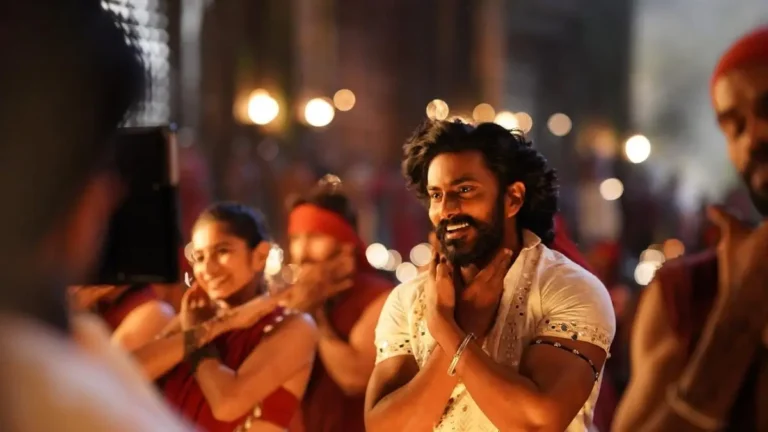
Nagabandham Movie Review: ★★★☆☆ (3/5)
Virat Karrna impresses with his commitment, but the film’s bloated runtime and uneven storytelling make the journey exhausting. Abhishek Nama’s ambitious mythological drama delivers visual grandeur but struggles to keep its story engaging for nearly three hours.
Rating: 3/5
Released: July 3, 2026
Director: Abhishek Nama
Cast: Virat Karrna, Nabha Natesh, Rishabh Sawhney, Jagapathi Babu, Murali Sharma, Mahesh Manjrekar
There’s a version of Nagabandham that could have been genuinely great. The premise is solid — ancient temples, hidden sacred relics, a battle between dharma and greed stretching across centuries. The production design is lavish. Visually, the film makes you sit up and take notice, especially in the opening stretch. But somewhere between the ambitious concept and the actual execution, something goes badly wrong. And it keeps going wrong for nearly three hours and ten minutes.
At the centre of Nagabandham is the Brahma Kamalam — a sacred golden flower hidden inside the ancient Ranganatha Swamy temple at Srirangapuram. A ruthless villain named Ali (Rishabh Sawhney) wants it, working for the centuries-old, cave-trapped Bairagi. Standing in his way is Rudra (Virat Karrna), a simple boat operator in the same village who becomes the unexpected protector of the relic and everything it represents.
There are dual timelines, a past-life connection, flashbacks to the 1700s, temple lore, a love story, a sister’s wedding track, Naga Sadhus, Afghan invaders, and crocodile fights. It’s a lot. Perhaps too much.
To his credit, Virat Karrna doesn’t phone this in. He has clearly worked hard on his physique, and his portrayal of the 17th-century Naga Sadhu is genuinely striking — there’s a presence to those scenes that stands out. His action sequences are handled with energy and physicality that few newcomers can pull off at this scale.
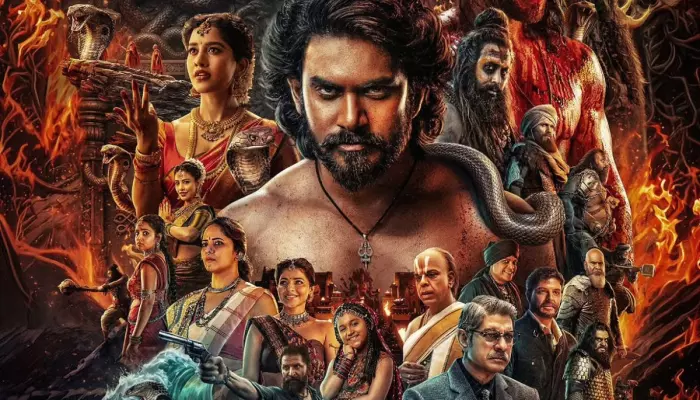
The problem isn’t the actor. It’s what the writing asks of him. Rudra as a character has almost no vulnerability, no real emotional arc, and exists primarily to look powerful and deliver long speeches about Sanatana Dharma in the final act. The film doesn’t let him be a person — it turns him into a symbol, and symbols are hard to root for.
Rishabh Sawhney makes a solid villain with decent screen presence. Jagapathi Babu is reliable as always. Nabha Natesh gets a dual role with some actual depth this time, and she handles it reasonably well. The women in the film, however, are largely reduced to decorative roles — which feels like a significant missed opportunity in a story that could have been more.
The first hour of Nagabandham is genuinely engaging. The temple set built for the film is magnificent. Soundar Rajan’s cinematography is rich — well-framed, beautifully lit, with real cinematic texture. Some of the VFX holds up impressively for a film not backed by massive studio money.
But then the screenplay starts to fall apart. A dream song appears out of nowhere. A celebration number follows ten minutes later. The pace collapses completely. The second half introduces an extended flashback set in the 1700s that runs close to an hour — and while the setting is interesting, the confrontations become repetitive long before they’re done. Two separate climax fight sequences, both unnecessarily stretched, test your patience in ways the film never recovers from.
Similar Read: Rao Bahadur Review
The editing is arguably the film’s weakest technical element. At least 30 minutes could have been trimmed without losing anything meaningful.
Nagabandham leans into a familiar and common template — communal tension, religious symbolism, a rage-filled Hindu hero protecting his culture from outside forces. The film uses saffron and green as deliberate visual symbols and frames Rudra’s journey as something more politically loaded than spiritually sincere. Whether that troubles you or not will likely shape how you experience the film overall.
Nagabandham is proof that visual ambition alone cannot carry a film. The frames look expensive, the scale is impressive, and Virat Karrna shows genuine commitment. But without a tight screenplay, without emotional depth, and without the discipline to know when enough is enough, all of that effort adds up to an exhausting experience rather than a satisfying one.
Watch it if you’re a fan of the genre and happy to overlook narrative flaws for the sake of spectacle. Everyone else may want to wait for OTT.