


We love a good rags-to-riches story in Indian cricket. A boy from nowhere, no money, a father’s sacrifice, and then the IPL auction board flashing a crazy number. Mukul Choudhary gave us exactly that this season. His father took loans, faced legal trouble, gave up everything — and Mukul repaid it all with that 54 off 27 against KKR that had an entire stadium on its feet.
But here is what I want to say before we talk about Anukul Roy. Not every inspiring cricket story starts in crisis. Some start in a government advocate’s home in Samastipur, Bihar, with a father who simply refused to let geography kill his son’s talent. That is a different kind of sacrifice. Quieter. Less dramatic. And almost always overlooked.
Anukul Roy’s story is the overlooked kind. But it is every bit as worth telling.
Born in the Wrong State at the Wrong Time
Anukul Sudhakar Roy was born on 30 November 1998 in Samastipur, Bihar. His father Sudhakar Roy was a practicing lawyer — a respected man with a stable life. Not a family under financial stress. A family that had options.
What they did not have was a state cricket team.
For 14 years, Bihar was wiped off the Indian domestic cricket map. No Ranji Trophy. No proper turf wickets. No selectors watching. If you were a talented young cricketer growing up in Bihar during those years, you simply did not exist in the system’s eyes. Your talent was real. The pathway was not.
So every morning, Sudhakar Roy left his legal practice, and father and son boarded the 5:30 am bus — 70 kilometres each way — just so Anukul could train properly. Think about what it means for a lawyer, a man with a career and dignity, to make that choice every single day. Not because the family was desperate. Because the boy deserved better than what Bihar could offer.
That is how the story begins. Not with poverty. With purpose.
Also Read: Who is Krish Bhagat
Crossing the Border, Starting Again
When Anukul was fourteen, the family made a harder call. He moved to Jamshedpur, just across the state line in Jharkhand. Same language, completely different cricketing world. The Jharkhand State Cricket Association had actual structure — age group matches, proper pitches, coaches who showed up, and most importantly, a domestic ladder that went somewhere.
But relocating for cricket in India has its own hidden cost. The boys he now trained alongside had played together since they were eleven or twelve. They had shared memories, inside jokes, a brotherhood built over years. Anukul Roy had talent and not much else. He was the outsider.
He dealt with it the way smart cricketers always do. He made himself too good to leave out. He bowled more overs in the nets than anyone else. He batted lower down in domestic games, contributed whenever asked, and slowly, quietly, built a reputation in Jharkhand cricket that nobody could dispute.
Also Read: Digvesh Rathi Life Story — What’s Gone Wrong for LSG’s Mystery Spinner in IPL 2026?
2018 — India Wins, The World Moves On
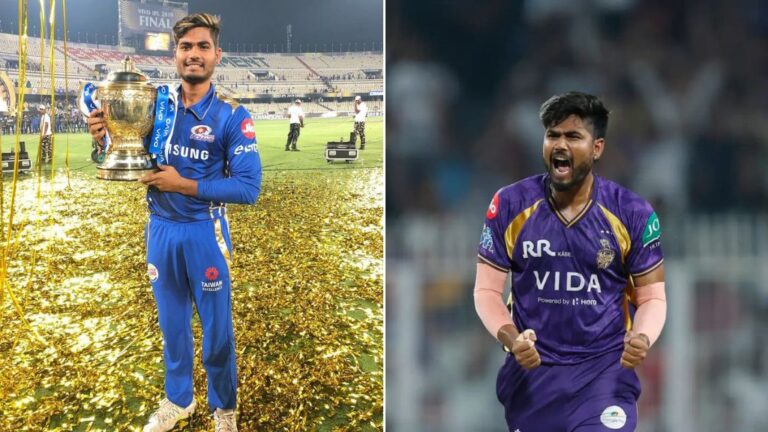
The 2018 ICC Under-19 Cricket World Cup was Anukul Roy’s moment to announce himself globally. He did exactly that. He finished as India’s joint highest wicket-taker in the tournament with 14 wickets. He did it while managing recovery from an ankle stress fracture that had threatened his selection right before the squad was announced. India won the title. There were celebrations everywhere.
And then, as always happens with Indian cricket, the spotlight moved quickly. Prithvi Shaw. Shubman Gill. The batting names traveled furthest and fastest.
Anukul Roy, the left-arm spinner who had helped India actually win the tournament, went back to Jharkhand.
Mumbai Indians picked him up in the 2018 auction. Twenty lakh rupees. He trained hard, showed up early, kept his head down. He barely played. Season after season, the IPL was something that happened around him rather than to him. He watched matches from the dugout more times than any U-19 World Cup winner should have to.
KKR eventually brought him in. He has spent seven IPL seasons being what cricket insiders call a “net asset” — the kind of player everyone appreciates in practice but cannot find a spot for on matchday. Retained for less than the price of a luxury car. You could argue the system undervalued him. You would be right.
Similar Article: Who is Eshan Malinga?
What Changed Before IPL 2026 — And Why It Actually Matters
Here is the thing about cricketers who grind in domestic cricket for years. They do not suddenly become different players. They just finally get conditions where what they already were starts to show up properly.
Roy spent the 2025 pre-season doing the work that never makes headlines. Buchi Babu Trophy. Domestic camps. Hot stadiums in Tamil Nadu where the ball grips and the batsmen get honest feedback. He worked specifically on his batting — opened his stance slightly, worked on getting into better positions against the short ball. His T20 strike rate went from around 137 to 160. In List A cricket he was striking at 122. These are not cosmetic numbers. This is a bowler-who-can-bat becoming a genuine lower-order threat who changes match situations.
The bowling, though — that was never the problem. Anukul Roy bowls left-arm orthodox spin the way it used to be bowled before every spinner felt pressure to have a mystery variation. Stump to stump. Fast. Flat. Accurate. He does not give batsmen width to free their arms. He does not give them pace to work with. Captains can set attacking fields when he bowls because he controls the pressure naturally.
Justin Langer, the LSG head coach who watched Mukul Choudhary do something similar with a bat against KKR, said it best about young cricketers like these two: they have that look in their eyes. Hungry. Curious. Wanting to get better every single day. Anukul Roy has had that look since he was fourteen and crossing state borders on a bus to find a cricket ground that would take him seriously.
The Players Indian Cricket Was Sleeping On
This IPL 2026 season has quietly become the season of the overlooked.
Mukul Choudhary walked in when LSG needed 54 off 27 balls and hit seven sixes like he had been waiting his whole life for that exact moment — because, really, he had. His story is one of dramatic sacrifice and a father’s almost reckless belief.
Anukul Roy’s story reads differently but carries the same weight. A state that did not exist on the cricket map. A father who drove 70 kilometres daily before eventually moving the whole family. Seven IPL seasons on the bench. Fourteen wickets at an Under-19 World Cup that India won. Years of Jharkhand performances that should have earned more chances at the top level.
Both these players are finally getting attention they deserved years ago. And that should make all of us — fans, selectors, commentators — ask an honest question about how many Anukul Roys are still out there, bowling accurately in domestic cricket, waiting for someone to actually look.
The Spinner Who Was Always There
Anukul Roy is twenty-six years old. He is not a prospect anymore. He is a proven domestic performer, a U-19 World Cup winner, and a left-arm spinner who gives any T20 captain exactly what a captain needs — control in the powerplay, containment in the middle overs, and now a batting cameo that can change a game’s shape.
Some players need the world to believe in them before they believe in themselves. Anukul Roy was never that kind of player. He believed first, moved states for it, recovered from an ankle injury for it, sat on IPL benches for seven seasons for it, and kept showing up.
Bihar’s cricket infrastructure failed him. The IPL system was slow to reward him. But the man himself never flinched.
That, in the end, is its own kind of story worth telling.