


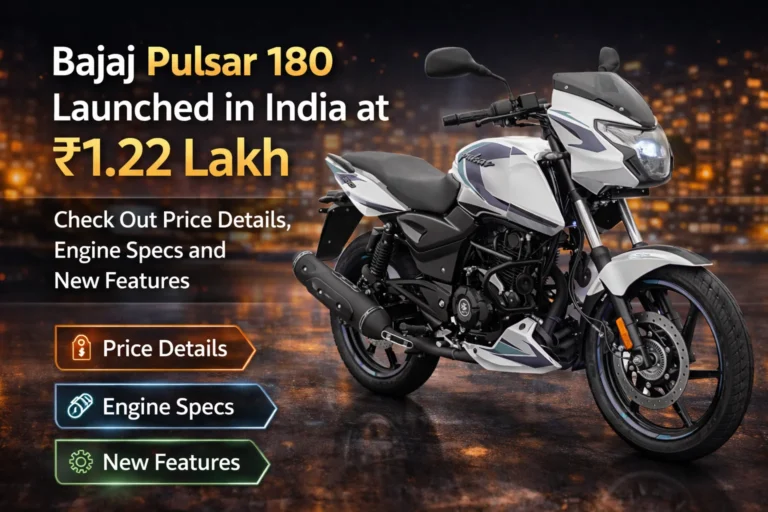
There are motorcycles you forget about, and then there are motorcycles that genuinely meant something to a generation of riders. The Bajaj Pulsar 180 is firmly in the second category.
After going missing from showrooms for nearly three years, the Pulsar 180 is back in India in 2026, priced at ₹1.22 lakh ex-showroom. The timing is deliberate — Bajaj is celebrating 25 years of the Pulsar brand, and bringing back the 180 is as much a tribute to that legacy as it is a product launch.
For a lot of riders who grew up watching older brothers ride these, or who saved up for one as a first real bike — this relaunch carries more weight than a spec sheet can capture.
Where It Sits in the Lineup
The Pulsar 180 has always occupied an interesting spot. Not the entry point, not the flagship — something in between that made a lot of sense for riders who wanted more performance than the 150 without stretching their budget to the 220F.
That positioning hasn’t changed.
| Model | Price (Ex-Showroom) |
|---|---|
| Pulsar 150 | ~₹1.10 lakh |
| Pulsar 180 | ₹1.22 lakh |
| Pulsar 220F | ~₹1.39 lakh |
At ₹1.22 lakh, you’re paying roughly ₹12,000 more than the 150 for a meaningful bump in performance. And you’re staying well under the 220F’s price while getting a bike that feels noticeably more capable than the smaller sibling. For a lot of everyday riders, that middle ground is exactly where they want to be.

The Engine — Familiar, Dependable, and Still Relevant
The Pulsar 180 runs the same 178.6cc single-cylinder engine it’s always been known for, and Bajaj hasn’t tried to reinvent it. They’ve tuned it, refined it, and kept it doing what it does well.
| Specification | Details |
|---|---|
| Engine | 178.6cc, single-cylinder |
| Power | ~17 PS |
| Torque | ~14–15 Nm |
| Transmission | 5-speed manual |
Seventeen horses from a 178cc single might not sound dramatic in 2026, but the way this engine delivers power is the point. It’s smooth, responsive, and builds in a way that feels predictable and confidence-inspiring — qualities that matter a lot more for daily riding than peak figures on a dyno.
Long-time Pulsar riders will feel at home immediately. The throttle response, the way it pulls from low revs, the sound — it’s all there.
Mileage and Real-World Riding
Bajaj claims around 40 to 42 kmpl, which is reasonable for a bike in this performance segment. In real city traffic with regular stop-and-go riding, you’d likely land somewhere around 38 to 40 kmpl, depending on how you ride it.
That’s practical. This isn’t a bike you buy and then spend half your salary fuelling. It commutes efficiently during the week and has enough in reserve to make weekend highway runs genuinely enjoyable.
The lightweight chassis plays a big part in the riding experience too. The bike moves through traffic without fighting you, and the throttle response is quick enough to feel engaging without being twitchy.
Also Read: 2026 Maruti Suzuki Baleno Facelift: Expected Features, Safety Upgrades, and Engine Details
Design — Classic Pulsar, Subtly Updated
Bajaj made the smart call of not trying to completely reimagine the Pulsar 180’s look. The muscular fuel tank, the sharp lines, the aggressive stance — that DNA is preserved. What they’ve added is a layer of modern detailing that makes it feel current without making it unrecognisable.
You get LED headlamps and indicators, which make a real visual difference both in terms of how the bike looks standing still and how well you’re seen on the road at night. Updated graphics and new colour options give it a fresher feel. The tail section is cleaner and more contemporary.
It looks like a Pulsar 180. It also looks like a 2026 motorcycle. Both things are true simultaneously, which is exactly what a comeback model needs to achieve.
Features — More Than You’d Expect at This Price
Bajaj has been sensible about what they’ve added here. The feature set isn’t overloaded, but there are enough updates to make this feel like a genuinely current product.
The semi-digital instrument cluster is a clear improvement over the older fully analogue unit — it’s readable, reasonably comprehensive, and fits the character of the bike. LED lighting is standard throughout. Select variants reportedly include Bluetooth connectivity, which is increasingly expected at this price point.
The switchgear quality has been improved, and the overall finish feels tighter than older Pulsar 180 models. These are the kinds of details that matter when you own a bike for three or four years — they affect daily satisfaction in ways that raw performance numbers don’t.
Suspension, Brakes, and How It Handles
| Component | Details |
|---|---|
| Front Suspension | Telescopic forks |
| Rear Suspension | Twin shock absorbers |
| Brakes | Front disc, rear disc |
| Safety | Single-channel ABS |
The suspension setup is tuned for Indian roads — which means it deals with potholes and broken surfaces without beating you up, while still giving you reasonable feedback when you push into corners. It’s not a sports bike setup, but it’s not supposed to be. It’s a comfortable, capable everyday package.
Single-channel ABS on both variants is a genuine positive. It’s not just a regulatory checkbox — it makes a real difference in emergency braking situations, especially on wet or uneven road surfaces. Having it standard at this price shows Bajaj taking safety seriously rather than just meeting the minimum.
Disc brakes on both ends give you adequate stopping power for the performance on offer, and they respond progressively rather than sharply, which suits the bike’s character well.
What’s Actually New in 2026
To be clear — this isn’t a ground-up redesign. It’s a smart, focused update on a proven formula. What Bajaj has done is bring the Pulsar 180 back with enough changes to make it relevant in 2026 without losing the qualities that made people love it in the first place.
The LED lighting, updated graphics, improved feature set, and refined finish are the headline changes. Under the skin, the engine and fundamentals remain consistent with what loyal Pulsar riders know and trust.
For a comeback model, this is the right approach. Change too much, and you alienate the people who wanted it back. Change too little, and it feels lazy. The 2026 Pulsar 180 threads that needle reasonably well.
Also Read: Triumph Tracker 400 Launched in India at ₹2.46 Lakh – Engine Specs and Other Features
How It Compares to the Competition
The Pulsar 180 competes directly with the TVS Apache RTR 180 and Honda Hornet 2.0 in this segment — both strong motorcycles with their own loyal followings.
The Apache leans sportier in both feel and styling. The Hornet brings Honda’s refinement and reliability credentials. The Pulsar 180 counters with strong brand legacy, wider service network coverage across India, and a price that’s competitive for what it delivers.
Which one you choose will come down to what you prioritise. If brand familiarity and proven reliability across diverse conditions matter most — the Pulsar holds up well against either rival.
Should You Buy It?
If you’re in the market for a dependable, mid-range commuter that has some real personality to it — yes, the Pulsar 180 at ₹1.22 lakh is a solid choice.
It rewards riders who want something more engaging than a basic commuter without demanding the budget of a 220 or 250. The mileage is practical, the performance is genuinely fun, and the feature set has been updated enough to not feel dated.
And if you have history with the Pulsar 180 — if this was the bike you wanted when you were younger, or the one you remember a family member riding — the comeback carries an emotional appeal that specs alone don’t convey.
Some bikes are just part of people’s stories. The Pulsar 180 is one of them. It’s good to have it back.