


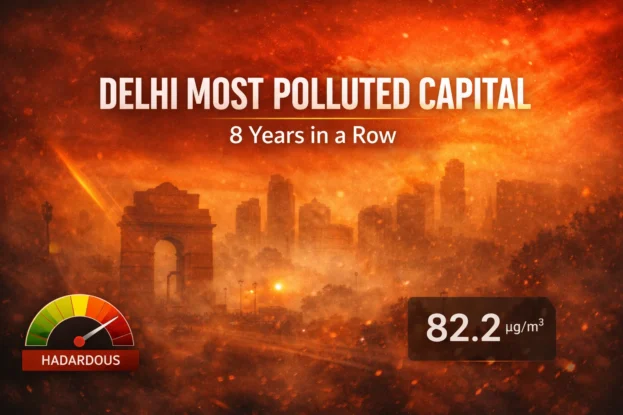
Delhi has once again been ranked the most polluted capital city in the world, continuing its streak for the eighth consecutive year from 2018 to 2025. The latest World Air Quality Report 2025 by IQAir confirms that New Delhi remains at the top despite slight improvements in air quality.
The report, released in March 2026, highlights that while pollution levels have reduced marginally compared to the previous year, they are still far above safe limits. This makes Delhi’s position one of the most concerning environmental challenges globally.
Delhi’s PM2.5 Levels: Latest Data Explained
The most critical indicator of air pollution is PM2.5 concentration, which refers to fine particulate matter that can enter the lungs and bloodstream. In 2025, New Delhi recorded an annual PM2.5 level of 82.2 µg/m³, which is extremely high.
This figure is 16.4 times higher than the World Health Organization’s recommended safe limit of 5 µg/m³. Even when compared to India’s own standard of 40 µg/m³, Delhi’s air quality remains more than double the acceptable level.
Delhi vs Entire NCR: A Wider Pollution Picture
When the entire Delhi region (not just the New Delhi municipal area) is considered, the pollution levels are even more alarming. The broader Delhi area recorded around 99.6 µg/m³, placing it among the most polluted cities globally.
In fact, Delhi ranked as the fourth most polluted city in the world when compared with other global urban areas. It was behind smaller cities like Loni, Hotan, and Byrnihat, which recorded even higher PM2.5 levels.
Top 10 Most Polluted Capital City in the World
The IQAir report ranks capital cities based on annual PM2.5 levels. Delhi continues to lead the list, followed by several Asian and African capitals.
| Rank | Capital City | Country | PM2.5 (µg/m³) |
|---|---|---|---|
| 1 | New Delhi | India | 82.2 |
| 2 | N’Djamena | Chad | ~91.6 |
| 3 | Dhaka | Bangladesh | ~68 |
| 4 | Dushanbe | Tajikistan | ~57.3 |
| 5 | Hanoi | Vietnam | ~45 |
| 6 | Kathmandu | Nepal | ~45 |
| 7 | Abuja | Nigeria | ~42 |
| 8 | Jakarta | Indonesia | ~41.7 |
| 9 | Manama | Bahrain | ~40–45 |
| 10 | Ulaanbaatar | Mongolia | ~40–45 |
These rankings show that developing regions with rapid urban growth and limited pollution control measures dominate the list.
Why Delhi Continues to Rank No.1 in Pollution
Delhi’s consistent ranking as the most polluted capital is due to a combination of local and regional factors. The city faces pollution sources throughout the year, making it difficult to achieve sustained improvements.
One of the biggest contributors is vehicular emissions, as Delhi has one of the highest vehicle densities in India. Industrial activity, construction dust, and waste burning also add to the pollution load daily.
Seasonal Factors That Worsen Air Quality
Pollution in Delhi becomes significantly worse during the winter months. From October to February, the city experiences a sharp rise in PM2.5 levels due to weather conditions and external factors.
Crop residue burning in nearby states like Punjab and Haryana plays a major role during this period. Combined with low wind speed and temperature inversion, pollutants get trapped over the Indo-Gangetic Plain, creating severe smog conditions.
Also Read: 15 Tallest Statues of Indian Gods – Height and Address Details
Policy Measures and Challenges in Implementation
Several measures have been introduced over the years to control pollution in Delhi. These include the Graded Response Action Plan (GRAP), odd-even vehicle schemes, and stricter construction regulations.
However, implementation remains inconsistent across regions, especially in the NCR belt. Weak enforcement and lack of coordination between states continue to limit the effectiveness of these policies.
Global Perspective on Air Pollution Crisis
Delhi’s ranking also reflects a larger global issue where only a small number of countries meet safe air quality standards. Many rapidly growing cities in Asia and Africa face similar challenges due to urbanization and industrial growth.
The concentration of polluted capitals in developing regions highlights the need for stronger environmental policies and cleaner technologies. It also shows that air pollution is not just a local issue but a global public health concern.