


Wartime and geopolitical crises often disrupt traditional financial systems. Banks may shut down, currencies can lose value, and cross-border payments become difficult.
In such conditions, cryptocurrencies emerge as an alternative financial system. They allow people to store, transfer, and access money without relying entirely on banks or governments.
Table of Contents
Why Crypto Gains Attention During Conflicts
During wars, financial restrictions such as capital controls and sanctions become common. These restrictions limit access to money, pushing individuals and institutions to explore alternative solutions.
Cryptocurrencies offer borderless transactions and faster transfers. This makes them attractive in situations where traditional systems are slow or restricted.
Real-World Use Cases of Crypto in Wartime
Donations and Emergency Funding
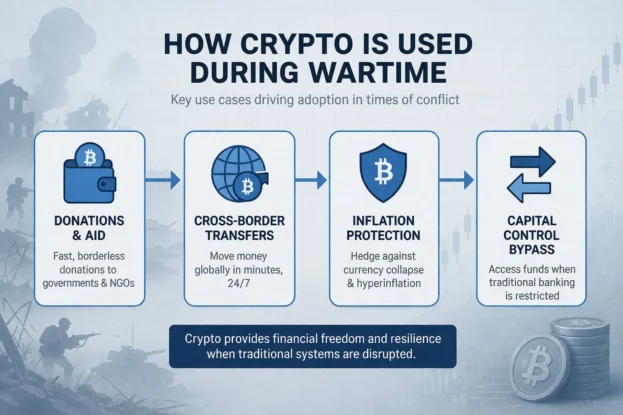
One of the most visible uses of crypto during war has been fundraising. Governments and organizations have received global donations directly through crypto wallets.
These funds are often used for humanitarian aid, medical supplies, and essential logistics. The speed of transactions allows funds to arrive within minutes instead of days.
Cross-Border Transfers and Remittances
In conflict zones, sending money internationally becomes a major challenge. Traditional banking channels may be disrupted or unavailable.
Crypto enables quick and direct transfers across borders. This is especially useful for refugees and families relying on financial support from abroad.
Aid Distribution Through Blockchain
Some organizations have used blockchain technology to distribute financial aid. This includes delivering funds through digital wallets to displaced individuals.
Also Read: Best Stocks to Buy This Month
Such systems reduce dependency on cash and provide transparency in how funds are used. It also ensures aid reaches people even without bank accounts.
Capital Preservation in Crisis Economies
In countries facing currency collapse or high inflation, people turn to crypto as a store of value. This has been observed in multiple fragile economies.
While not perfect, crypto can sometimes help protect savings from rapid currency depreciation. It becomes an alternative when traditional assets are inaccessible.

Crypto as a Safe-Haven Asset: What Evidence Suggests
The idea of crypto as a “safe haven” asset is still debated. A safe haven is an asset that maintains or increases value during market uncertainty.
Some studies suggest that Bitcoin shows positive returns during geopolitical shocks. This indicates short-term safe-haven characteristics in certain situations.
Short-Term Gains vs Long-Term Stability
Crypto has shown the ability to perform well immediately after major global events. Investors sometimes use it for short-term opportunities during crises.
However, long-term evidence is less convincing. Crypto prices remain volatile, making it unreliable as a consistent safe-haven asset.
Comparison with Traditional Safe Assets
Traditional safe-haven assets include gold, government bonds, and stable currencies. These have a longer history and more predictable behavior.
Crypto, on the other hand, is still evolving. It may complement traditional assets but cannot fully replace them in risk management strategies.
Key Reasons Investors Consider Crypto During War
1. Censorship Resistance
Crypto operates on decentralized networks, reducing reliance on central authorities. This makes it harder for funds to be frozen or blocked.
In wartime, when governments impose restrictions, this feature becomes highly valuable for individuals and businesses.
2. Fast and Borderless Transactions
Crypto transactions are processed quickly and are not limited by banking hours. This ensures access to funds at any time.
This speed is critical in emergencies where immediate financial support is needed.
3. Inflation Protection Potential
Crypto, especially Bitcoin, has a limited supply. This creates a perception of protection against inflation and currency devaluation.
While this benefit exists in some cases, it is not consistent across all markets or conditions.
4. Portfolio Diversification
Adding crypto to a portfolio may improve diversification. It behaves differently from traditional assets in certain situations.
This can help reduce overall portfolio risk during periods of market stress.

Major Risks of Investing in Crypto During Wartime
1. High Volatility
Crypto prices can fluctuate significantly within short periods. This makes it risky for investors seeking stability during crises.
Large price swings can result in substantial losses, especially during uncertain market conditions.
2. Regulatory and Legal Risks
Governments often tighten regulations during wartime. Crypto transactions may be monitored, restricted, or even banned.
Changing rules can affect access to funds and impact investment outcomes.
3. Operational Challenges
Crypto relies on internet access and digital infrastructure. In war zones, these systems may be disrupted.
Power cuts, network shutdowns, or technical issues can limit access to funds when they are needed most.
4. Cybersecurity Threats
Crypto platforms are frequent targets of cyberattacks. Hacks and scams can lead to loss of funds.
Investors must ensure strong security practices to protect their assets.
5. Short Market History
Crypto is a relatively new asset class. Its behavior during long-term geopolitical crises is still uncertain.
This lack of historical data makes it difficult to predict future performance accurately.
Also Read: How Cryptocurrency Platforms Are Changing Online Entertainment: A Gambling Industry Revolution
Comparing Crypto with Traditional Wartime Assets
| Asset Type | Stability | Accessibility | Risk Level | Historical Reliability |
|---|---|---|---|---|
| Gold | High | Moderate | Low | Very Strong |
| Government Bonds | High | Moderate | Low | Strong |
| Cash | Moderate | High | Moderate | Strong |
| Cryptocurrency | Low | Very High | High | Limited |
This comparison shows that crypto offers accessibility but comes with a higher risk compared to traditional assets.
Practical Considerations for Investors
Define Your Investment Objective
Investors should clearly understand why they are considering crypto. It could be for diversification, protection, or transaction convenience.
Having a clear goal helps in choosing the right strategy and managing expectations.
Limit Exposure
Crypto should be a small part of a diversified portfolio. Overexposure can increase overall risk significantly.
A balanced approach ensures better risk management during uncertain times.
Focus on Security and Access
Secure storage methods, such as hardware wallets, can protect assets. Backup systems are also essential.
Ensuring access to funds during emergencies is as important as the investment itself.
Stay Updated on Regulations
Regulatory changes can impact crypto investments quickly. Investors must stay informed about legal developments.
Understanding compliance requirements reduces the risk of penalties or asset restrictions.
Where Crypto Fits in a Wartime Strategy
Crypto is not a perfect solution, but it can play a supporting role in financial planning. It offers flexibility, speed, and alternative access to funds.
At the same time, it requires careful handling due to its risks and uncertainties.
A Shift in How Money Moves During Crisis
Wartime conditions are changing how people think about money. Traditional systems are no longer the only option during financial disruptions.
Crypto represents a new layer of financial access—one that works alongside existing systems rather than replacing them.
For investors, the real question is not whether crypto is safe, but how it can be used wisely in uncertain times.