


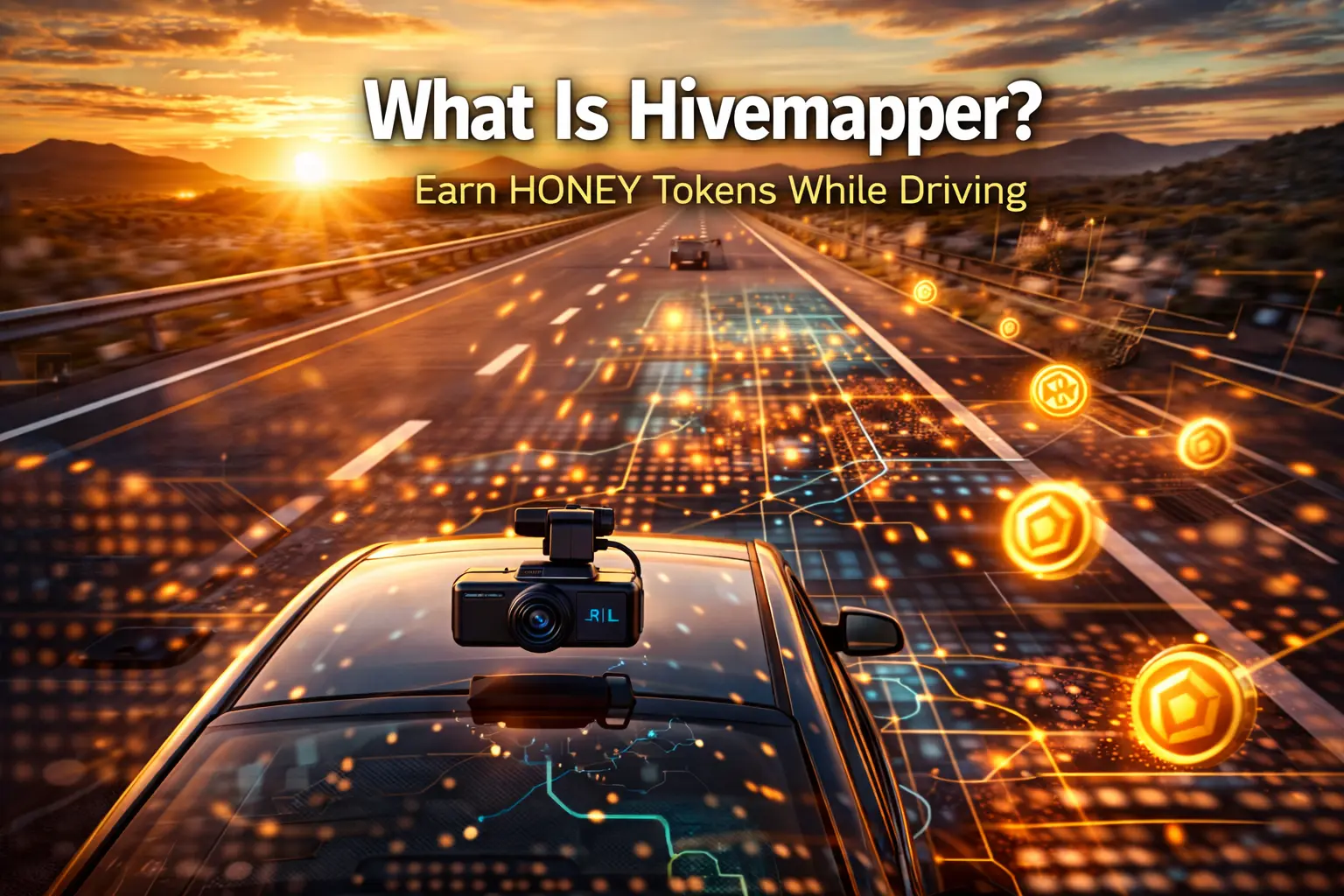
You already drive every day. To work, to the market, to that one place you keep going back to, even though it adds twenty minutes to your commute. It’s routine. It costs you fuel and time, and occasionally your patience when the GPS sends you somewhere that doesn’t exist anymore.
What if those same roads were quietly earning you cryptocurrency while you drove them?
That’s Hivemapper. And before you roll your eyes — it’s not a scheme, it’s not vaporware, and it’s not asking you to recruit anyone. It’s a live, working network that pays everyday drivers in HONEY tokens in exchange for fresh map data collected through a dashcam on their windshield.
This guide covers everything — what it is, how it works, what you need, and what you can realistically expect to earn. No hype, just the full picture.
What Is Hivemapper?
At its core, Hivemapper is a decentralised mapping network.
Instead of one company sending out fleets of camera cars to photograph the world’s roads the way Google does, Hivemapper crowdsources that work to ordinary drivers. You mount their dashcam on your windshield, drive your normal routes, and the camera records the road. That footage gets turned into usable map data, and you get paid in HONEY tokens for contributing it.
Simple exchange. But why does it matter?
Because Google Maps and most other major mapping platforms have a real problem — their data goes stale. Roads change. New developments come up. Businesses move or close. Traffic patterns shift. Yet the maps millions of people rely on are often months or years out of date in many areas. In fast-growing cities across India, Southeast Asia, Africa, and Latin America, the gap between how roads actually look and how they appear on a map can be enormous.
Hivemapper’s solution is to turn every driver into a contributor. Build a map that’s constantly being refreshed by the people who actually use the roads, rather than waiting for a centralised company to send a camera car around every eighteen months.
The project was founded by Ariel Seidman and runs on the Solana blockchain — chosen for its speed, low transaction costs, and ability to process the volume of small rewards a global contributor network generates continuously.
The simplest way to describe it: Hivemapper is Google Maps — except you get paid to build it.
How the Technology Actually Works
Understanding the mechanics makes the whole thing feel less mysterious and a lot more like what it is — infrastructure.
Three groups of people make the network function:
Contributors are everyday drivers who collect map imagery using the Hivemapper Dashcam. Everything starts here. Without drivers uploading footage, the map doesn’t exist.
Map AI is Hivemapper’s artificial intelligence system that takes raw dashcam footage and converts it into structured map data. It pulls out road geometry, reads signage, detects what’s changed since the last time that road was mapped, and assigns quality and freshness scores to each contribution. You never interact with it directly — it runs in the background after you upload.
Data Buyers are the businesses that actually purchase this map data. Logistics companies, autonomous vehicle developers, urban planners, app developers — anyone who needs fresh, accurate road information. They pay for access using HONEY tokens, which they have to buy on the open market first. That purchasing demand is what gives the token real-world backing.
The Solana blockchain ties it all together. Every contribution gets logged, every reward gets paid out, every data purchase gets recorded — transparently and automatically. No single company decides who gets paid or how much.
One concept worth understanding before you start is freshness. Not all map data is valued equally. A road that hasn’t been mapped in six months is worth more to contribute than one that was mapped yesterday. Freshness scores directly affect how many HONEY tokens a drive earns — so contributors who deliberately target under-mapped or recently changed areas earn considerably more than those who drive the same already-covered routes every day.
The flow looks like this:
You drive → Dashcam records footage → Map AI processes it → Data buyers purchase the map → HONEY tokens land in your wallet
Every link in that chain is doing real work. That’s what separates Hivemapper from most crypto reward projects — the token is connected to something the world genuinely needs.
Understanding HONEY Tokens
HONEY is the native token of the Hivemapper network, built on Solana. It’s how contributors get paid, how governance decisions get made, and how data buyers access the map.
That last use case is what matters most for the token’s value. When a business wants to purchase Hivemapper’s map data, they don’t pay in dollars. They pay in HONEY — which they have to acquire on the open market first. Once spent on data, that HONEY is burned — permanently removed from circulation. So the more businesses use the map, the more tokens get destroyed, which tightens supply over time. It’s a deflationary mechanic tied directly to real usage.
As a contributor, you earn HONEY through several routes. Basic map coverage contributions form your baseline reward. Quality bonuses kick in for clear, well-calibrated footage with accurate GPS data. Freshness multipliers add to earnings when you map roads that haven’t been covered recently. Consistent contributors who drive and upload regularly also benefit from streak rewards.
A few honest points before you get too excited:
HONEY trades on Solana-based decentralised exchanges and its price moves with the market like any other crypto asset. Your token earnings are real regardless of price — but what they’re worth in rupees or dollars at any given moment will fluctuate. Treat it as passive income with upside, not a fixed monthly salary.
HONEY at a glance:
- Blockchain: Solana
- Uses: Contributor rewards, governance, map data access
- Burn mechanism: Yes — burned when data buyers purchase access
- Where to trade: Jupiter, Raydium, and select centralised exchanges
What You Need to Get Started
The barrier to entry is genuinely low. No coding, no technical background, no prior crypto experience needed. If you can mount a dashcam and install an app, you’re fully equipped.
Here’s the complete list:
The Hivemapper Dashcam — the only hardware officially supported by the network. It records in 4K, has a wide-angle lens and built-in GPS, and automatically uploads footage to the network over your home Wi-Fi when you get back from a drive. It mounts on your windshield and runs off your car’s USB port or cigarette lighter. Available through the official Hivemapper website, which ships internationally, including to India.
The upfront cost is real and worth acknowledging openly. This isn’t free to start. But even setting the crypto side aside entirely, you’re buying a quality 4K dashcam that protects you on the road. If you stopped earning HONEY tomorrow, you’d still have a useful device.
A smartphone with the Hivemapper app — available on both iOS and Android.
A Solana-compatible wallet — Phantom or Solflare are the most popular and easiest for beginners. Your HONEY rewards are deposited directly here.
Home Wi-Fi for overnight footage uploads.
A car and somewhere to drive — which you already have.
Your complete starting checklist:
- Hivemapper Dashcam (official hardware only)
- Hivemapper mobile app
- Phantom or Solflare wallet
- Home Wi-Fi
- A car, a windshield, and your daily routes
Also Read: Should You Invest in Crypto During War? Opportunities and Risks You Must Know
How to Start Earning — Step by Step
Step 1: Order the Dashcam
Go to the official Hivemapper website and place your order. If you’re in India, factor in two to three weeks for delivery. Don’t try to use a third-party dashcam — only the official hardware connects to the reward system. Any workaround you find online is either outdated or simply doesn’t work.
Step 2: Set Up Your Solana Wallet
Do this before your dashcam even arrives. Download the Phantom app, create a new wallet, write your seed phrase on paper, and store it somewhere safe. Not in a screenshot. Not in your notes app. Offline, physical paper. This is the key to your earnings — lose it, and there’s no recovery option.
Phantom takes about five minutes to set up and is straightforward for someone who has never touched crypto before.
Step 3: Download the App and Create Your Profile
Download the Hivemapper app and connect your Solana wallet during setup. This links your contributor account to your wallet so that rewards flow automatically when your footage is processed. Take a few minutes to familiarise yourself with the dashboard — it shows your coverage map, earnings history, and upload status.
Step 4: Mount and Calibrate the Dashcam
Mount the dashcam on your windshield in a central, clear position — usually behind the rearview mirror works well. Connect it to your phone via Bluetooth through the app, and run through the calibration process. This aligns the GPS with the camera angle, and it matters — accurate GPS data directly affects your quality score, which directly affects how much you earn.
Step 5: Drive — Strategically
Once the dashcam is active, it records automatically. You don’t touch it while driving.
But where you drive is the most important decision you’ll make as a contributor. Before your first outing, open the Hivemapper Explorer — a public map showing coverage density and freshness across the entire network — and look for under-mapped roads near you.
In India, this is a real opportunity. Major city roads in Mumbai, Delhi, and Bangalore are mapped regularly. But surrounding suburbs, tier-2 and tier-3 cities, new development corridors, industrial zones, and rural highways are often significantly under-mapped — and they earn accordingly.
Your highest-earning drives will rarely be your most familiar ones. The gaps in the map are where the money is.
Step 6: Upload Overnight
When you get home, connect to your Wi-Fi. The dashcam detects the network and uploads automatically. Check the app the next morning to confirm everything went through. Processing typically takes a few days before rewards appear.
Step 7: Receive Your HONEY
Once your footage passes through the Map AI and is verified, HONEY tokens are deposited to your Phantom wallet. You’ll see the transaction in both your Hivemapper dashboard and your wallet.
From there, you can hold, swap for SOL or USDC on Jupiter or Raydium, or participate in network governance. Your call.
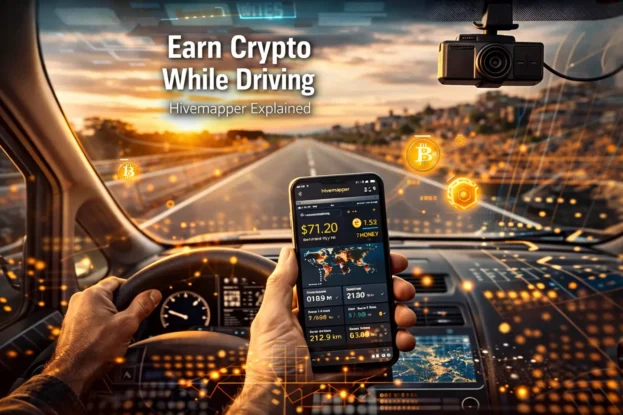
What Can You Realistically Earn?
This is the question everyone wants an honest answer to, so here it is — it depends, but the pattern is clear.
The biggest factors are how much you drive, where you drive, how fresh those roads are, and what HONEY is worth when you convert. Here’s a realistic breakdown based on community-reported data:
| Contributor Type | Daily Distance | Monthly HONEY | Notes |
|---|---|---|---|
| Casual commuter | 20–30 km | Low to moderate | Familiar routes, lower freshness, steady but modest |
| Rideshare or delivery driver | 80–150 km | Moderate to high | High variety, strong freshness opportunities, best regular earner |
| Dedicated mapper | 150+ km | High | Actively targets under-mapped zones, maximum returns |
The pattern is consistent: more distance, more varied routes, more deliberate targeting of under-mapped areas equals more HONEY. Rideshare and delivery drivers who are already covering large distances daily are particularly well-placed — their existing work becomes a passive earning layer at essentially zero extra effort beyond the dashcam.
These are estimates based on community reports. Actual earnings vary by region, token price, road freshness, and network conditions.
Is the Dashcam Worth Buying?
Let’s be direct about this.
The dashcam is a real upfront cost. Whether it’s worth it depends on your situation.
Think of it this way — you’re not buying a crypto gadget. You’re buying a 4K road safety dashcam that also earns you cryptocurrency when you drive. If HONEY went to zero tomorrow, you’d still have a quality device that protects you in accidents, insurance disputes, and road incidents. That value exists independently of crypto.
As an earning device, break-even time depends heavily on your usage. Active contributors in under-mapped areas tend to recover the cost meaningfully faster than casual commuters in well-mapped metros.
This makes the most sense for:
- Daily commuters covering 30+ km across varied routes
- Rideshare and delivery drivers are already spending hours on the road
- People living in tier-2 and tier-3 Indian cities, where coverage is genuinely sparse
- Early adopters who understand that contribution value is highest before a region gets saturated
Worth thinking twice if:
- You drive fewer than 15–20 km daily on the same fixed route
- You’re in an area that’s already heavily and freshly mapped
- Crypto price volatility makes you uncomfortable
Why This Is Bigger Than Just Earning Tokens
Zoom out for a moment, because the bigger picture here is actually interesting.
Hivemapper isn’t just a crypto project. It’s a genuine infrastructure play. The autonomous vehicle industry needs fresh, precise map data to function safely. Logistics companies need accurate road information to optimise routes. Emergency services need current maps. Urban planners need real-world data to make sensible decisions.
All of these industries currently rely on centralised mapping providers that update slowly and charge heavily. Hivemapper is building the alternative — a community-owned, constantly refreshed, globally crowdsourced map that any business can buy data from.
For India specifically, the timing is interesting. India’s road network is expanding at one of the fastest rates in the world. New highways, expressways, industrial corridors, and suburban developments are being built continuously. Mapping that expansion in real time — and earning HONEY for doing it — puts Indian contributors in a strong position right now, before the rest of the network catches up.
The network effect works in the early contributors’ favour. More drivers mean more coverage, more coverage attracts more data buyers, more buyers burn more HONEY, stronger token fundamentals. Getting in early in underserved regions compounds over time.
Also Read: Top 7 Crypto Wallets to Buy Your First Bitcoin
Frequently Asked Questions
Do I need to know anything about crypto?
No. Mount the dashcam, install the app, set up a Phantom wallet in five minutes, and drive. The crypto side runs in the background.
Is it available in India?
Yes. The dashcam ships internationally, Indian drivers can fully participate, and India’s combination of rapidly growing road infrastructure and large under-mapped areas makes it one of the better opportunities globally for contributors right now.
What happens to my footage?
The Map AI extracts road data from your footage for use by data buyers. Raw video is not publicly accessible or sold. Check Hivemapper’s privacy documentation for their full data handling policy if this concerns you — it’s a reasonable question.
Can I use a different dashcam?
No — only the official Hivemapper Dashcam is compatible with the reward system. Don’t waste time looking for workarounds.
How often do rewards arrive?
A few days after upload and processing, tokens are deposited directly to your wallet. There’s no monthly cycle — rewards flow as contributions are verified.
Can I lose my tokens?
Your tokens sit in your wallet and won’t disappear unless you lose access to your wallet credentials — which is why the seed phrase matters so much. The market value of those tokens will fluctuate, but the tokens themselves stay in your wallet.
Your Commute Just Got a Lot More Interesting
You’re going to drive those routes anyway. The question is whether you do it as a passive commuter or as someone getting paid for the same journey.
Hivemapper is live and working. HONEY has genuine utility built into the network — it’s not just speculation. And in India, especially, early contributors in under-mapped areas are sitting in a genuinely advantageous position before the rest of the network fills in the gaps.
Open the Hivemapper Explorer today. Look at how your city and surrounding areas appear on the freshness map. You might be living in one of the most under-mapped — and therefore highest-earning — zones in the entire network.
Then get the dashcam. Set up the wallet. Take your first mapped drive.
The roads aren’t changing. Your earnings from driving them could.