


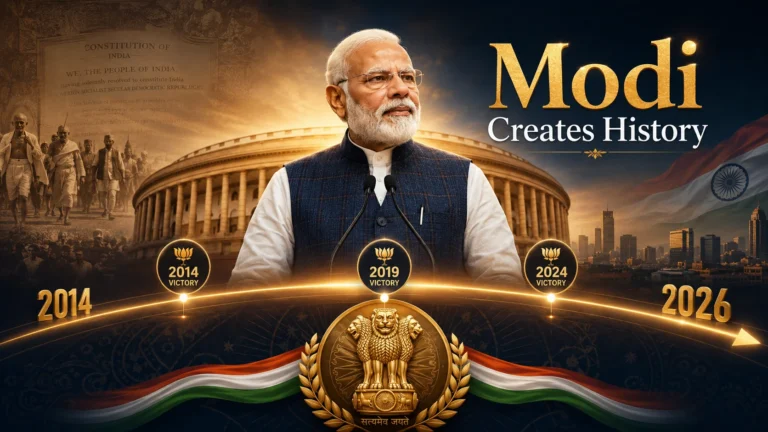
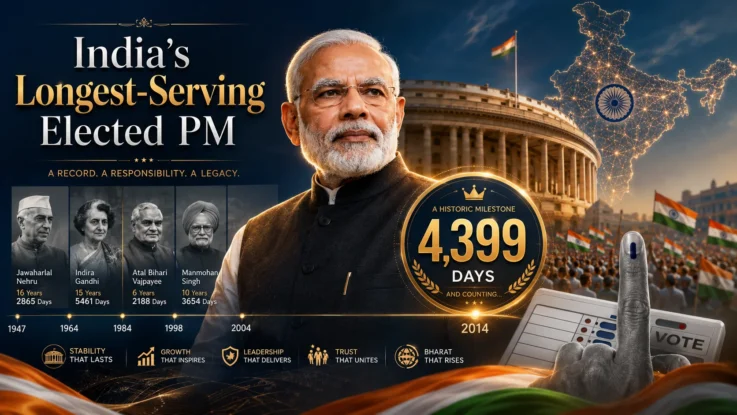
June 10, 2026, will be recorded as a significant date in Indian political history. Prime Minister Narendra Modi completed 4,399 consecutive days in office as an elected Prime Minister, officially surpassing Jawaharlal Nehru’s record of 4,398 days. The milestone makes Modi the longest-serving democratically elected Prime Minister in India’s history.
Modi first took the oath of office on May 26, 2014, and has since governed through three consecutive electoral victories — in 2014, 2019, and 2024. As of today, he has served 12 years and 15 days in office.
Understanding the Record
The distinction here is specific and worth understanding clearly. Nehru remains India’s longest-serving Prime Minister by total duration — over 16 years. However, his first five years from 1947 to 1952 were served as the head of an interim government before India’s democratic elections were formally institutionalized. The record Modi has surpassed covers continuous tenure as a Prime Minister elected through democratic elections.
Modi is also the first non-Congress Prime Minister to complete three consecutive terms, matching Nehru’s achievement of leading his party to three successive election wins.
A Series of Records Along the Way
This milestone didn’t arrive suddenly. In the months leading up to it, Modi had already passed several other significant markers.
On July 24, 2025, he first crossed Indira Gandhi’s consecutive tenure record. On June 7, 2026 — just days before the Nehru record — he officially became India’s second-longest-serving Prime Minister in consecutive terms with 4,078 days, surpassing Gandhi’s 4,077. On March 21, 2026, combining his time as Gujarat Chief Minister and Prime Minister, he became the longest-serving head of elected government in India with 8,931 days.
Key Figures at a Glance
| Metric | Narendra Modi | Jawaharlal Nehru |
|---|---|---|
| Consecutive Days as Elected PM | 4,399 days | 4,398 days |
| Total Tenure | 12 years, 15 days (ongoing) | 16 years, 286 days |
| Election Wins as Party Leader | 3 consecutive (2014, 2019, 2024) | 3 consecutive (1952, 1957, 1962) |
| First Oath Date | May 26, 2014 | August 15, 1947 |
Unique Distinctions
Modi holds several records that stand apart from those of any previous Prime Minister. He is the first Prime Minister born after Independence, having been born on September 17, 1950, in Vadnagar, Gujarat. He is the longest-serving non-Congress Prime Minister. He is the longest-serving Prime Minister from a non-Hindi-speaking state. And he is the only leader to have won six consecutive elections — three as Gujarat Chief Minister in 2002, 2007, and 2012, and three as Prime Minister in 2014, 2019, and 2024.
From Vadnagar to New Delhi
Modi’s personal journey to India’s highest office has been widely documented. He grew up in modest circumstances in Vadnagar, helping his father sell tea at a railway station before joining the RSS. He served as Gujarat’s Chief Minister for more than 13 years before entering national politics in 2014, becoming the first non-Congress leader to secure a full parliamentary majority in the Lok Sabha.
Also Read: The Government Has Cut Ujjwala LPG Subsidy From 9 Cylinders to 4
What Comes Next
Modi continues his third term in office, with the next general elections due in 2029. His administration’s key policy decisions — the Goods and Services Tax, the Insolvency and Bankruptcy Code, the abrogation of Article 370 in Jammu and Kashmir — have been central to how his governance record is being assessed by analysts.
The record achieved on June 10, 2026 is a factual milestone in India’s democratic journey. Whatever political views people hold, the longevity and electoral consistency it represents is a significant chapter in the story of Indian democracy.