


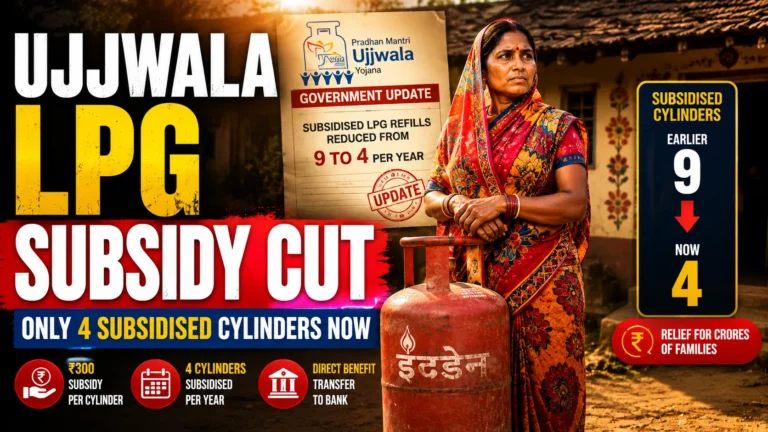
The Pradhan Mantri Ujjwala Yojana has been one of the government’s most visible welfare programs since its launch — providing LPG connections and subsidised cooking gas to millions of low-income households across India, helping families move away from firewood, coal, and other traditional fuels that are both health hazards and environmental concerns.
That scheme is still running. But the subsidy structure underneath it has just changed in a way that will matter to many of the families it serves.
What Has Changed Under the Ujjwala Scheme?
The government hasn’t scrapped the subsidy — it’s narrowed it.
Previously, PMUY beneficiaries received a ₹300 subsidy on up to nine LPG cylinder refills per year. From now, that same ₹300 subsidy applies only to the first four refills. Any refill after that — the fifth, sixth, seventh cylinder — comes at full market price with no government support.
Ujjwala LPG Subsidy: Old vs New Rules
| Feature | Earlier Policy | Revised Policy |
|---|---|---|
| Subsidised Cylinders Per Year | 9 | 4 |
| Subsidy Amount Per Cylinder | ₹300 | ₹300 |
| Annual Maximum Subsidy | ₹2,700 | ₹1,200 |
| Eligible Beneficiaries | PMUY Households | PMUY Households |
The headline number: maximum annual subsidy drops from ₹2,700 to ₹1,200. That’s ₹1,500 less support per household per year for those who were using more than four cylinders.
Why Has the Government Reduced the Subsidised Refills?
The government’s justification is rooted in consumption data. According to official figures, the average PMUY household uses roughly four cylinders annually — meaning, the argument goes, most beneficiaries won’t actually be affected by the cap because they weren’t using more than four cylinders anyway.
The logic here is that limiting the subsidy to four cylinders aligns the policy with actual usage patterns while reducing the fiscal burden on public finances. Officials have framed it as a smarter allocation of resources rather than a withdrawal of support.
Whether you find that convincing probably depends on whether your household falls into the majority that averages four or fewer cylinders, or the minority that uses more.
How Much Subsidy Will Beneficiaries Receive Now?
The ₹300 transfer still goes directly to your bank account through the Direct Benefit Transfer mechanism after each subsidised refill. Nothing changes about the payment method — it’s the number of eligible refills that’s reduced.
Annual Subsidy Calculation
| Number of Subsidised Cylinders | Subsidy Per Cylinder | Total Annual Subsidy |
|---|---|---|
| 1 | ₹300 | ₹300 |
| 2 | ₹300 | ₹600 |
| 3 | ₹300 | ₹900 |
| 4 | ₹300 | ₹1,200 |
Make sure your Aadhaar is linked to your LPG connection and your bank account details are current — if either is outdated, subsidy payments can be delayed or missed.
Who Is Eligible for the LPG Subsidy?
The revised subsidy still applies only to PMUY beneficiaries. To receive it, you need a valid Ujjwala LPG connection, Aadhaar linked to that connection, a bank account registered for DBT, and active consumer status with your distributor.
If you’re unsure about your status, check through your LPG distributor directly or through the oil marketing company’s official portal.
Impact on Rural Households
This is where the policy gets more complicated than the government’s consumption data suggests.
For a small household using three or four cylinders a year, the change may not feel significant. But larger families — joint households with more people cooking more meals — can easily consume six, seven, or eight cylinders annually. These households will now pay full market price for whatever they use beyond the fourth refill.
In rural and semi-urban areas where household incomes are under sustained pressure, that additional cost isn’t trivial. The Ujjwala scheme was designed specifically to help households where cooking fuel affordability is a genuine daily concern — and the families who use more than four cylinders a year are often the larger, economically stretched ones that the scheme was most intended to support.
Political Reactions to the Decision
The revision has triggered predictable political friction. Congress leaders have accused the government of reducing support for low-income families at a time when household costs remain elevated, calling the move an effective cut to one of the country’s most important welfare programs.
The government has pushed back, pointing to the consumption data and arguing that the revised limit matches actual usage for the vast majority of beneficiaries. Officials have maintained that the scheme continues to provide meaningful support and that the change reflects efficiency improvement rather than withdrawal.
Both positions have some validity. The government is right that average consumption is around four cylinders. Critics are right that the households consuming more tend to be larger and more economically vulnerable — exactly the people the scheme was designed to help most.
Also Read: 8th Pay Commission: What Is the 3,490-Calorie Factor Behind the ₹69,000 Salary Demand?
How Beneficiaries Can Check Subsidy Status
Ways to Check LPG Subsidy Status
| Method | Details |
|---|---|
| LPG Distributor Portal | Login using your consumer number |
| Oil Marketing Company Website | Check subsidy transaction history |
| Mobile Apps | Available through LPG service providers |
| Bank Account Statement | Look for DBT credit entries |
| Customer Care Helpline | Call your distributor’s support line |
Check regularly — especially at the start of the financial year when the cylinder count resets — so you know exactly where you stand with your four subsidised refills.
Ujjwala Scheme Continues to Cover Millions
The Pradhan Mantri Ujjwala Yojana remains one of the largest clean cooking fuel initiatives anywhere in the world. The structural change to four subsidised cylinders doesn’t end the program or fundamentally alter its purpose — it narrows the support available.
For most beneficiaries using fewer than four cylinders a year, the practical impact will be limited. For larger households or those in regions with higher cooking fuel usage, the reduction from ₹2,700 to ₹1,200 in maximum annual support is a real and tangible change in their household budget.
Understanding exactly how the new rules apply to your specific situation is the most useful thing you can do right now — so you can plan your refill timing and manage your cooking fuel costs accordingly.