


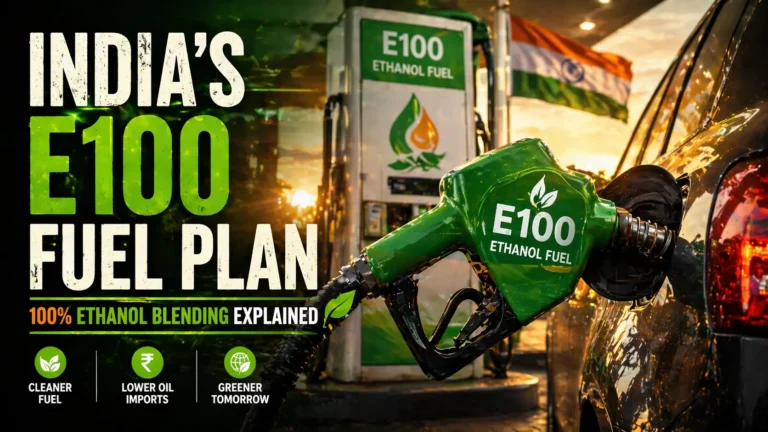
India has just rolled out E20 petrol across the country, but Union Minister Nitin Gadkari is already looking far beyond that milestone. Speaking at the Indian Federation of Green Energy’s Green Transport Conclave last week, the road transport and highways minister said India must work towards 100 percent ethanol blending in petrol — a target that would effectively eliminate conventional petrol from the fuel mix.
“In the near future, India should aspire to achieve 100 per cent ethanol blending,” Gadkari told the gathering. He pointed to the ongoing conflict in West Asia as a stark reminder of just how exposed India is to global energy shocks. “Today, we are facing an energy crisis due to the war in West Asia, so it is necessary for us to become self-reliant in the energy sector,” he added.
The timing of his remarks matters. On April 1, 2026, India completed the nationwide rollout of E20 petrol — petrol blended with 20 percent ethanol. This was achieved ahead of the original 2030 target set by the government. For Gadkari, it proves the country can move fast when it wants to. Now he wants that same energy directed toward an even more ambitious goal.
Why is this such a big deal? The numbers tell the story. India currently imports around 87 percent of its crude oil needs. That dependence costs the country roughly Rs 22 lakh crore every single year — money that flows out of India’s economy and into the hands of oil-exporting nations. Every time there is a war, a political crisis, or a supply disruption in any part of the world, Indian consumers feel it at the pump.
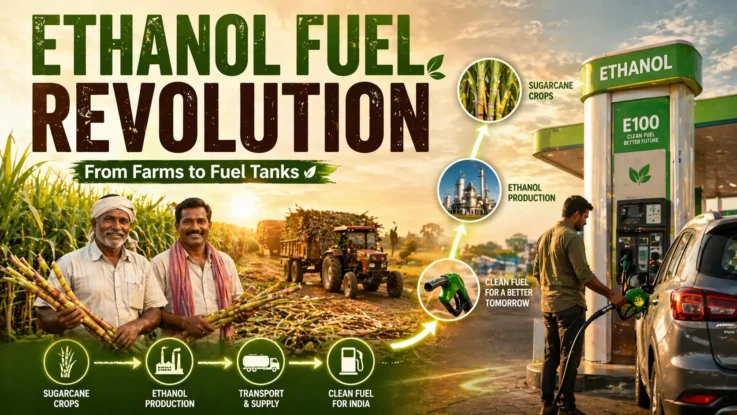
Ethanol offers a way out of this trap. Unlike crude oil, ethanol can be made right here in India — from sugarcane, maize, agricultural waste, and other locally available materials. Producing it domestically would mean keeping that money inside the country, creating rural jobs, and giving farmers a new, steady source of income. It is not just an energy story; it is an economic one.
There is also the environment to consider. Ethanol burns cleaner than petrol. When it combusts in an engine, it releases less carbon monoxide and fewer harmful particles into the air. Moving to higher ethanol blends would reduce tailpipe emissions across millions of vehicles on Indian roads — without requiring anyone to buy an electric vehicle right away.
Countries like Brazil have already proven this works at scale. Brazil has operated on 100 percent ethanol vehicles for decades, and its sugarcane-based ethanol industry is one of the most efficient in the world. Gadkari has repeatedly cited Brazil as the model India should follow.
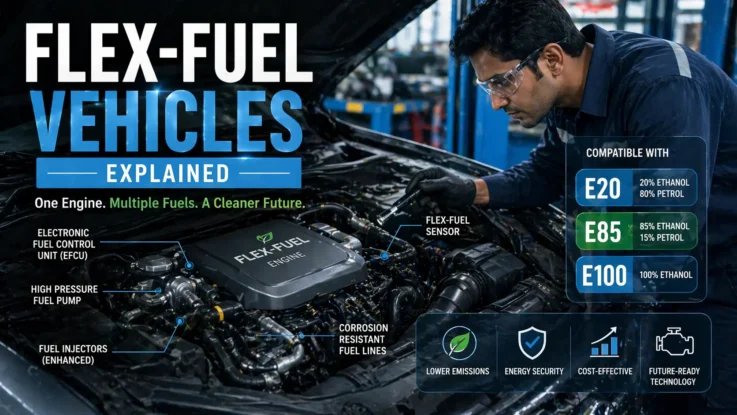
But making the leap from E20 to E100 is not as simple as changing a setting on a dial. The current generation of Indian vehicles was built to handle up to E20 with minor modifications — mostly to prevent engine corrosion. Going to E85 or E100 is a completely different engineering challenge. These blends require flex-fuel engines, which are specially designed to run on any combination of ethanol and petrol. Most vehicles on the road today simply cannot handle them.
This means carmakers will need to start building flex-fuel vehicles in large numbers, and fairly soon. The government’s push for higher ethanol blending is expected to accelerate this shift. In fact, several automakers have already started working on flex-fuel models after earlier nudges from the ministry. But it will take time, and transitioning an entire vehicle fleet is a generational task.
There are more hurdles beyond just the engines. Petrol pumps across India would need separate storage tanks and dispensing units for high-ethanol blends. Setting up this infrastructure — especially in smaller towns and rural areas — will require serious investment and planning. And then there is the question of ethanol supply itself: scaling up production fast enough to fuel the entire country, without diverting food crops or straining water resources, is a genuine challenge that agronomists and policymakers are watching closely.
Not everyone is cheering from the sidelines. Gadkari acknowledged that parts of the petroleum industry have been lobbying against higher ethanol blending targets, with some criticism of E20 fuel circulating on social media. He dismissed much of it as politically motivated, and industry bodies like SIAM and ARAI have backed the blending push, saying the impact on vehicle performance is minimal while the economic and environmental benefits are real.
Also Read: Delhi Is Turning 5 Major Roads into 24-Hour People-Friendly Streets: Here’s What’s Changing
Beyond ethanol, Gadkari also touched on green hydrogen as a longer-term fuel of the future. But he was candid about the obstacles — hydrogen is expensive to produce and difficult to transport. He set a benchmark of producing one kilogram of hydrogen at one US dollar before India can realistically become a hydrogen energy exporter. “Transport of hydrogen fuel is a problem,” he said, adding that producing hydrogen from waste could be the key to unlocking both cost savings and new jobs through a circular economy.
For now, the immediate focus is on ethanol. The government has already issued a draft notification allowing E85 fuel, which signals the next step in the blending journey. If India follows through on Gadkari’s vision, the petrol your car runs on a decade from now could look very different from what it does today — or it might not exist at all.
What does this mean for you as a vehicle owner? In the short term, not much changes. E20 is already available, and your current vehicle can likely run on it without issues. But if you are planning to buy a new car or two-wheeler in the coming years, it may well be worth checking whether it is flex-fuel ready. That feature, once considered optional, could soon become essential.