


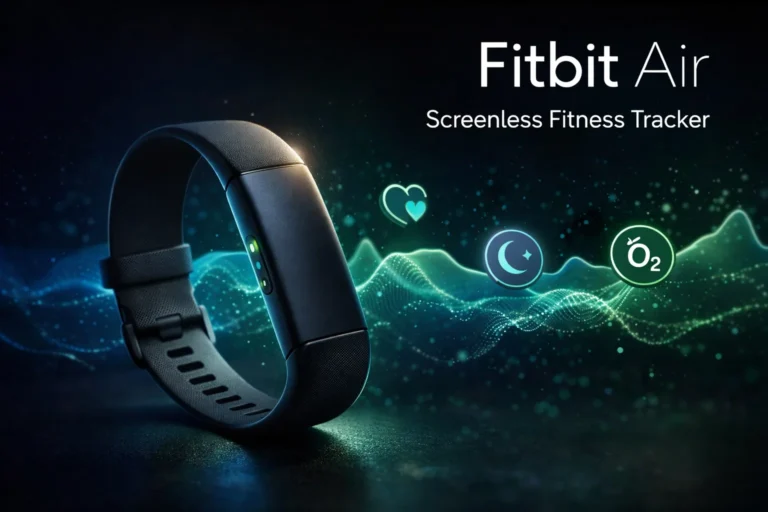
There’s a quiet shift happening in the fitness wearable world, and Fitbit Air seems to be right at the centre of it. Leaked details pointing toward a launch around May 16, 2026 have been circulating across multiple sources, and the picture they’re painting is genuinely different from what most people expect from a Fitbit product.
No screen. No notifications. No display at all, actually. Just a band on your wrist, sensors doing their thing around the clock, and all your health data waiting for you in the app whenever you want to look at it.
Before you raise an eyebrow — this is actually a category that already exists and has passionate users. Whoop and Oura have built real followings around exactly this concept. The question is whether Google can do it better, or at least more accessibly. Based on the leaks, the answer might be yes.
Table of Contents
So What Exactly Is Fitbit Air?
Strip away the usual smartwatch expectations and you get something closer to what Fitbit Air appears to be — a health monitoring band designed to be worn 24 hours a day, seven days a week, without ever needing you to interact with it directly.
The idea is borrowed from devices like Whoop, which has found a serious audience among athletes and health-conscious users who care more about recovery data and sleep quality than checking the time or reading a text on their wrist. You wear it, it tracks everything, and when you actually want to understand how your body is doing, you open the app on your phone.
For people who find smartwatch notifications exhausting, or who want their health tracker to stay completely in the background, this kind of device makes a lot of sense.
The $99 Price Point Changes the Conversation
Here’s where Fitbit Air starts to look genuinely compelling. Leaked pricing puts it at around $99 — roughly ₹8,000 to ₹9,000 in Indian terms — with a straightforward one-time purchase model rather than a subscription.
That’s a significant contrast to Whoop, which requires a monthly membership fee on top of the hardware cost. For users who want similar health insights without committing to recurring payments, Fitbit Air could be a much more accessible entry point into this style of fitness tracking.
Optional premium features may exist — that’s the standard modern approach — but the core experience appears to be a pay-once, use-forever proposition. If that holds true at launch, it removes one of the biggest friction points that’s kept some people away from this category.
When Is It Actually Coming Out?
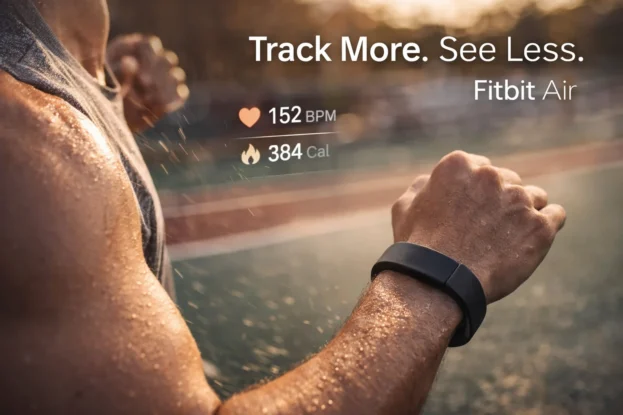
The date being mentioned most consistently across leaks and supply chain reports is May 16, 2026. That timing lines up reasonably well with Google’s usual product announcement rhythm, which gives it some credibility.
That said — and this is worth repeating — Google hasn’t officially confirmed anything. The May 16 date is based on leaked information, not an official announcement. It could shift. But when multiple independent sources converge on the same window, it’s usually a sign that something is close.
What It Looks Like
The design brief here seems to be: wear it comfortably, forget it’s there, never take it off. Leaked colour options include Obsidian, Lavender, and Berry — a decent range that covers both understated and slightly more expressive preferences.
The band is expected to be flexible and lightweight, prioritising all-day and all-night comfort above everything else. That matters a lot for a device meant to be worn continuously. If it’s uncomfortable to sleep in, the whole concept breaks down.
Multiple band styles are reportedly in the works — including performance-oriented and more premium options — giving users some room to customise based on how they live and what they do.
What It Actually Tracks
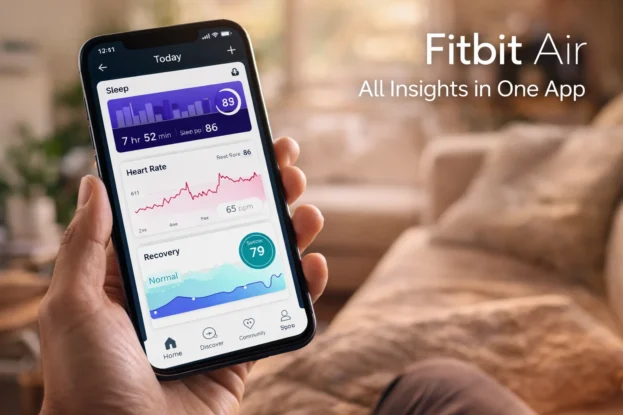
Despite having no screen and a simple appearance, Fitbit Air is expected to pack in a solid range of health monitoring capabilities. Continuous heart rate tracking, sleep analysis, SpO2 measurement, recovery metrics, and stress tracking are all on the expected feature list.
The recovery and stress angle is particularly relevant. These are the metrics that devices like Whoop have built their reputation on — understanding not just how active you’ve been, but how well your body is bouncing back. For anyone training regularly or just trying to understand their overall health patterns better, that kind of data is genuinely useful.
Everything gets surfaced through the Fitbit app, where you can dig into trends, look at how today compares to your baseline, and — presumably — benefit from whatever AI-driven insights Google chooses to build on top of the raw data over time.
How It Stacks Up Against Whoop and Oura
This is the natural comparison, so let’s be direct about it.
Whoop and Oura have both proven that screenless health tracking has a real and growing audience. They’re both good at what they do. But they’re also expensive in different ways — Whoop through its subscription model, Oura through its upfront hardware cost which sits considerably above $99.
Fitbit Air appears to be targeting the gap between “I’m curious about this style of tracking” and “I’m willing to commit serious money to it.” At $99 with no mandatory subscription, it dramatically lowers the barrier to entry.
The tradeoff might be in the depth of data or the sophistication of the coaching features — Whoop in particular has invested heavily in its analytics and recommendations. Whether Fitbit Air can match that quality at this price point is the real question, and one we won’t know the answer to until people actually get it on their wrists.
Also Read: Ai+ NovaWatch RotateCam 4G Launched in India with 180 Degree Rotating Camera
What This Means for Fitbit as a Brand
Fitbit under Google has had a somewhat quiet few years. The acquisition happened, the integration with Google’s ecosystem proceeded gradually, but there hasn’t been a truly breakout product that redefined the brand.
Fitbit Air feels like a genuine attempt to carve out a distinct identity rather than just competing with Apple Watch and Galaxy Watch in the same way everyone else does. Going screenless isn’t a gimmick — it’s a deliberate product philosophy that says some users are better served by less, not more.
If the execution is right, this could be the most interesting thing Fitbit has done in years.
The Bigger Question Worth Thinking About
Here’s something worth sitting with before the official reveal lands. Do you actually need a screen on your fitness tracker? Or do you mostly glance at it, get slightly distracted, and then go back to what you were doing?
For a lot of people, the screen on a fitness tracker is more of a habit than a necessity. The real value is in the data — and that data doesn’t need to be displayed on your wrist to be useful.
Fitbit Air is essentially making a bet that a meaningful number of people are ready to accept that trade-off. Given where the market has been heading, it might be a smarter bet than it first appears.