


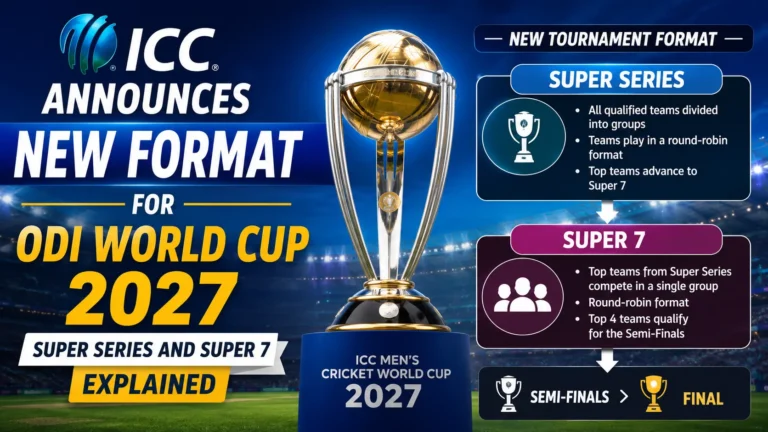
Cricket’s biggest 50-over event is getting a significant makeover. The ICC officially announced a new format for the 2027 Men’s ODI World Cup on Wednesday, introducing two brand new stages — the Super Series and the Super 7 — that reshape how the tournament flows from start to finish.
The announcement came following the ICC’s Annual Conference in Edinburgh over the weekend. The tournament runs from October 4 to November 21, 2027, co-hosted by South Africa, Zimbabwe, and Namibia. Here’s a complete breakdown of what’s changing, how the new format works, and why the ICC felt the change was necessary.
Table of Contents
Why the ICC Changed the Format
The honest answer is that too many matches at recent tournaments felt like they didn’t really matter.
The ICC pointed to concerns raised at their annual conference about dead rubbers — matches that take place after both teams are already mathematically eliminated or already certain to advance. Empty stadiums during these games were becoming a visible problem.
The T20 World Cup had just produced several foregone conclusions, and the ICC wanted to ensure that even the early stages of the ODI World Cup carry genuine stakes. Their solution wasn’t to change the number of teams — 14 was already confirmed — but to restructure the format so that knockout pressure arrives earlier and every game has real consequences.
The New Format Step by Step
The 2027 ODI World Cup will now have three stages before the semi-finals, which is the most significant structural change the tournament has seen in years.
Round 1 — The Super Series
This is where the tournament begins, and it’s designed specifically for the three lowest-ranked teams among the 14 qualifiers — the teams finishing 12th, 13th, and 14th in the qualification standings.
These three sides play each other in a round-robin format. Only the team that finishes top of the Super Series advances to the next stage. The other two teams go home.
It’s a knockout-style opener that guarantees every ball in this stage has enormous significance. For the three teams involved, there is no margin for error.
Round 2 — The Group Stage (30 matches)
Once the Super Series is done, 12 teams compete in the main group stage — the 11 teams who were ranked 1st through 11th plus the one Super Series winner.
These 12 teams are divided into two groups of six. Each team plays the other five in their group once, generating 30 matches across the two groups.
The top three teams from each group — six teams total — automatically advance to the Super 7. The best fourth-placed team across both groups also goes through, making it seven teams in all.
Round 3 — The Super 7 (21 matches)
This is the most exciting new addition to the format.
Seven teams play each other once in a single round-robin stage, generating 21 matches. At the end of the Super 7, the top four teams advance to the semi-finals.
The semi-final matchups are structured as follows — the team that finishes first in the Super 7 plays the team that finishes fourth, and the second-placed side plays the third-placed side.
Semi-finals and Final
The four Super 7 qualifiers meet in the semi-finals, and the two winners play in the final. Standard knockout cricket from there.
How Does This Compare to Previous Editions?
The 2019 and 2023 World Cups both featured 10 teams in a single round-robin league where every side played every other side once. The top four at the end went straight to the semi-finals. Simple, clean, and effective — but limited in the number of teams involved.
For 2027, the original plan before Wednesday’s announcement was to have two groups of seven teams, with the top three from each group advancing to a Super 6 stage before the semi-finals. That format has now been scrapped in favour of the new Super Series and Super 7 structure.
The key improvement of the new format is that the Super 7 round-robin stage — seven teams all playing each other — creates a genuinely competitive penultimate stage where anything can happen right up to the final match. No team can coast through, and the battle for the top four positions will likely go down to the wire.
Which Teams Qualify
The 14 spots at the 2027 World Cup break down clearly.
Ten teams qualify automatically — the two co-host nations, South Africa and Zimbabwe, plus the eight teams ranked highest in ODI rankings as of September 2026. That cut-off date is important for teams currently on the fringes of the top eight.
The remaining four spots come from a global qualifier, which will be a 10-team competition featuring the next two highest-ranked teams after the automatic qualifiers, four teams from the World Cup Cricket League 2, and four teams from a qualifier playoff. This qualifier is expected to take place in December 2026 or January 2027, most likely in Namibia or South Africa.
Also Read: Argentina Beat England to Reach FIFA World Cup 2026 Final
The complete fixture list and exact group composition will be confirmed at an ICC meeting in October, which will also finalize the next Future Tours Programme.
South Africa is expected to host the majority of matches, with Zimbabwe hosting around ten and Namibia staging a handful.
Australia, the defending ODI World Cup champions, having won the title six times in total, will be among the favourites when the tournament kicks off in October 2027.
For cricket fans, the new format promises more consequential matches, more drama in the earlier stages, and a Super 7 finale that should be genuinely gripping to follow. The ICC has clearly tried to fix a real problem, and on paper at least, this new structure looks like it does exactly that.