


Barreda Review: ★★★★☆ (4/5)
Barreda is a well-made and serious true-crime drama that genuinely tries to look beyond the killer and reckon with the damage left behind. Luis Machín is excellent in the title role, but the film’s good intentions are undermined by giving Barreda more screen time than the women whose story it claims to be telling.
Rating: ★★★★☆ (4/5)
Language: Spanish
Genre: True Crime, Crime Drama, Biographical Drama
Runtime: Approximately 2 hours
Director: Javier Goggi
Cast: Luis Machín, Carla Peterson, Mercedes Morán, Marcelo Subiotto
True-crime storytelling always comes with an uncomfortable built-in tension: how do you tell the story of a notorious killer without inadvertently making him the most compelling person in the room? It’s a question that has sunk more thoughtful projects than you’d expect. Prime Video’s Barreda understands the problem clearly — and then spends much of its runtime failing to fully solve it.
The film is based on the real case of Ricardo Barreda, a dentist from La Plata who murdered his wife, mother-in-law and two adult daughters in 1992. Rather than simply recreating the crime, director Javier Goggi is interested in the poisoned family environment that surrounded it and in how Barreda subsequently tried to reposition himself as the wronged party in his own story.
That’s a more thoughtful ambition than most true-crime productions manage. The execution, though, is mixed.
Luis Machín’s performance as Barreda is the film’s most undeniable achievement. He plays the character without any of the theatrical menace that actors often reach for when playing killers. Barreda under Machín’s interpretation is quiet, distant, slightly disconnected — someone who has built a performance of normalcy and wears it so consistently that the wrongness underneath him only becomes visible in small moments.
It’s an excellent piece of work, and it makes Barreda genuinely unsettling in the way that real human evil tends to be — not operatic, just off. The problem is that the better Machín is, the more gravity his character creates. And the film, almost despite itself, keeps getting pulled into that gravity.

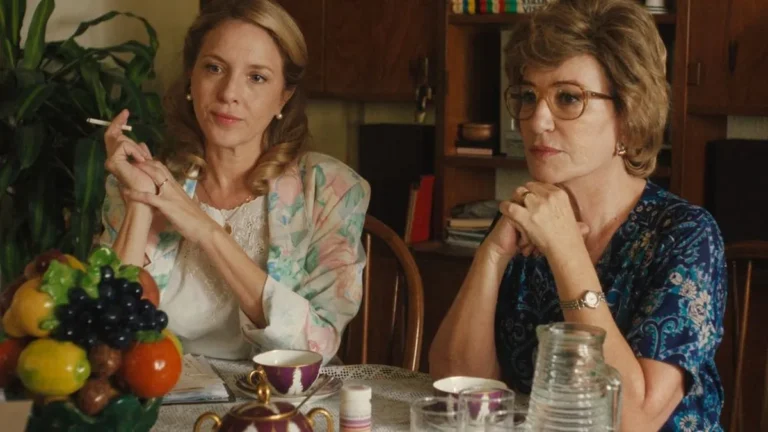
The most interesting idea in Barreda is its stated intention to shift focus toward the women who shared a house with him — Gladys and Elena, played by Carla Peterson and Mercedes Morán.
Both are very good. Their performances suggest lives lived in the particular tension of a household where control operates quietly, where fear doesn’t announce itself and where the normal-looking surface conceals something that has been corroding for years. The house itself becomes a character — people sharing rooms, sharing meals, occupying the same spaces while living in completely separate emotional realities.
The film is most powerful when it trusts this atmosphere and lets viewers read it. It’s least powerful when it cuts away from it to return to Barreda. Which it does, repeatedly. The women begin to feel like supporting characters in their own tragedy, which is exactly the problem the film sets out to correct.
The screenplay moves between two periods — the aftermath of the murders, including the arrest and trial, and the family life that preceded the killings. It’s a structure that serves the material well.
Rather than walking through events chronologically, the film assembles the picture in pieces, allowing a darker understanding to develop gradually. The courtroom sequences are handled with particular restraint — cold and serious, without sensationalising the case or turning the legal proceedings into drama-by-numbers.
Marcelo Subiotto as the prosecutor brings a quiet, methodical authority that contrasts well with Barreda’s attempts to shape his own narrative. Their interactions have a low-key tension that doesn’t rely on raised voices to be effective.
One thing Barreda genuinely gets right is its treatment of the public fascination that surrounded the real case.
Barreda became a peculiar figure in Argentine popular culture — someone who attracted a strange, uncomfortable celebrity, with segments of the public treating him almost as an antihero. The film doesn’t indulge that mythology. It looks at the fascination itself with a critical eye, asking not just what happened inside one house but why a society found itself so drawn to the man responsible.
That sociological dimension is where the film feels most original and most relevant. It’s doing something more interesting than most true-crime productions bother to attempt.
The central problem is the uneven allocation of attention. The film’s stated purpose is to resist the Barreda-centric retelling of this story — and then it keeps returning to Barreda. The victims are present, and they’re portrayed with care, but they don’t fully emerge as complete human beings with interior lives that exist independently of their relationship to him.
More time with the women — their personalities, their relationships with each other, their lives before the house became what it became — would have made the film’s emotional impact considerably greater. As it stands, they remain somewhat in his shadow, which is the exact dynamic the film is trying to challenge.
The pacing also falters in the middle section, where the film covers aspects of Barreda’s character that have already been established and doesn’t find enough new ground.
The production quality throughout is strong. The 1990s setting is recreated without the nostalgia that often softens period dramas. The direction keeps the violence in its proper place — present, felt, but never exploited.
Similar Article: Part Timers JioHotstar Review
Barreda is a serious, carefully made true-crime film with a genuine moral purpose and a central performance that deserves attention. It’s clear about what it wants to say and mostly disciplined in how it says it.
But the film doesn’t fully escape the trap it’s trying to avoid. By keeping its subject so consistently at the centre of the story, it gives a killer more importance than it intends to — and less than it owes to the people whose lives he ended. The ambition is admirable. The execution gets most of the way there.
Worth watching for viewers who engage with crime dramas based on real events, particularly those that want to go somewhere more thoughtful than recreation and reconstruction.
Rating: 7.5/10