


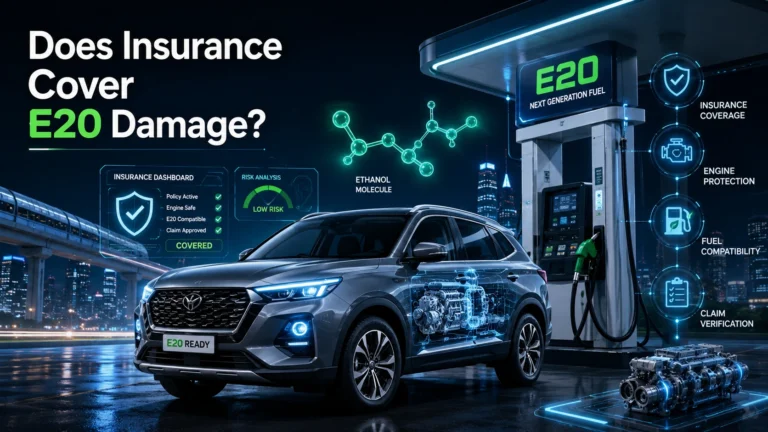
E20 petrol has been quietly becoming the standard at fuel stations across India, and with that shift comes a question a lot of car owners haven’t had to ask before: what happens if this fuel actually damages the engine, and will insurance cover it?
It’s a fair question, and the answer isn’t a simple yes or no. Most newer cars are built to handle E20 without any trouble. Older vehicles are a different story, and that gap is exactly where the confusion around insurance claims tends to start.
Why E20 Petrol Is Being Used
E20 fuel blends 20 percent ethanol with 80 percent petrol. The push toward higher ethanol blending comes from the government’s broader goals — reducing oil imports, supporting domestic farmers who supply the ethanol, and lowering vehicle emissions overall.
Carmakers have responded by introducing E20-compatible engines in their newer models. The complication is that a significant number of cars already on Indian roads were built before this became the norm, which raises real questions about long-term effects on fuel lines, injectors, and seals.
Will Insurance Cover E20 Fuel Damage?
Here’s the honest answer: it depends. Standard comprehensive car insurance doesn’t automatically cover every type of fuel-related issue. Insurers look closely at why the damage happened before deciding whether to approve a claim.
If your vehicle was being used exactly as the manufacturer intended, you’re generally on stronger ground. If the insurer concludes that the wrong fuel was used for a car that wasn’t built to handle it, things get considerably more complicated. The single biggest factor in all of this is whether your specific vehicle model is officially approved for E20 use.
When a Claim May Be Accepted
Claims tend to have a better chance when the vehicle is officially E20-compatible, the owner has been using the fuel the manufacturer actually recommends, the damage results from a sudden mechanical failure rather than something that built up over time, and the insurer’s surveyor doesn’t find evidence of misuse.
A modern E20-ready car that develops an unexpected fuel-system problem despite proper use has a reasonable case, depending on the specific policy terms and what the technical inspection finds.
When a Claim Could Be Rejected
Things get harder if the vehicle isn’t approved for E20, if the owner knowingly used a fuel the manufacturer had warned against, or if the damage looks like gradual wear and tear rather than a sudden failure — which most policies simply don’t cover regardless of the fuel involved.
If the insurer determines the damage built up slowly over months or years of incompatible fuel use, that’s typically treated very differently from an accident or a sudden, unexpected failure.
This is exactly why owners of older vehicles should actually read their owner’s manual before making E20 their default fuel choice rather than assuming it’ll be fine.
What Vehicle Owners Should Check
If you’re not sure whether your car can handle E20, the steps are straightforward. Check the owner’s manual first. Visit the manufacturer’s website for model-specific guidance. Call or visit an authorized service center if you want a direct answer. And keep your fuel purchase and service records — they become genuinely useful if a dispute ever comes up later.
What Insurance Policies Usually Cover
Comprehensive car insurance is generally built around accidents, fire, theft, floods and natural disasters, and third-party liability. Mechanical breakdowns and gradual engine wear typically fall outside standard coverage unless you’ve added a specific warranty or extension.
That distinction matters here. Fuel-related engine damage doesn’t automatically fall into the category your policy is designed to cover, which is why understanding your specific policy terms matters more than ever as E20 becomes the norm.
What Car Manufacturers Are Saying
Many automakers have confirmed that their newer petrol models are E20-ready, and using the fuel in those cars shouldn’t create warranty issues. For older models, the guidance is more cautious — manufacturers generally recommend checking model-year-specific information rather than assuming compatibility. Some brands have also upgraded fuel-system components in recent vehicles specifically to handle higher ethanol content more reliably.
The Bigger Picture
India’s shift toward E20 isn’t slowing down, and ethanol blending percentages are likely to increase further in the coming years. As that transition continues, expect more clarity to emerge around fuel compatibility, warranty conditions, and how insurers handle these specific claims. The industry is still catching up to the pace of the policy shift, and clearer guidelines will likely follow as more claims and disputes work their way through the system.
Similar Article: Hero Launches Flex Fuel Splendor+ and HF Deluxe Flex Fuel
Before You Fill the Tank
For now, the safest approach is straightforward: use the fuel your vehicle’s manufacturer actually recommends, and keep your service records in order. If your car is officially E20-compatible, you’re in a much stronger position if a dispute ever arises. If it isn’t, a quick conversation with your manufacturer or service center before switching fuels is worth the five minutes it takes.
When it comes to insurance claims, the line between approved use and unsupported use is often the entire difference between a claim getting paid and getting denied.