


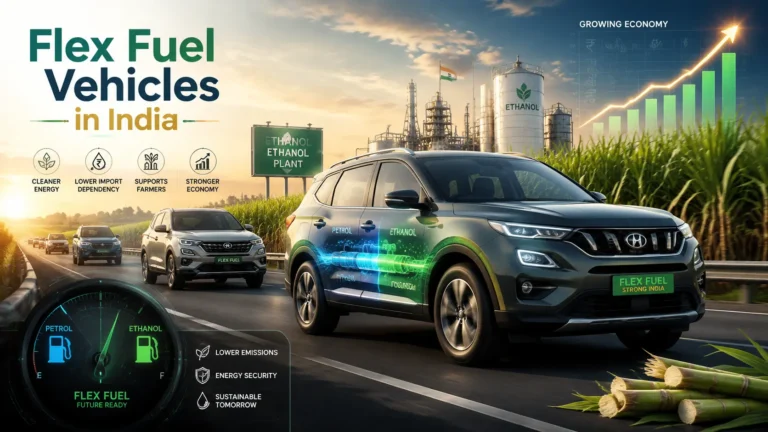
Electric vehicles get most of the attention when people talk about India’s automotive future. But there’s another technology that the government is pushing just as hard, that requires far less infrastructure revolution to work, and that could reach far more Indian households in the near term.
Flex-fuel vehicles — cars and two-wheelers that can run on petrol, ethanol, or any blend of both — are back in serious focus. Here’s what you actually need to know.
What Are Flex-Fuel Vehicles?
A flex-fuel vehicle, or FFV, is engineered to handle a wide range of fuel mixtures — from standard petrol to high-ethanol blends like E85 (85% ethanol, 15% petrol) or even pure ethanol in some configurations. The engine detects what’s in the tank and adjusts its settings automatically. You don’t have to do anything differently as a driver.
This isn’t experimental technology. Brazil has been running a significant portion of its vehicle fleet on ethanol for decades, and flex-fuel vehicles have been a mainstream choice there for years. India is now looking at the same model, adapted for its own agricultural strengths and energy needs.
The vehicles being sold in India today that are described as “E20 compatible” are a starting point — they can handle a 20% ethanol blend. True flex-fuel vehicles go much further, accepting much higher ethanol concentrations and adjusting automatically.
Why Is India Pushing Flex-Fuel Vehicles?
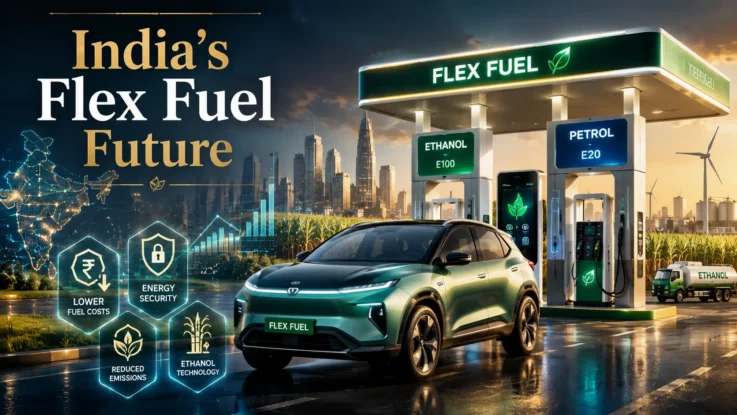
The short answer: India imports more than 85% of its crude oil. Every time global oil prices spike, the impact runs directly through the economy — into fuel prices at the pump, into transport costs, into the price of goods, and into pressure on foreign exchange reserves.
Ethanol is produced domestically, primarily from sugarcane and agricultural waste. Using it instead of imported petrol keeps money inside India’s economy rather than sending it overseas. The government has identified three clear benefits it keeps coming back to: reduced oil imports, lower emissions, and better income for farmers.
That last point matters more than it might initially seem. A substantial increase in ethanol demand creates direct commercial opportunity for sugar mills, agricultural cooperatives, and rural farmers. For a government always conscious of rural economic development, that’s a significant policy lever.
What Would 50% Adoption Mean for Car Buyers?
If half of all new vehicles sold in India eventually become flex-fuel compatible, the most immediate change for buyers is choice.
Right now, you fill up with petrol because that’s essentially what’s available at most pumps. With flex-fuel capability and expanding ethanol infrastructure, you’d have the option to use higher ethanol blends when they’re available — and if those blends are priced lower than petrol, your running costs could drop meaningfully.
The government’s goal of making flex-fuel available at around 5,000 fuel stations by the end of 2027 is the specific infrastructure milestone that determines when this becomes genuinely practical. If that target is met, flex-fuel stops being a theoretical option and starts being something you actually encounter on your regular commute route.
The vehicle range is expanding too. Manufacturers are developing flex-fuel options across hatchbacks, SUVs, motorcycles, and commercial vehicles. The industry has been waiting for clearer policy signals and infrastructure commitments before going all-in, and those signals appear to be arriving.
One honest caveat: flex-fuel vehicles will likely cost slightly more upfront than equivalent petrol models, because the fuel system modifications needed to handle high ethanol blends add to manufacturing cost. The economics only fully work if you’re actually able to regularly access cheaper ethanol fuel. Otherwise you’re paying more for a car and not getting the savings.
Impact on India’s Economy
Scale this up across millions of vehicles, and the economic implications become substantial.
Lower crude imports reduce the pressure on India’s current account deficit — which has been a persistent concern whenever oil prices rise. The money saved on imported fuel can circulate domestically instead. Higher domestic ethanol demand supports agricultural processing industries and rural livelihoods.
New investments in ethanol production, distribution networks, and vehicle manufacturing for the flex-fuel segment would generate employment across multiple sectors. Industry analysts who’ve modeled various adoption scenarios consistently find positive economic impacts at scale — the question is always whether the policy consistency required to get to that scale will actually materialize.
The Challenges Ahead
The honest picture requires acknowledging the gaps.
Fuel availability is the central problem. A flex-fuel vehicle is only useful if you can find high-ethanol fuel. Right now, dedicated flex-fuel pumps are rare. The government’s 5,000-station target by end-2027 sounds ambitious because it is — that’s a significant rollout in roughly eighteen months, and execution matters more than announcements.
Consumer awareness is genuinely low. Many Indian car buyers don’t fully understand the difference between an E20-compatible vehicle and a true flex-fuel vehicle, or what higher ethanol blends actually mean for performance and running costs. Building that understanding is a prerequisite for mass adoption, and it requires sustained communication rather than one-time launches.
Pricing has to work for consumers. Industry leaders have been clear about this: if high-ethanol blends aren’t noticeably cheaper than petrol at the pump, consumers won’t switch even if flex-fuel vehicles are available. The economics need to hold at the retail level, not just in policy documents.
GST and incentive structures are still being worked out. The auto industry has asked for tax cuts and phased rollout support. The government says it’s examining incentives. The gap between examining and implementing will determine how quickly manufacturers are willing to invest.
Also Read: Top 10 Best Electric Cars in India: Which EV Should You Buy?
What Happens Next?
India’s transport future isn’t going to be won by any single technology. Electric vehicles, hydrogen, biofuels, and flex-fuel all have roles to play in a market as large and diverse as India’s.
What makes flex-fuel interesting right now is its pragmatism. It doesn’t require an entirely new charging infrastructure. It doesn’t demand a complete change in consumer behavior. It uses existing vehicles with modified fuel systems, existing fuel stations with additional dispensers, and existing agricultural supply chains with expanded ethanol capacity.
If the infrastructure rollout happens on schedule, if fuel pricing stays competitive, and if manufacturers follow through on their flex-fuel lineups, India could have a genuinely working ethanol mobility ecosystem by the end of the decade.
Whether that “if” becomes a “when” is the question the next two years will answer.